

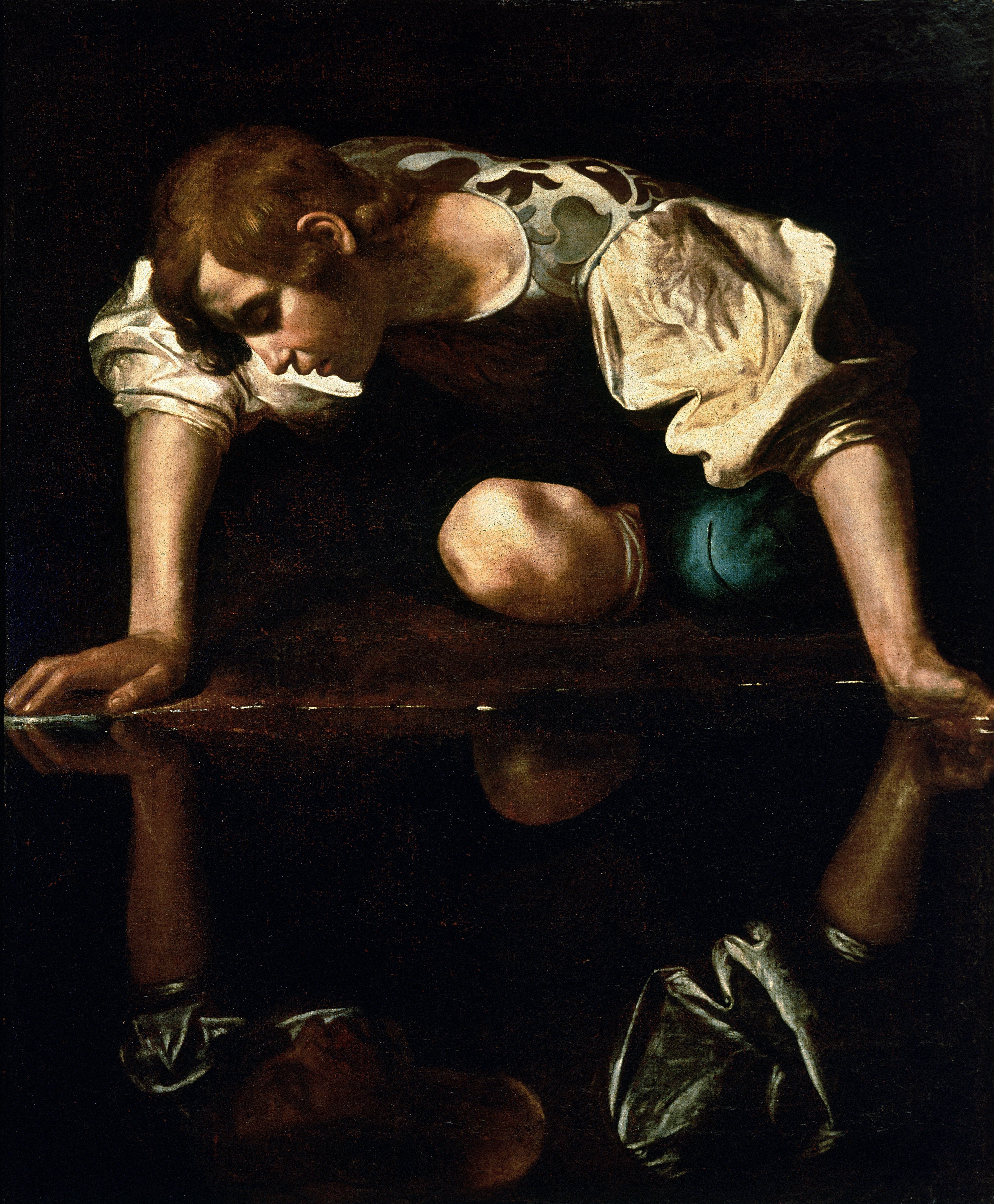
The most interesting part of the myth of Narcissus is usually left out in its retelling: The beautiful boy doesn’t think he’s fallen in love with his reflection - he thinks it is someone else in the water.
The illusion of Other is what keeps the reflection so spell-binding. If he had known it were “just him,” staring back, the allure would presumably fade. This is not straightforwardly a story about taking too much pride in the status gained from appearance. Those elements apply, but not as something primary but rather a tell-tale side-effect of something much deeper.
Greatness, as opposed to something like excellence, requires depth. That means most people will spend their whole lives avoiding greatness for fear of becoming what also lurks in the depths: madness.
Put roughly, if all preceding types of animal awareness are a bullhorn, then human consciousness is a mic and sound system. Louder, but also categorically different at least in one particular way: if you stick the microphone near the speaker, a feedback loop causes a mind-bending shriek.
This sort of self-referential madness is everywhere. It is the reason people don’t “listen” but instead glassy-eyed wait for you to stop talking. They can’t see you, but only their own reflection.
I once gave a ride to a homeless guy in LA to help him figure out some government assistance requirements. In the backseat, he was babbling about how gnomes had taken the “electronics” in his brain and plugged them into themselves. It struck me that his insanity was just an extreme version of the feedback loops that make me a bad listener.
This is also the reason writing platforms like Substack are always threatening to become writers’ platforms for writers to teach other writers about writing. This is an example of corporate insanity because no one wants to stay on a platform where everything it produces and promotes is about how to succeed on itself. No one, that is, except the writer writers writing about writing writing.
I grew up across the street from what we used to call an “insane asylum.” We don’t call it that anymore, not because insanity is no longer a thing, but because the insane are actually overly well-adapted to society’s basic assumptions, and we simply can’t acknowledge that. The first principles of any society are in essence, insane, precisely because they are self-referential.
We became terrified of asylums because they represented the horror of our own collective madness. Then, we blamed the institutions themselves for the fear they represented. Then, we defunded or renamed them something softer like “mental health centers” and thereby neutered or eliminated their actual purpose. Then, we gave the now-free insane life-long meds (which do often work quite well at making those outliers closer to the norm and therefore better able to tolerate society’s implicit insanity), and then release them into that society. Many of them stopped taking their meds, reporting that the voices in their head told them to. Those ended up becoming the sort of people who talk to themselves on street-corners, which we all still ignore and fear, just like we did with the asylums.
A man like that named PigBooty sometimes rants in the church parking lot across the street from my house. He’s there today. It is the sort of town where everyone knows PigBooty, but there is no longer a place for him to go. Even my dad, a very small-government type guy, thinks it was wrong to defund the asylums back in the 80s. We know what most people won’t allow themselves to know because all the insane people in Louisiana were bused to our little town.
Here’s what you’d actually notice about insane people if you could allow yourself: they are insufferable. They are your thoughtless aunt times a thousand. They are the final boss of soulless bureaucrats. Generally, they are not spooky, mystical, or insightful. They are paranoid and selfish to the extreme. They never see you, but only themselves in you, and they both hate and love themselves. If you let them, they will take everything from you and make you hate and love yourself, too.
What makes insanity so disturbing is not its alienness, but its familiarity. Go to an asylum fifty years ago and you would have seen people struggling with mundane pride, never humiliated. To be humiliated, actually, would be a good first step. One woman was cleaning her entire home with a toothbrush. She also made her kids sleep on the floor so they wouldn’t mess up her beds. To protect this delusion, she was convinced that everyone who tried to help her was secretly in love with her. When asked, “Do you know cleaning your house with a toothbrush is not normal?” she replied, “Who wants to be normal?”
Insanity is not when you won’t play by the rules of society; it’s when you play by the rules too closely. Insane people prove that “first principles” always eventually destroy themselves through a foundational paradox. Insane people just collapse before their civilization does. To even make a safe place for them to go would be to dangerously acknowledge that unspeakable truth.
G.K. Chesterton said that modern people deny the reality of sin, even though it is as obviously real as dirt. However, he thought that we would never deny the reality of insane asylums as proof we still knew that mental collapse is possible, if not moral collapse. I’m sure he would be surprised that, a hundred years later, we’re denying even the existence of lunatics.
When I see homeless people dragging around plastic mountains of trash in their shopping carts, the reason irritation arises in me, if I allow myself to notice, is because I see myself in them. I can see it most clearly in photographs of myself - slightly sullen and heavy. Why am I hauling all that trash around?
Really, what is it about humans that we can so uniquely “fall” into ourselves?
Douglas Hofstadter said human consciousness is a “Strange Loop.” He uses the image of a camera pointed back at the screen its output is displayed on. If you’ve ever done that, you know the effect it produces: an infinite regress of hallways of cameras on screens that worms to the left and right edges when you tilt the finder.
He then points out how the things we think of as most real and reliable are also, in fact, Strange Loops. Mathematics, for example, cannot prove the validity of itself without invoking assumptions from within its own system. Euclid’s first formulae - the foundations of all of mathematics - is full of self-referential and unfalsifiable assumptions like infinitely thin lines and imaginary points in infinite space. Mathematics was never meant to be a universal ontology, as some take it to be today, but only a tool to achieve pragmatic ends, built on the foundation of “just pretend with me for a sec.”
Hofstadter wants you to see that these Strange Loops are what make humanity unique and beautiful. He uses Bach as an example, whose music creates a motif out of nothing, and then a counter-motif, nested, and then spiraling upward, like Jacob’s Ladder.
I, of course, didn’t know Hofstadter and it’s been a while since I’ve read his work. But this all strikes me as a flavor of 20th century Romantic nihilism; “Do not go gentle into that goodnight,” Imagine Sisyphus Smiling sort-of-thought. To them, all truth claims are, in the end, spurious, but we should go on fighting, anyway, like a good Brit during the blitz. This quickly falls apart into 21st century un-romantic nihilism when we realize that the “romantic” part is also based on nothing in particular.
I don’t think Strange Loops are most fundamental to our consciousness. They uniquely appear in human consciousness, yes, but not because they are so wonderful. You could say, in fact, they are our very capacity for mediocrity and madness.
Kierkegaard thought that his own work, poetry and philosophy, was essentially evil. He sensed that the Strange Loop created by language was, at best, only gestured toward escaping its own hall of mirrors and at worst, hell.
Here, now, we have to try to remember that we are currently using that very hall of mirrors - this Strange Loop of English - and are crafting for ourselves an ever-more-convincing prison of potential madness. If you look here hard enough for long enough, you will fall. You are only seeing yourself in these words.
Language can lead us to ever higher levels of understanding, oscillating between what we theorize and what is experienced, but all too often, we insist that what language has convinced us is all there is to know.
Most of the time, most of us manage to avoid the worst of this madness by what amounts to a thoughtless nonchalance. Basically, we never examine anything hard enough to realize everything falls apart into self-referential contradictions. We skim the tops and therefore stir up no depths.
The problem with this approach is that greatness, you may have gathered, requires depth. That is why the two, greatness and madness, are often found playing together. They are, nonetheless, not at all the same.
Madness peers into strange loops - anything: language or a sport or a vocation - and finds there the birthing contradiction, and allows that realization to break everything above it. It is existential, it is self-aggrandizing, and it is boring.
Greatness, on the other hand, picks a vocation (any vocation) and both falls in love with its rules and also learns to take its contradictions lightly. The water that drowns the insane is where the great gently float on their backs.
This is much more difficult than it sounds because it is not possible to lie to yourself in the depths. All Strange Loops break down there, even language. If I managed to, for example, write the most encouraging sentence ever, it would lose all meaning to you as you realized the inherent absurdity of language, down in the depths - the only realm where greatness can possibly emerge. The only thing you can do down there, then, is something like literally getting on your physical knees.
Nothing but what is Singular survives down there: not society, not personality, not your income - nothing. And so most of us stay on the surface, only lightly insane and therefore mostly mediocre. We settle for the hall of mirrors near the entrance - seeing endless reflections of ourselves, convinced vaguely that they are that fascinating Other.
There is a way out of this madhouse, but all the words in the world can only point you to the door. You alone can open it.
What?!?
This essay is not finished. You opened up so many strands of thought and left them there ... just dangling ... towards the depths.
Please take this as an invitation to write more about/tangent to this. Not to clarify necessarily, but to go further through the dark cavern.
I have so many questions!
Why do we think greatness requires depth? I 'felt' the statement as true, like I feel the statement 'weather has an effect on our psyche' to be also true. But do we believe greatness requires depth because we recognize great people by their achievements and by some scars that they wear that must have come from the depths? And why do we call them great? If almost everybody could write music like Bach, we wouldn't call Bach great, right? Sure, we associate effort and talent with greatness, but we also know that that's not all. Do we recognize Bach as great because we enjoy his work, even though most seldom understand it. We appreciate the great because they dug something (presumably from the depths) and brought it up while remaining recognizable - you could still speak to and understand Bach, unlike a lunatic. But, I would bet that most would not have understood him if he spoke from his depths, if he spoke about how he dug up his achievements; he probably would not even know how to speak about it. Epigones and students most often can't reach the depths their masters reached.
If we're actually drawn to the Other when we're looking into ourselves, is it because the Other is really there, or are we fundamentally mistaken? Or are we just looking into what feels to be the most probable place for the Other, where we see the most accessible cavern?
Do we need to take a physical tool with us in the depths to prevent us from going insane? A writer takes a pen, a musician, his instrument, a painter his brush, colors and easel, an insane person ... well ... nothing. An incomprehensible person with nothing to show is called insane; an incomprehensible person with stacks of paintings in his basement is called great. Is the object in her hand the last remaining reminder of the reality she descended from?
In this train of thought, Jesus, who so many consider great, is the closest man to an insane man. He left nothing to show for his work in the depths. He called himself son of God, the Word of God, descended into the lowest depths and has risen only to show himself to a handful of people, never to be seen again, left the most mysterious, obscure 'entity' called the Holy Ghost. Kierkegaard makes a very compelling point about the fact that it would have been incomparably harder to have believed in Jesus if they met him in the flesh than 2000 years after. The story of Jesus is easier to believe than the person.
I remember a National Geographic documentary about a lioness caring for a springbok like her own cub. Would that lioness be considered insane or great? And I don't know the true story. I've only seen the footage where the little springbok, which was uncontrollably shaking (as I presume we would start to uncontrollably shake if we were made to spend the night with a known serial killer) as the lioness would keep her paw with claws retracted on the little creature's back, caring for her. I don't know how the story could be true - in the sense that I don't see how this could have happened in an environment where humans weren't involved. I believe a singular lioness may come to believe once in 1 million years that a springbok can be her cub, but I don't see how the pack would be made to believe the same for any meaningful time period. What I'm trying to say is that only the human consciousness can even create the 'insane' and 'great' - even in other species - and what we consider great or insane looks like they spring from an awfully simple observation and thought - something like "I notice an unexpected behavior in an individual, something that I don't see in the majority of the individuals like me or it, so I name this insane or great".
Species not weighed down by a conscience have no depths. They recognize their "other", their kin, their parents, their predators, and some, maybe even themselves. One of the great differences between us and animals is how little the individual means to itself. Sure, the animal does everything it can to survive, but it never stops when it sees itself in the pond. We not only stop to look at ourselves in the pond, but when we stop, we erase the world and, insanely or greatly, replace it with what we find in that pause.
James, I've been following you for some time, and I find your essays more and more intriguing. Thank you again for throwing a pebble into the existential pond.
I enjoyed reading this, thank you!
It makes me wonder, have you read or heard of the book 'House of Leaves' by Danielewski? It is a big tangled knot of a Strange Loop.