

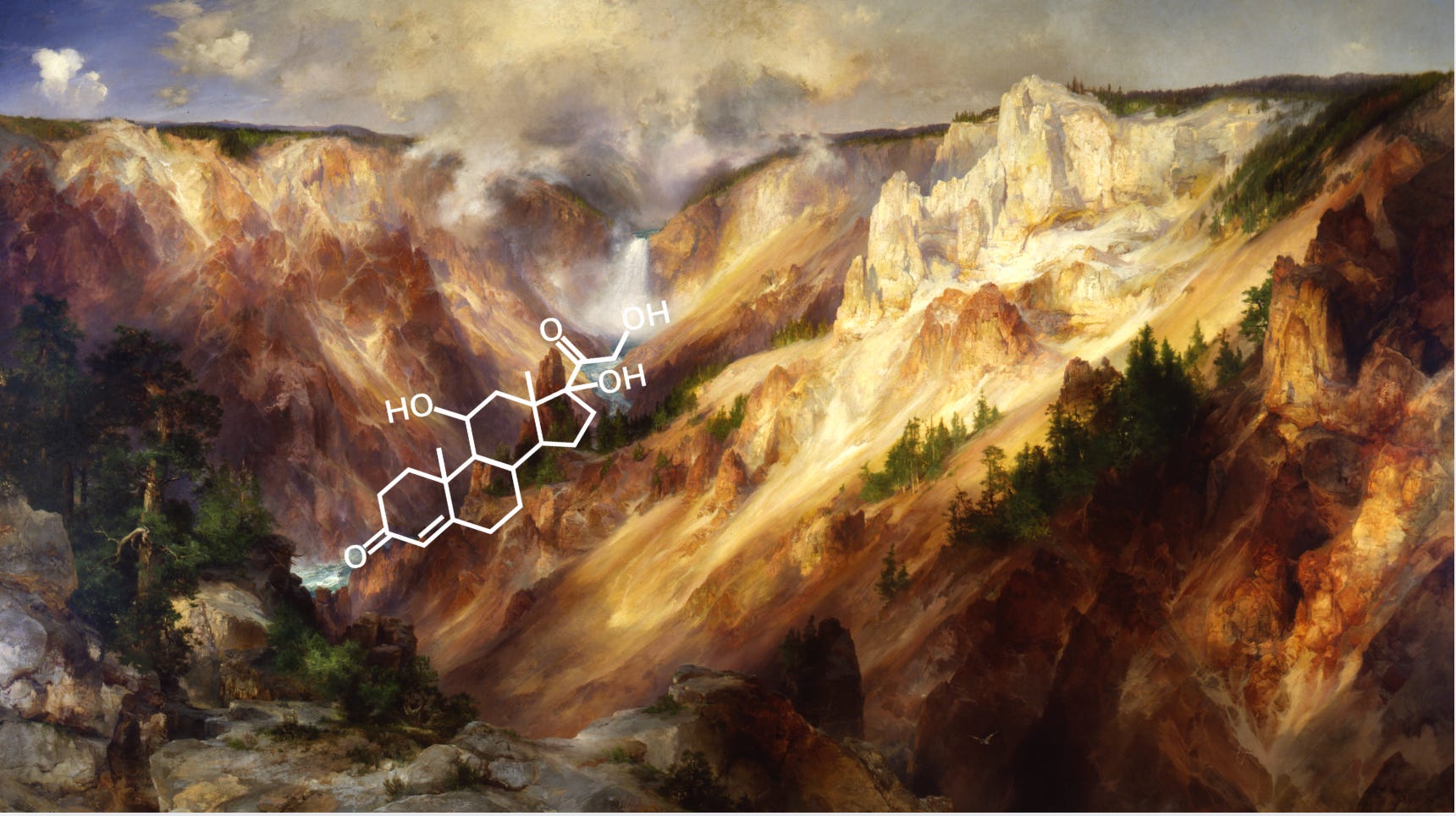
You wouldn’t say that the Colorado River stressed the otherwise faultless surface of Arizona. We tend to use a vaguely artisan verb: Carve. The Colorado River carved, over millions of years, the Grand Canyon.
Language is so perfectly revealing. You wouldn’t go so far as to say that the river crafted the canyon. That would give it slightly too much agency. But you wouldn’t use an overly mechanical verb like “stress.” We want our clockwork universe, but not so much that the Grand Canyon can’t still be beautiful in a vaguely artisan sort of way. So, we’ve settled on the reverent-but-not enough-to draw-attention-to-itself verb: Carve.
In that linguistic concession, we reveal our hand. “Carve” still implies intention. We suggest, through our unconscious verb choice, that the canyon is an intrinsic good. Human excavators scar and stress the ecology; the Colorado River alone may carve it like a cosmic whittler.
Modern people are themselves very stressed and traumatized and scared. We would like to carve out some time, but mostly we are overworked and overwhelmed. We don’t seem to notice that the difference between stressing and carving is only a matter of intention and timeframe. That is to say, the difference is the implicit metaphors.
Like a solvent, modern metaphors tend toward breaking themselves into the smallest functional bits to find “base reality” underneath the metaphor itself. The images shrink toward ultimate precision, but somewhere along the way they mistake banality for accuracy. Words like “cortisol” are thought to be very precise atomic units of stress, but really they are so flattened of the surrounding context they have become practically void of content. That metaphor refuses to identify itself as a metaphor and tries to project itself as a self-evident fundament, along with an array of other self-evident fundaments, discovered and yet-to-be-discovered. The bits then turn around and blame the cosmos itself for their own poverty of meaning.
It all really is just bad poetry. Iain McGilChrist describes it like a man who discovers that he can study the details of pond scum with a magnifying glass. He turns his looking glass toward the stars and declares what a shame it is that ancient people didn’t have access to this wonderful technology. It makes the heavens blurry, though, so he concludes that stars don’t exist.
Through the looking glass of chemical metaphors, the intricate qualia of of negative emotion becomes mundanely “stress” caused by “cortisol.” What was once tragedies with morals and arcs that spanned lives and histories, is instead systematically flattened into a single fancy latinate noun.
In fact, cortisol is a mostly unhelpful metaphor because it makes what might be a formative experience a purely “stressful” one. We could imagine that we are being carved into a grand and purposeful beauty over time, rather than a collection of dead car parts which should be used carefully for the longest possible functionality.
I can feel that I may be blaspheming by suggesting stress isn’t a chemical. If so, everything that follows will seem “fluffy” or “woo” if I don’t clear something up: I would never deny that cortisol can be measured at the time of stress. I also wouldn’t deny that you could manufacture stress by introducing a chemical. When patterns manifest physically, they always reveal their causal means, which can themselves be exploited by the higher pattern of scientific inquiry. What I am denying is that cortisol is the same thing as stress.
Saying “my cortisol just spiked” is just as impoverished an expression as me saying “I need to put ink down” (I’m writing this first draft by hand). Yes, it’s nominally true that when the ideas start flowing, so does my ink. In fact, it helps visually that the ink is a liquid and might offer some helpful viscosity to my sometimes chunky ideas.
Importantly, though, the material ink is incidental to the writing. It could just as well be done with charcoal, finger in sand, or hen-pecks on a Qwerty. The ink or its corollaries are an indicator of when the ideas are flowing, but it is not the ideas. Ink isn’t ideas. Cortisol isn’t stress.
You can’t fix bad ideas at the level of ink, and you can’t fix a bad life at the level of cortisol. That’s tricky because if you’re studious enough, you could definitely find some helpful patterns in ink: bad ideas are maybe associated with rushed handwriting or cheap pens. You could waste your whole life, actually, trying to optimize your writing by looking at what is revealed in ink, in grammar, in sentence structure. In the same way, there are a billion youtube videos on how to lower cortisol, none of them approaching a point. They’re built on the foundation of a metaphor at the wrong layer.
A better metaphor is an ecological one: the place where meaning happens is best thought of as a landscape. This makes sense, because we evolved on a landscape, developed our first languages on them, and those languages continue to be complex metaphors for an now imagined landscape of meaning. Locations for food sources become information which we forage for in essays, predators become stressors which we must choose to fight or flee.
It was popular like ten years ago to say something to the effect of “Your body reacts to an email like it’s a tiger,” as if your biology is just so hopelessly confused about the modern world that it can’t be expected to formulate a proper emotional calibration to an email. Even this line of reasoning, though, fell out of fashion as it was too loquaciously narrative and we chipped it down to the much more sterile and therefore controllable chemical metaphors.
I think the tiger metaphor was closer to being helpful, but it still wasn’t taking its implications seriously enough. Yes, getting an email (it would need to be a consequential email from your boss or something) can feel like encountering a tiger. That’s true. The metaphor still fails because it suggests that that response is inappropriate.
We have climbed the abstraction ladder so high that this is not obvious, I know. Let’s look at an intermediate example to better see why that might be. Imagine a farmer who has spent years building a farm and gathering grain for the protection and livelihood of his children and their children. Now imagine his grain silo catches fire. He will certainly have cortisol in his brain. Is he in any present bodily danger? No. Is there a tiger nearby? No. His meaning-making systems, which are indeed built on ancient emotional systems adapted to hunter-gatherer relationships with natural landscapes, are properly calibrated to the destruction of a meaningful symbol on the “landscape” of his future flourishing. The fact that the farmer’s emotional system is so deeply attuned to these metaphors that he could panic as if he were being physically attacked is actually a sign of their attunement and sophistication. He knows that the burning silo means struggle and suffering not only for him now, but also for himself in the future and even for his offspring long after he is gone. Semantic abstractions allow him to feel that pain and threat as if it were a tiger here and now, which is the fundamental reason humans are able to plan for the future.
This lineage of metaphor never actually failed. It’s just scary, and so we take an easy way out if we can manage to. When you get an email from your boss, you feel like you are being stalked by a tiger. The fact is, that’s appropriate. Your body’s highly attuned situational awareness in your ecological niche tells you that what you may or may not learn is of mortal importance for you and your lineage. The message is a portal to a landscape of meaning. You have the ability to feel the threat of loss of resources in the future as a hyper-predator here and now.
The fact that modern people are stressed and overwhelmed is not a sign that the system is somehow become miscalibrated, but rather that we have a great power to sense a future of possibility and yet have lost much of the epistemic courage that might move us closer to that future. We settle for the low-hum of the fear of a billion possible tigers rather than gird our loins for necessary confrontations with the right ones. We’ve woven a comforting new metaphor that tell us that the modern landscape renders us helpless to all the tigers who don’t exist.
The modern counter-metaphor says that all these fears are merely Paleolithic holdovers. Aberrant chemicals to be medicated away. This is a terrible mistake. Your meaning landscape has actually rightly identified certain behaviors or events to be something akin to super-predators stalking you. The silo that would otherwise feed you and your family is burning to the ground. To medicate or numb the feelings is to blunt your ability and urgent motivation to stop the flames or kill the tiger, to be courageous enough to carve out an even more beautiful and prosperous future, which we must sense is a real possibility in the ecological landscape. We aren’t wrong to think we might do better.
It is still understandable that we would construct an anesthetic counter-metaphor. The meaning landscape has this horrible quality of being able to bring the future’s sufferings and regrets all here and now in the form of an unbeatable psychic dragon (which is an amalgamation of all predators). For most of Western history, the aim was to try to defeat the dragon and win the gold. Lately, we’ve decided that there’s no such thing as dragons, while they eat us alive through our low-meaning email jobs. We can no longer imagine that accepting them as real would have positive effects despite it being painful in the short term. We dull our ability to “see” the meaning landscape with distractions.
Consider: In Louisiana, you’re liable to hit a deer with your car. The deer can see the headlights, sure, but they can’t “see” the meaning of them. They can’t connect the smell of exhaust to the fear of death. They don’t have the linguistic metaphors to connect their primal fear of black bears to the symbol of my wife’s VW Beetle. So, they stupidly make a break for it exactly at the wrong moment. We, on the other hand, are cursed with the knowledge that headlights mean death, that emails are sometimes portals toward suffering or wealth, and that computers may contain tigers and dragons.
The reaction to “stress” should never be the aspiration to forfeit our ability to see meaning landscapes. We can’t, anyway. We can’t aspire to be like the deer because the deer dies stupidly and we at least know enough to know to not want that. Despite wishing otherwise, we can “see.” Even if I blindfold you, you know to not walk on a highway and you know how far to stand from a stranger. To whatever extent, you are a visionary. A prophet.
Stop relying on bad metaphors like “cortisol” that hide the fact that we are well-adapted perceive a rich metaphorical ecology of future predators and promised lands.
Open your eyes, see the horror of the dragons and the promise of gold, and make better decisions.
This is a great essay. I have found it useful when studying to retain the mental image of an exam as a predatory animal. Animals can be chased and hunted, by rendering stress a lifeless entity, like a chemical, it suggests that the solution lies in a bottle rather than in an action.
“Stress should be more afraid of you than you are of it”.
This framing only works in the predatory animal frame, and is left nonsensical in the biochemical frame. But ironically this framing has often times lowered my “measurable cortisol level” far more than anxiolytics have.
It could be the case that some metaphorical frames dominate others, meaning they perform better even according to the metaphysical axioms of the dominated frame.
Anyways, enjoyed the essay!
"You can’t fix bad ideas at the level of ink, and you can’t fix a bad life at the level of cortisol." exactly!