

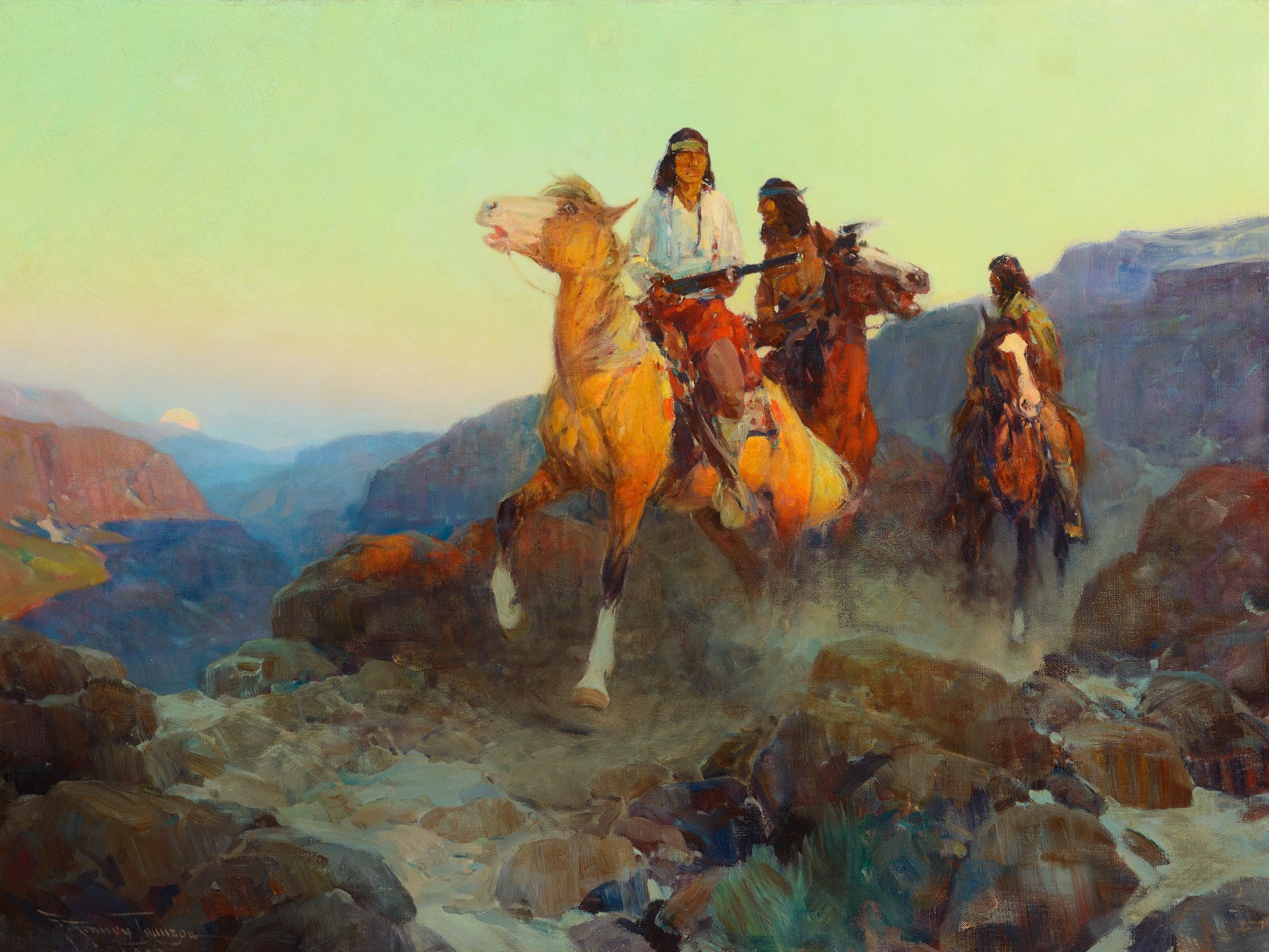
This is the first entry in a series called American Archetypes, where Eddie LaRow and I explore artifacts of the unique mythos of Americana. Check out Eddie’s first entry in the series here.
When we would play cowboys and Indians as kids, you were just as likely to want to be an Indian.
My dad had a house a ways off the road. My cousins would come over and we had some of the best times of our lives running and hunting each other in the shadows with toy weapons and homespun rules about staying dead if shot.
The point of the game, the thrill of it, which we would have never been able to put our fingers on at the time, was the drama of the European mind confronting the fundamentally foreign American wood. Our ancestors had not adapted to these creekcut hills and we knew in our blood. The cowboy is the self-sufficient loner who confronted that heart of darkness with some grit. The Indian delighted in the rhythm of that chaos and the terror it represented to the abstracted man. There was pleasure in playing both roles. Both spirits exist in all boys, more or less.
Personally, I was drawn to being the loner cowboy. I liked having only light baggage, my toy pistol and the soaring freedom to rely on my wits. The sprawling shadows pressing in on me from the outside felt like the comforting pressure of a heavy quilt, one that kept me feeling alert and energized by the very presence of a primal threat.
I found that the kids you would probably now diagnose with ADHD tended more to be drawn to the woods itself, the adventure of being one with what causes fear in others. They would sprawl themselves into tall grass in pitch dark shadow of the sodium lamp opposite the house, popping out to tag you with a Nerf dart when you least expected it. We knew a kid like that, let’s call him DuBois.
In science class we did an experiment where one kid would hold a dollar bill between your open fingers. You, like a gunslinger, had to pinch them together when the other kid dropped it without warning. Only DuBois was fast enough to catch it. Reflex speed is strongly correlated with IQ, which makes sense because it is a quick measure of how quickly and efficiently your nervous system can process inputs and produce the right outputs.
I doubt DuBois would have done well on a paper IQ test, though. I don’t recall him doing very well in school. His shoes were always worn through the soles because he was always moving around. He would climb bell towers and do backflips into the endzone. He would laugh with you, bite you, then punch you, and that was if he liked you. He was great to be around, but untamable by parents and teachers. He was a good and loyal friend.
Camille Paglia said that the reason there are no female Mozarts is the same reason there are no female Jack the Rippers: genius of the highest degree requires the harnessed energy of the male killer. This is a bit of a paradox or maybe a natural bottleneck because most wild males like DuBois don’t usually encounter the cause nor the means to channel that energy up the many layers of abstraction to produce something like world-class art. It’s very rare.
My suspicion is that the stereotype that the most intelligent people are frail contains a half-truth: the frail are more often given a reason to channel their limited energy up through abstractions by the mere fact that their options are narrow. Theirs are not the highest potential nervous systems, but merely the ones likeliest to tame.
Although it is the most predictive and useful measurement we have managed to produce in psychology, tests of general intelligence (g) will almost certainly mislead at the margins in that fashion: they report heavily on the average Western ability to sit still and work with pure abstractions on paper. True outliers will confound that average.
To great controversy, this January large amounts of metadata were compiled and released on race differences in IQ. If you believe that a standard measure of average IQ is a good measure of something existentially important for the freedom of your “group,” then these findings will be unacceptable to the values of the Rousseauian West where everyone must be, at least in terms of natural potential, the same. They will be ignored, discredited, and buried. If, however, you believe that there is something to loving others besides their ability to sit still and move abstractions around in hyperspace, then these findings are both unsurprising and non-distressing.
The French postmodernists were great critics of the West, even if their solutions were bad. Or, I guess, their solutions were nonexistent and therefore bad. Still, though, it was from them I learned to appreciate that the way we tend to measure intelligence is itself biased toward Western outcomes. That there are things more important than dealing with abstractions. Raucous idiot genius (which beguile measurement) like in Shakespeare and Mozart, to name one. Wild philos like I felt from DuBois, to name another.
What ultimately confounds standard measurements of IQ, which, make no mistake, are still highly predictive of how successful you will be in a Western bureaucratic state, is that an overall well-functioning body and therefore nervous system indicates an agile mind better than anything else. Therefore, the greatest minds will be fundamentally unlike those who are “above average” in the standard Western sense. A great artist is nothing like a competent lawyer.
Taking this seriously opens up some doors of inquiry that are normally shut tight behind taboo. Namely, why researchers who live with tribal peoples sometimes come away with the sense that they may be more intelligent, in a way. Jared Diamond, who wrote the famous book “Guns, Germs, and Steel,” had this intuition after spending time with islanders.
What struck him was that these people could remember 10,000 plants and multiple square miles of landscape, down to the inch. I struggle to get to Starbucks without maps. Drop me among those men, I would be dead in three days. Thanks to the harsh pressures of survival, they are all healthy, strong, and embodied. Their intelligence wasn’t built for abstractions, it was built for aggressive movement in a non-hypothetical landscape. That’s what Diamond was picking up on: they would catch the dollar bill. They had wide jaws from chewing meat and raw fruit and never needed braces and never lost their adult teeth. Like an extrapolation of my friend DuBois, they are also much more violent (in the case of ancient Illinois tribes, seventy times more than in the modern US). They murder outsiders and ritual victims without a hint of guilt. They often even eat them. (They omitted that scene from Pocahontas.)
From the other end we approach an incomplete truth. Are they noble savages or stupid cannibals? One thing American natives first noticed about Westerners was their faces: a kind of visible misery, a haunted abstraction. Being more attuned to embodied life, they could perceive something wrong with the Western soul, even from a distance. So, are Europeans sophisticated and civilized, or are we abstracted, frail, bureaucratic colonizers? Useful truths here require us to hold opposites in tension without letting them collapse into a simple binary, which is the definition of propaganda.
The James Cameron Avatar movies, for example, are propaganda. It panders to the Rousseauian picture that the state of nature is a pristine good only troubled by the forces of culture. The “natives” in the movie have all the positive qualities of natives without any of the uncomfortable negatives, that is, their extreme violence. This lack of symmetry in his storytelling pings our deepest intuitions as wishful thinking. It makes sense of the fact that these movies are gigantic mega-blockbusters and yet somehow have no impact on our culture. We don’t seem to remember them.
The fact is, living with tribal natives would be unthinkable for a modern liberal. The violence rates are higher than the worst nightmare of New York’s history. Brutality to outsiders is common, and frequent mimetic disputes are resolved with a scapegoat, often a child or a virginal sacrifice. In fact, a large part of the irreligiosity of modern people, especially those who have been protected by it for hundreds of years like Inner and Northern Europe, is that they have no idea what waits for them outside the walls. Brutal ancient kings guard the perimeters of their now soft lives. We can get so comfortable that we sometimes genuinely believe things would be better in the “pure” state of nature. As Jack Nicholson said in A Few Good Men, “You can’t handle the truth!”
Western researchers trip all over themselves to avoid noticing this. Jane Goodall was so shocked to find that chimps (we’re not even talking about people yet) engage in bouts of seemingly sadistic violence that she hid her findings for years. The author of “Guns, Germs, and Steel” also avoids making a note of this fact, despite that he certainly encountered it. He instead focuses on the qualities of the “noble savage,” which, as I have covered above, are indeed there to be seen. Reactionary types would perhaps refute me here and suggest that if they were so intelligent and in harmony with nature, how come they don’t have a civilization like ours? They’ll point to IQ as the major cause of this deficit and think of themselves as brave for being able to tell the truth about it.
I can see why they come to these conclusions because Rousseauian types are so dishonest, even with themselves, that it can be tempting to dismiss all their findings. If we know what motivates them, though, (a compassion for the marginal) then you can more easily separate the wheat from the chaff. They are not maliciously anti-Western as some of the more paranoid rightists would suggest. They just genuinely care for the poor in spirit, which is a good quality as long as it doesn’t come before the truth.
“Guns, Germs, and Steel” offers this good observation: the reason that Europe and Asia were able to advance in culture and technology is because the continent of Eurasia is very wide. That means that if you manage to breed a highly edible plant in Portugal, you can also easily grow it in South Germany and even China. If you domesticate an animal in Mongolia, you can also shepherd it in England. The chances of finding the right plants and animals upon which to build a civilization are much higher because of pure surface area. Places like the Americas, Africa, and Australia, however, are more tall and skinny. If you happen to find a suitable crop in South Africa, you can’t plant it in either Chad or Egypt. The same goes for domestic animals.
The book is more subtle and complex than this, not to mention the ongoing disputes about the reported facts. The upshot is, at least, a very plausible reason to doubt that the advancements that took place in Eurasia were only to do with the relative intelligence of the people who lived there. That, and a host of things not listed here, known and yet unknown, give credence to some epistemic humility and a respect for the world’s natives and even to the primitive within you. I’ll also remind you that pre-Christian Europeans were famously some of the wildest people on the planet. They gave rise to the terms Barbarian, Gothic, Berserker, and Viking, with all their attendant primal violence.
Now, when we talk about the American natives, we can keep a cool head and resist flying into pseudo-religious outrage. Speaking of, Matt Walsh just released a documentary on YouTube about the “real” history of the Indians. He lays out how most of the things we are taught about this period in school are just not true. The Trail of Tears was built on misleading figures and named decades after the fact. The American natives were brutal, violent, and merciless to a much higher degree than most of the Westerners they fought (with a few notable exceptions). It’s true, Matt Walsh is a provocateur. He wants to spark outrage because it gets him more attention online. That’s how the internet works. Still, he’s showing us something at least partly true that we have trouble looking at.
We have found other ways to bypass these taboos and depict tribal and pre-Christian violence in literature, like in the novel Blood Meridian. It takes a totally different tack than Walsh. What allows Cormac McCarthy to depict the violence of the natives in that bloody Western is that there is no redeeming order in the cowboy, either. He is revealed to be just as violent and primeval as his native counterpart.
This is meant to be disturbing. Characters like the judge, who represent the pinnacle of Western sophistication and education, use Western Christianity as a façade to become an even more powerful force of death and chaos. He functions like an organizing principle that gathers primitive drives toward violence and magnifies them rather than restrains them.
That is a sharp observation. It shows Christianity at its worst. Or more precisely, Christians at their worst: using it as a way of magnifying violence rather than transmuting it. This is what we would call Machiavellianism, or the spirit of the Antichrist, which the judge exemplifies well.
What McCarthy cannot fully articulate, however, is what Christianity does when actually adhered to. He gestures toward it: he notes that the new land is “thirsty for blood,” so much so that it could not be quenched by a thousand sacrifices of Christ. In that small moment, he recognizes something real: that the Mass, the Eucharist, is meant to satisfy the primal bloodlust of the pre-Christian savage inside all of us. As René Girard argued, early human societies are always caught in cycles of mimetic violence that resolve themselves through scapegoating. Christianity presents itself as the ultimate scapegoat, not to eliminate violence outright, but to redirect it toward what is highest, through the sacrifice of the perfect victim. In theory, this allows us to stop enacting scapegoat patterns on each other through senseless, nihilistic violence. To aim that impulse upward toward the proverbial Mozart and away from the danger of Jack the Ripper.
This forces a recognition that McCarthy wants to ignore: that we are all capable of savagery, but that this can and has often been ritualized, acknowledged, and redeemed. At its best, this produces a people who confront their inner violence regularly and, ideally, transmute it into civility and courage. That is the ideal. It is not even close to how it often plays out in the West, but it is what Christendom is meant to do. To the extent that the West is not stuck in cycles of primitive violence, it has succeeded. McCarthy cannot quite land here because he is constrained by the implicit Rousseauian reflex: if you depict Native Americans as savage, you must depict Westerners as even more savage. In other words, you may either depict the state of nature as pure or show unredeemable nihilism all the way to the bottom. It is totally taboo (ironically, only in the highly Christianized West) to suggest that Christians ever succeeded in abating their fallenness, even a little.
Still, the real story is not that natives are savage and Westerners are civilized. Nor is it the inverse. The real story is that there is something like a pre-Edenic harmony, being “one with nature,” is indeed more alive in the native. That really is partially lost in Westerners. The Westerner, in aspiring to a merely comfortable rather than rigorously true Christianity, fails to become truly moral. As Nietzsche observed, we mostly rely on the façade of Christianity to restrain overt violence while still expressing it in sublimated forms whenever we can get away with it. We are only moral in the West mostly because we are cowardly, frail, and comfortable.
Westerners, in that fashion over centuries, developed more “sophisticated” modes of sublimating our drive to primal violence: technowar, bureaucracy, colonization. Those can be just as brutal, only abstracted and without the need for savage courage and embodied intelligence. Indeed, when Westerners first encountered Native Americans, they were often outmatched because natives were not obliged to veil their violence. The Comanches, for example, repeatedly defeated the more “advanced” American forces by mastering a sort of guerrilla warfare on horseback. Small groups of wild American vigilantes had to relearn how to fight more primally. They learned directly from the natives, and some also learned how to live in deeper continuity with nature through contact with indigenous life.
The native thus represents both unity with nature and its shadow: unselfconsciousness that produces both vitality and tribal violence. The Westerner represents self-consciousness and individuation: the lone figure, which produces order and clarity, but also abstraction, alienation, and a kind of spiritual dislocation. Our deepest obligation is to fully transmute violence into genius by making conscious sacrifices.
Imbalanced stories like Avatar, as much as they hope to do the right thing, entertain but fail to transform a culture. We can feel its lack of gravitas like an epistemic fake wood plastic siding on a suburban house. We only like it when it’s new. Certainly, Matt Walsh correcting the propaganda of the noble savage will allow him to ride the wave of new propaganda in the opposite direction. That will also ultimately fail to satisfy us.
What makes both cowboys and Indians so salient to the American imagination and by extension the entire world is the tension of incommensurate opposites. Inside every boy is the spirit of both the cowboy and the Indian. Sometimes they war, sometimes they learn from each other. Neither will ever totally destroy the other in their search for answers.
Twins each contain a light and a shadow. The problem is not choosing one over the other. It is integrating them. What is required (always) is a kind of callosum, a connection between these two modes of apprehension. Feet in the dirt, head in the stars.
That is the better story: the Indian who becomes literate, a spirit guide between worlds; the cowboy who goes native, becoming a protector of what is sacred, natural, and real.
This is always a negotiation. A temporary peace treaty, if we’re lucky.
James,
I've only written a fan letter to one other published writer. It's a scary task because I know my words will be common and folksy. I'm an aging boomer and have been subscribed for a while now. Saturday morning enrichment has become something I look forward to thanks to your writing.
Your essays function on many levels and always send me to the web to look up the references. Careful re-reading always leads me in a newer directions. Your themes resonate my surface because I'm from Louisiana and have French roots. On deeper levels, the tension produced from overlapping layers of masculinity, cultural polarities, anthropology, psychology, and religion make me wish I'd read more as a younger man.
See you next week,
Daniel
I was exclusively an Indian, and for three years when I was a boy we lived right next to a hundred acre wood where I would disappear all day long whenever possible.
That was in Falls Church, VA and it’s long since been bulldozed for expensive suburban houses.
There’s a lot of apparently good research indicating ADHD is quintessential hunter:warrior cognition