

If a child were to point at an analogue clock and ask why the hands move around it all day, and you answered “electrons in the battery turn a little motor inside,” it would be fair to say that you’ve missed the point of the question.
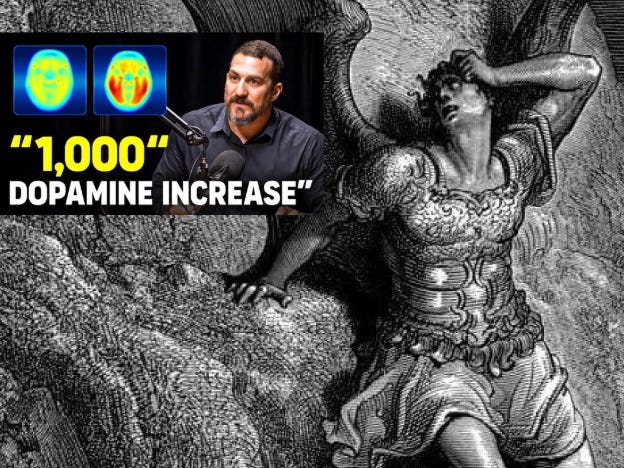
Given that, it’s weird to me that when we pose questions to ourselves, like, “Why am I so addicted to my phone?” or “Why can’t I stick to my New Year’s resolutions?” we tend to give ourselves an answer that clearly misses the point: “Dopamine in my brain.”
To get to the actual point of the question, the batteries or the plastic gears would be pretty low on the list of things to explain. In fact, you’d probably need to start with a highly contextual and cultural explanation of what “time” is. Maybe you would then explain how to read the clock and how that number relates to the position of the sun outside. You could even explain how time is one of the four dimensions according to relativity. Never would you think to say that the electrons in the wires “create” time. They are very incidental within the grand network of interrelated phenomena that is time.
And yet… dopamine.
Dopamine has an official-sounding Latinate name, not a guttural Germanic work-a-day sound like “meaning.” It describes a measurable chemical, not a vague metaphysical concept like “joy.” It invokes the very calm and reasonable curiosity of a Huberman podcast, not the rambunctiousness of wonder or wisdom.
Most importantly, dopamine can be categorized, optimized, and controlled. It is like Thor in the catalogue of latinate chemicals of life - their king and leader. Others in the pantheon include Testosterone, Serotonin, and Oxytocin. Dopamine is their king because it most directly signals motivation, which is the ultimate state of being in the self-help pantheon. His is the state of control and certainty. His eternal enemy is Cortisol, the king of early-aging and burnout.
What’s lost in this chemical cosmology, as we will see is probably intentional, is the vertical dimension. Its absence only becomes obvious once we realize how easily we access the vertical dimension when doing other stuff. Trying to optimize well-being by worrying about dopamine levels, for example, is like trying to express yourself better by using more vowels because, studies show, that language with more vowels, on average, contain more meaning than language with comparatively more consonants. While that may be true (I just made it up), and you may be able to find comparable correlations with a chemical like dopamine, the information still only stands to do nothing but confuse you.
I can’t increase the transfer of meaning from me to you by worrying about vowels, in the same way that you can’t improve meaning and therefore motivation by worrying about dopamine. It’s not that the chemical’s role as reported is factually incorrect; it’s just Not True in a “higher” sense (up the vertical dimension). It does not get you “where you want to go,” and I have proof because the more YouTube videos you watch about optimizing dopamine, the worse you feel.
And, after all, if dopamine was really a meaningful lever to improve meaning, putting it directly into your body ought to do the trick much more efficiently than protocols. People have been doing it for ages, with great success, actually. And they love it, actually, sometimes more than life itself. It’s called cocaine, and it’s cheaper than a dopamine detox retreat, and a hell of a lot more fun, too.
The reason we (mostly?) don’t just do that is because we actually do understand, when push comes to shove, that meaning doesn’t live in the fancy latinate names of brain chemicals any more than Mozart’s Lacrimosa is found in one E-minor note. Meaning, like time (and music), is contextual, cultural, and historical.
We hide this realization from ourselves. Tellingly, not all the time, but only when it comes to finding purpose. We know how to answer the child’s question about the clock, but suddenly forget how to climb the vertical dimension when asked about our doom scrolling problem. Hm.
“Dopamine,” in this way, is an ontological dumping ground, where difficult questions about our choices and resulting virtue go to hide in highly-convenient spot-nihilism. Huberman is good-looking enough and the chemical names officially-scientific-sounding enough to produce a low-level anti-religion to keep the ghosts of Christmas Past, Present, and Future from haunting us year-round.
The trouble is, we all believe in the vertical dimension, anyway. We all know how to dance without thinking about our toes and we all know how to write without thinking about vowels; it’s called fluency. This disconnect, as it becomes more and more starkly obvious, creates some uncomfortable cognitive dissonance. People, you may notice, have a tendency to lose fluency in other areas as they become more committed to their horizontal dimension in regards to meaning. They become too proud to dance, too busy to go for a walk, too serious to laugh.
And here we land on the motivation behind making dopamine a dumping ground for uncomfortable questions. We don’t actually want an answer to the question, “If meaning is a ladder, then what’s at the top and what does it think of me?”
Saying “God” or “judgment” here would, in my opinion, be about as effective as “yes-huh times infinity!” - only to the already-convinced or extremely credulous, and off-putting to anyone else. I haven’t earned the invocation and I don’t know what I’m talking about, anyway. As an aside, most of the time people bring up God in an argument, they are making this mistake. And I have a feeling that it’s a serious error that fits in the category of “Taking the Lord’s name in vain.” That could just be my bias against certain evangelical types, though.
What this intuition of a vertical dimension does confirm for us, at the least, is that we all sense: there is something higher than us, even if it is just a “higher self.” From that naturally higher perspective, it would inevitably have notes about our life and choices. Judgment, it turns out, is a natural consequence of moving up the vertical dimension, which we call gaining wisdom. It’s not a coincidence that we don’t like those words anymore (judgment or wisdom).
Instead, we prefer “smart,” which is the ability to move objects around efficiently in the horizontal dimension. That is very useful, unless you’ve got the wrong framework, and then you’re just busy moving deckchairs around the proverbial Titanic.
When pressed about this, people tend to respond by moving deckchairs faster. By that I mean they spend more time and money and frenetic energy trying to get their brain chemicals right, which would all be better spent looking for wisdom. They don’t do that, not because it’s so impossible, but people just don’t like to discover that the ship is sinking and radical transformation is required.
The most terrifying thing about being human, I think, is our ability to lie to ourselves. What starts out as an innocent fudge for reasonable comfort, quickly turns into an invisible and habituated lie that is nearly impossible to see outside of.
This fact is something you know very well about other people, if you’ve spent any time with them. You learn to dance around the lies people tell themselves, or even, if you’re a certain type, to reinforce them to create false intimacy. A real friend, by the way, is someone who is willing to point out delusions (in wise times and with kindness) and then help you suffer their absence. By this metric, most people have never had a single true friend in their life.
Sad, but true. Anyone with a little wisdom knows you generally can’t help people escape their lack of wisdom. Even when you think you can, you usually can’t. This helps me understand why wise people tend to speak less. A word to the wise: never try to wake a sleepwalker. What you may begin to notice is that it is very easy to see the problems of those with less wisdom than you, but those people, in turn, could not know the difference between your wisdom and a car salesman’s.
Yet more wisdom, though, would suggest to, “not look for the speck in your brother’s eye, but take the plank out of your own eye first,” which is the realization that there are people out there, right now, who can see, clear as day, your lack of wisdom and know exactly how to help you, but you don’t know their advice from a hole in the ground. This is a humbling realization, but an exciting one.
What wise people do has nothing to do with facts or evidence. Give a researcher enough budget, he will find all the data in the universe to justify his lack of wisdom. No, what wise people do is shine. Meaning, they evoke admiration and wonder. These states can’t be replicated with data and they can’t be reliably invoked with any protocol. Wisdom does not come in pieces to be assembled, it comes as a rapturous transformation of the whole - sometimes slowly, sometimes quickly, but never one piece at a time.
So, it’s not the blue light on the phone or the fluoride. Anyone who has ever done anything interesting would have done it anyway, even if they suffered a little leaded gasoline in the air or micro plastic in the balls. They didn’t need pink salt or morning protocols or saunas, either. Anyone who is trying to sell you those things, while probably presenting their “vital” life online, we have to assume is only gaining their vitality from your money and attention. The only chance you have, then, of attaining the same life is to suck in even more suckers like yourself, and you’re already pretty low on that pyramid scheme and the bottom grows exponentially.
That’s why people feel stressed and “burnt out.” Because the entire ecosystem around “dopamine” is a parasitic feeding frenzy. They sense perfectly well everything else described above, and yet they tell themselves the lie “Maybe I’ll be the exception.” Yeah, and maybe the Titanic will sink, but you won’t.
No information I could produce here could possibly save me or you from our own stupidity. Even if I knew the absolute truth, and I don’t, if I said it here, you would think it was arbitrary and improbable, and maybe the dumbest thing you ever heard. All we can afford each other is a disposition that may, if we’re lucky, induce an episode of wisdom. That disposition is extreme humility and an openness to wonder. Not curiosity - screw curiosity. Have you ever had someone ask you something “out of curiosity?” It’s never a real question, but just an opportunity for the asker to tell you what they already thought once you stop talking.
Wonder and rapture are key because they transform. And that’s what we all actually need - transformation.
James, thanks for the effort you put in to talk about this ubiquitous obsession with chemicals and the idea of optimizing ourselves by infusing the right ones and draining the wrong ones from our bodies. You named something that many in our age must feel but don't know how to express.
Loved the exposition of the chemical pantheon. Such a powerful metaphor.
And such unexpected tangents - about friendship, wisdom, and about the vertical of reality.
I'm grateful to you for making this verticality of reality more obvious, or maybe, in your words, letting your wisdom ‘shine’ about this topic.
" Anyone who has ever done anything interesting would have done it anyway, even if they suffered a little leaded gasoline in the air or micro plastic in the balls."
hahahahahah