

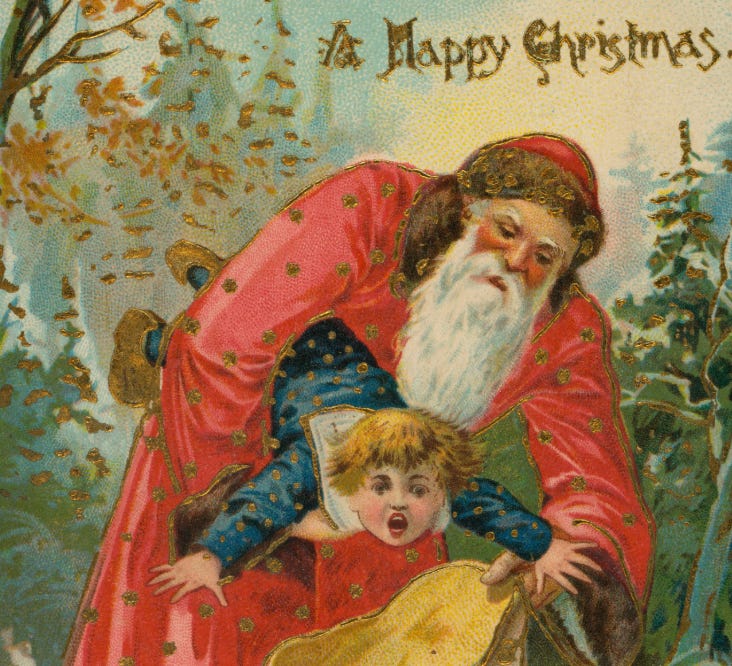
A friend asked my wife and I, “Are you going to let your kids believe in Santa Claus?” To which I said, “Well, I currently believe in Santa Claus, so, yes.”
He looked at me like I was trying to be cute and said I was talking about that Joseph Campbell stuff. He actually wanted to know if I was going to lie about a man literally living in the North Pole with elves.
If you know me, you know this sort of discussion gets me fired up. I had the idea for this essay about a month ago, but decided not to write it for fear of becoming a parody of myself. I changed my mind after this conversation with my friend, who is generally aligned with how I see things, but apparently not on the Santa Claus question.
His concern with the whole Santa thing is more the child-only elements: a fat guy doesn’t actually come into your house at night. When the kids find out, what else will they think is a lie? He’s personally heard things like, “I found out Santa wasn’t real, so I figured neither was God or the Easter Bunny.” A fair concern.
First of all, and I’m not being cute, of course Santa is real. He is a spirit that we all know how to embody and participate in. If I put a Santa suit on you and put you in front of kids, you would know exactly what you could and could not do. Not like a script or a machine, either. You would be able to play and therefore truly inhabit the spirit, proving that you both know and believe in Santa. You wouldn’t pull out a bottle of Jack or light up a cig, because you know that’s not Santa and it’s also wrong for kids to see Santa acting “wrong.” Further, we all fully participate in Santa’s yearly flight, buying toys and setting up the tree and stockings, and everything else I don’t need to list. In this, we embody the spirit of his elves, sometimes even against our will or own best interest. Collectively, we’re all totally possessed by his animating spirit, and we couldn’t stop it if we tried.
It’s not wrong to participate in that spirit for the delight of our children. What is wrong is sitting them down to tell them it’s all a conspiratorial lie. That is itself a vicious lie. He’s real - the magic is just subtler than we can get at in ordinary speech.
Here I feel like I run into a brick wall, because we are all at least somewhat materialist in our outlook. There is just a tic in the modern mind that wants to be like, “But if I literally went to the North Pole…” as if that’s the most important level of truth or revelation, even though you don’t act like that’s the case. If I told you that I know my wife loves me in my heart and pointed to my chest, would you try to convince me that my brain cells are actually in my head? Or would you just know that what I’m saying is truer than any facts about anatomy and that probably “symbolism” around the heart is so deep in the human psyche as to mean a multitude of things we can’t quite bring words to bear on but we know by intuition is more meaningful than a technical definition could ever be?
We all know this is how things work because we all know how to act this way without having to explain ourselves. You wouldn’t sit your kids down to explain money isn’t real, it’s just something made up that we all happen to believe in. You can tell yourself money is a lie if you want, but that’s not going to be very convincing to the debt collectors. And it’s probably a bad idea to tell your kids to not “believe” in money because we’ve been off the gold standard for decades and you think that makes it not real.
So, if you (or someone else) tells your child that Santa isn’t real and suddenly their belief structures all collapse into playground nihilism, maybe, actually, there is something wrong about what you said, not what the kid believed in before. Maybe their despair is a reflection of the fact that there is seriously something wrong with the way we think and talk about belief.
For us, the existence of the historic Saint Nicholas contrasted, say, with the current Santa Claus who has the elves and delivers the gifts - his design finalized by Coca Cola - again contrasted with those proto-Santas in Germanic myths where a creepy guy with a switch steals your kids’ toes in the night, is solid proof of it being a lie - and a silly one at that.
However, rhyming incarnations of the mythos is actually proof it is real, not the other way around. His pattern plays out in our culture in a particular way - but that doesn’t mean it’s arbitrary. The North Pole and the Elves and the sleigh - those images mean things that I wouldn’t pretend to have a full grasp of. All I know is that when I see a kid and ask, “What is Santa bringing you?” my conscience is completely clear. It is true in a pragmatic sense because the pattern of Santa works. It is stable and good, and the proof is in the fact that he keeps popping up to make us more generous and fun.
Importantly, Santa requires our participation - he needs us to believe in order for his existence to substantiate. We are his body and his elves. Not everything depends on your belief to exist, of course, but more than you might think. Seeing is not always believing, because believing sometimes literally changes what you are able to see. This, you may have noticed if you’ve been watching Christmas movies like Elf or Miracle on 34th Street, is their central claim about belief in Santa Claus. Done right, Santa doesn’t collapse belief. He demonstrates how belief makes possible what unbelief categorically can’t.
If we are to be disturbed by Santa, it’s not the whimsical details of his mythos that only kids believe (North Pole, etc.) Those are not lies, but carefully crafted cultural images that communicate more things about the spirit of Santa than we could say if we were too fixated on a forensic truth. My proof is how eagerly we all reproduce those images in the minds of any young people we happen to come across in December. The real lie would be to pretend you don’t already understand this.
The problem, if there is one, is the way that the commercial world has made Santa into entertainment-to-sell-toys above all, which sometimes makes all belief feel mawkish and childlike. That, it is good to remember, is an artifact of commercialization and TV, not the nature of belief, and is probably the actual source of our intuition that something about “lying” to kids about Santa is wrong.
There is a time to sit our children down to have a talk about Santa, not to destroy their belief, but to grow it. To help them see how their parents participated in Santa, and one day they will do the same for their own kids. In this way, belief transmutes from receiving to giving - and that, you may notice, works on a few levels.
I still believe in Santa because I am now become Santa. By this transmission, I am not made cynical, but I look still higher, with the heart of a child, toward the source of all belief, and there I see something I cannot here describe.
This is probably the truest thing I've ever heard about Santa Claus.
Just yesterday me and my girlfriend were talking about this exactly. You made everything so clear man, I feel like an idiot for not seeing this before. Thanks so much! Happy New Year too!