

“There will be a revival of Christianity when it becomes impossible to write a popular manual of science without referring to the incarnation of the Word.” - Owen Barfield
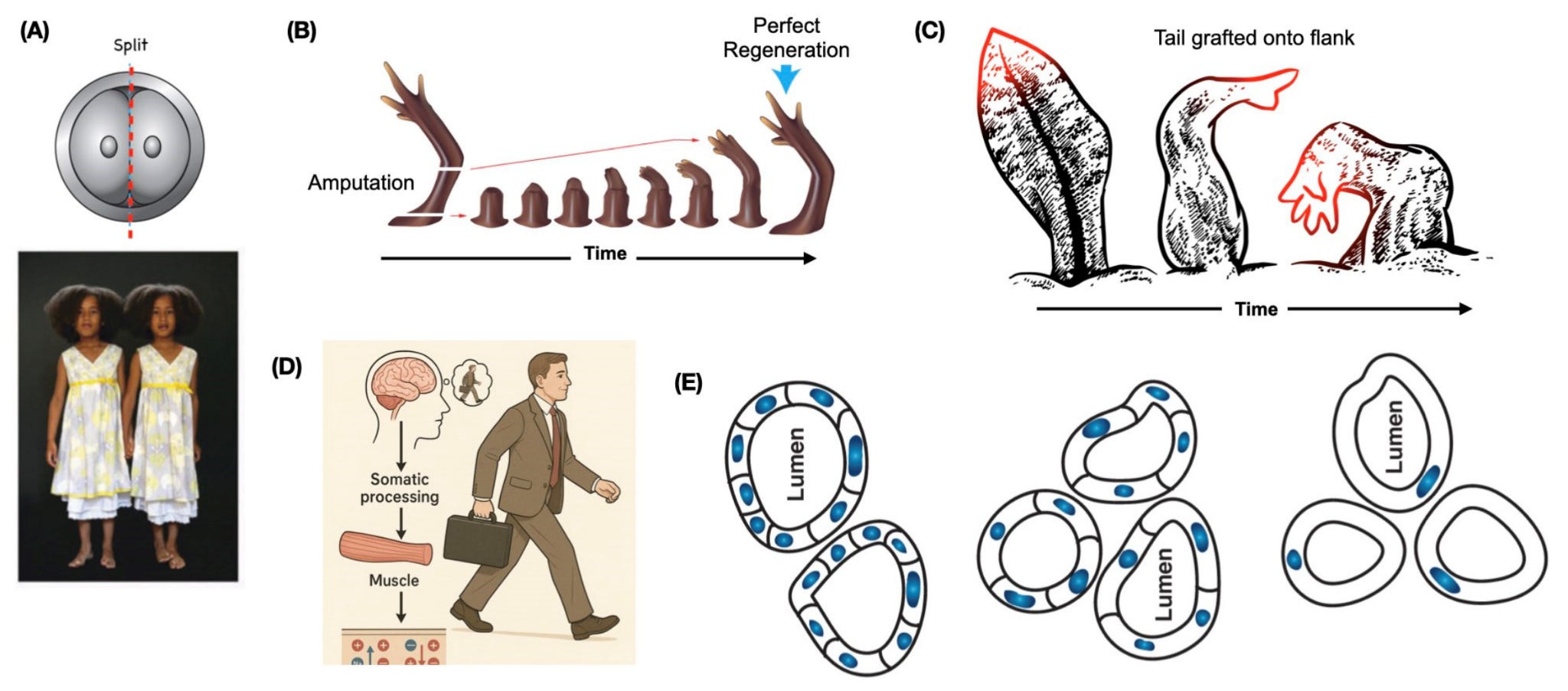
A couple of days ago, Michael Levin published a huge scientific paper. Levin had been doing some podcasts a few months back. I understood about 42% of what he said at the time.
What I have since gathered from reading his new paper, basically, is there’s a Platonic realm of patterns that “ingress” upon the physical world. “Mind” seems to be present, and even measurable, at all levels of 3D space, even in much simpler organisms than we previously would have thought. He argues that even the patterns of non-living things, like mathematics, also participate in this patterned “ingress” on our physical world.
I was extremely excited to see how popular this paper is. As a former and disillusioned materialist, it’s good to see that there is now mainstream, highly credible new research being done that offers an intellectually serious alternative. The increasingly inexcusable offense of the materialists, I’ve noticed, is their hand-waving about mind, consciousness, or any non-material phenomena by calling it all “emergent,” which is not much more than an epistemological shrug.
It always feels nice to see your long-held intuitions bearing out in the research, too. Not that I’m a scientist. People with much more technical knowledge on the subject will work out the finer details of it in ways that are well above my pay grade. Godspeed to you, I say.
What stood out as personally relevant to me is how Levin defines the “realness” of his Platonic realm of patterns. Namely, a pragmatic definition. Specifically, he says that he’s not particularly interested in working out how “real” this realm is, ontologically. What he’s discovered through his work on frog-cell robots, and self-re-organizing tadpole faces, and kidney-tube construction, is evidence of its usefulness as a precept. That’s a good-enough definition of “real.” By assuming this realm of patterns he is granted access to new horizons of research that are, so far, very predictive and revelatory. From here, we may also begin to postulate explanations for patterns of higher agency and intelligence that seem to exist without or among bodies, perhaps naming them again gods, angels, demons, or even miracles.
The thing for the next wave of research to do is to test and explore this “realm” by trying different experiments. He’s already demonstrated in new and interesting contours of this realm by showing, for example, that temporarily altering a flatworm’s electrical signaling can cause it to regenerate two heads instead of one, without changing its DNA, seriously challenging the idea that DNA is a mechanistic “blueprint” for building living bodies.
Which, by the way, was all very courageous on his part. This is a type of thing that is widely discouraged and pretty taboo in the modern research world. For him to spend a large majority of his life going down this route was a great risk. It’s still his pragmatic stance that, from my perspective, is the most shiny part of it all. I would argue that it even makes his own epistemic courage possible. Maybe I’m biased, but I feel this way because pragmatism is what personally led me back to religious belief.
I wrote about this two years ago now in my essay “Why I Am Christian Again,” in which I describe the seven levels of collective consciousness and how they developed through history. What I felt I ultimately landed on was a level above the modern and the postmodern ones. I perceived an even-higher level, pragmatism (I didn’t call it that at the time, but it fits perfectly). What was actually most interesting about the Christian metaphysic to me was that it worked. It iterates well through time. In fact, it is itself the bedrock of the scientific worldview that has, in the Nietzschean sense, tried to kill and reject its originator.
Let me make some low-resolution historical claims toward this point:
The modernist view, the seeds of which are all the way back in Plato, started around the invention of written language and subsequent rational, linear thought. This culminates in a society-wide perspective really starting in the 1500s or 1600s, with the philosophy of Descartes and the technology of the Gutenberg printing press, which extended literacy to a critical mass of the population.
From that era until the early 20th century, you see a slow development of a shared modernist perspective, ending in its eventual dominance of Western culture. Its ultimate failure was demonstrated in the Great Wars: the killing factories, eugenics, Nazi experiments. Not long after that, for obvious reasons, you get a disillusionment with pure modernism. Postmodernism arises. Now, in order to understand why pure modernism failed, and why postmodernism took its place, we have to understand the actual cognitive tenets of each.
Modernism is an elevation of an individual human consciousness out of the previously universal tribal mode of awareness. The tribal mode is very sensitive to relationships, the family, the tribe, your reputation. It’s mythical. Very “superstitious.” The burgeoning modernist worldview suggests that there is one objective view, outside of all of the subjective tribal views. You, individually can attain this objective view, through discipline and breaking social norms. Through this modernist lens, we discover non-superstitious and cause-and-effect laws that govern reality, beyond suddenly seemingly silly ideas of gods and angels and demons and so on.
Socrates was killed for having an early version of this orientation. You see the same sort of thing happening to Copernicus and Galileo, too. The modernist idea was, for a long time, considered to be rebellious and only at the margins. Finally, it takes center stage, sometime around the early 20th century. When the modernist scientific view was held as the consensus, scientism as a religion is allowed to unleash itself on the world without any constraint. At its extreme edges, manifesting in the atrocities of the Great Wars.
In the light of that, postmodernism is a step up in orienting fundamental principles. What it suggests is, well, if modernism says that there’s one objective view, we say that there are infinite possible objective views any individual can take. The one that you choose, however consciously or unconsciously, is to give you or your group power. The most horrifying case study is stuck in the imagination of moderns: the Nazis, who used “objective” science to kill “lesser” people.
Heading into the 21st century, postmodernism infects modernist ideals and, importantly, slows them down. For the rest of the 20th century, we see postmodernism seeping into not only all of our modernist ideas, but even down to our more tribal moral and social ideals, below modernism. Moral relativism takes hold in popular imagination.
That’s basically the psychic stage that we’ve been feeling since the end of the war: this tension, or battle, between modernism and postmodernism.
It feels like that era is coming to a close. It’s asking for a new synthesis: How can we continue to do modernist science without that pursuit destroying us? At the same time, how do we account for the fact that we often do take on a “scientific” lens just to gain power, and so on?
The antidote is Levin’s pragmatism, whose seeds were first developed in the 1800s in America by Charles Peirce. Actually, Levin directly quotes Peirce in his paper. Epistemologically, they have a lot in common. They both believe that these Platonic forms are not static and never-changing, like Plato himself did. As a “Logos,” they ingress into our world and “inform” our bodies and shared awareness. They give us the ability to be creative and play within and through our physical manifestation. But we can also have upward causality to them. They can change through “time” and embodied experience.
Levin doesn’t get into Charles Peirce’s famous semiotics. That is okay for our purposes. He’s talking about biological substrates and the presence of mind in all of them, which Peirce would agree with. You could easily place a more developed Peircean semiotics on top of the groundwork that Levin is laying out later (and perhaps have a lot more to say about the nature of LLMs). From there you could ask: What is it about our consciousness that is able to reflect on itself through Peircean Thirdness that makes it unique, perhaps, in the universe? Hopefully more to come on that.
At any rate, we seem to be entering a new age, just as we did at the turn of the 20th century. Some new critical mass, seeded long ago perhaps by the American pragmatists and the ancients before them, seems to be revealing itself as the pattern for our future collective consciousness. The pragmatic pattern seems to “want” to “ingress” as the solution to the postmodern problem. To give us a way to explore the “patterns” of an objective morality, say.
Some people have claimed that our next age will be a New Renaissance or New Romanticism. That could be true. But I find it almost amusing that, so far, the best evidence for the way of the future that allows us to get back to work is pragmatism, which is, in aesthetics at least, almost the opposite of a Romanticism.
Practically, though, what pragmatism affords us is a metaphysic that reinvigorates all the previous levels of consciousness, where modernism and postmodernism tended to cut us off from the past entirely, leaving us stranded and lost in the cosmos. Inverting that is Romantic, in its way.
Pragmatism could be a great enlivening force for our age. It lets us again feel the awareness and the intelligence of everything, while also not losing our modernist reason and logical approach. It’s a wonderful prospect, as far as I’m concerned. Unlike the postmodernist view that just says there are infinite possible perspectives, the pragmatist takes into account that there’s actually one more way to zoom out. It’s the fourth dimension: time. What you have to do is look at all of these infinite perspectives, but you actually have to watch them play out through time and see if they succeed by their own tenets.
Postmodernism deeply problematizes anyone’s claims on universal truths. That’s already self-defeating, because you’re suggesting that there are no routes toward truth. That creates personal nihilism, and nihilism creates an antagonism towards being itself, and whoever is antagonistic towards being wants to destroy being, and therefore does not propagate well through time. So postmodernism, even though it is technically higher than modernism, is a self-defeating psychotechnology, and therefore not true or “real” pragmatically.
In that way, we can now look anew at old spiritual traditions, morality, mathematics, technology, environmentalism, and race relationships. We can also reinvigorate our interest in assessing them and make academic philosophy feel alive and useful again. Instead of assuming that we have the one single objective perspective, or nihilistically believing there is none to find, we can evaluate each of our effectiveness through time, with the faith that we may arrive, if not at “true” then at least “more true.”
As a traditionalist, I believe we will come back to the Logos: the cruciform shape of the cosmos. I have that faith in my own particularities. But I don’t have to impose that faith in a sort of phony-Christian-unconscious-modernism that demands that people accept the strange propositions of an anachronistic pattern of speech. You don’t need to talk funny to believe.
I believe that the Logos is behaviorally and therefore pragmatically true. It causes the most flourishing through the longest timeline (dovetailing into eternity, actually). I can just relax and let people play with ideas and see what conclusions they come to. I don’t have to impose myself on any part of that process. I can trust in the generative, strange, contradictory, and revelatory experiences that the wild pursuit of Truth sometimes produces.
I don’t have to worry about what conclusion we’ll come to, because I believe that the Logos prevails. If I didn’t believe that, I wouldn’t know it to be the true pattern. I can only hope I fully allow it to ingress upon my life.
The word "nomos" in ancient Greek means both law (and tradition, custom, mores) and musical tune--the Greeks understood that pattern was the underlying structure of the cosmos.
Paradoxically, the Incarnation is--while seemingly messy like all biological life--is perhaps the ultimate expression of the deepest ineluctable pattern of Being.
The Classical Greeks adorned their temples with images of their gods. Holes were drilled into the hands and feet of the statues of the gods, which were then fastened with pegs into place on the proscenium of the temple.
Pontius Pilate presided over the greatest epiphany of all time when he sentenced Yeshua to be nailed by his hands and feet to a cross.
The execution of Yeshua was crafted to maximise his humiliation and agony. Fatefully, his death fused the human form of Greek gods with a thousand years of mysterious Hebrew poetry prophesying the coming of a Holy One, a Son of God, the creator and Lord of the Universe.
The Romans intended to mock Yeshua as he died hanging from a cross in a parody of the way Greek and Roman gods were affixed to temples.
Unwittingly, they chose the very form of execution whose pattern actually proclaimed his death to be a cosmic revelation of the God-man - he is revealed at the precise location where Heaven and Earth meet: on the vertical and horizontal axes of the nexus of space and time.
Yes, and amen. So much out there that is exciting (including 20-year waves) that I may be blowing out my adrenals, or whatever gland is embodied to create happy but still too-much expectational mind play. Excess of light is to be disciplined to discernment and time given to do so in my case. Per your prior piece, I have returned to wakefulness precisely at 3 am sensing that I need mind to shut up and listen because I was awakened at 3am.
At some point the primary challenge shifts from pursuit and explication of Truth to the everyday challenge of remembering what is True, and acting, even thinking in accordance.