

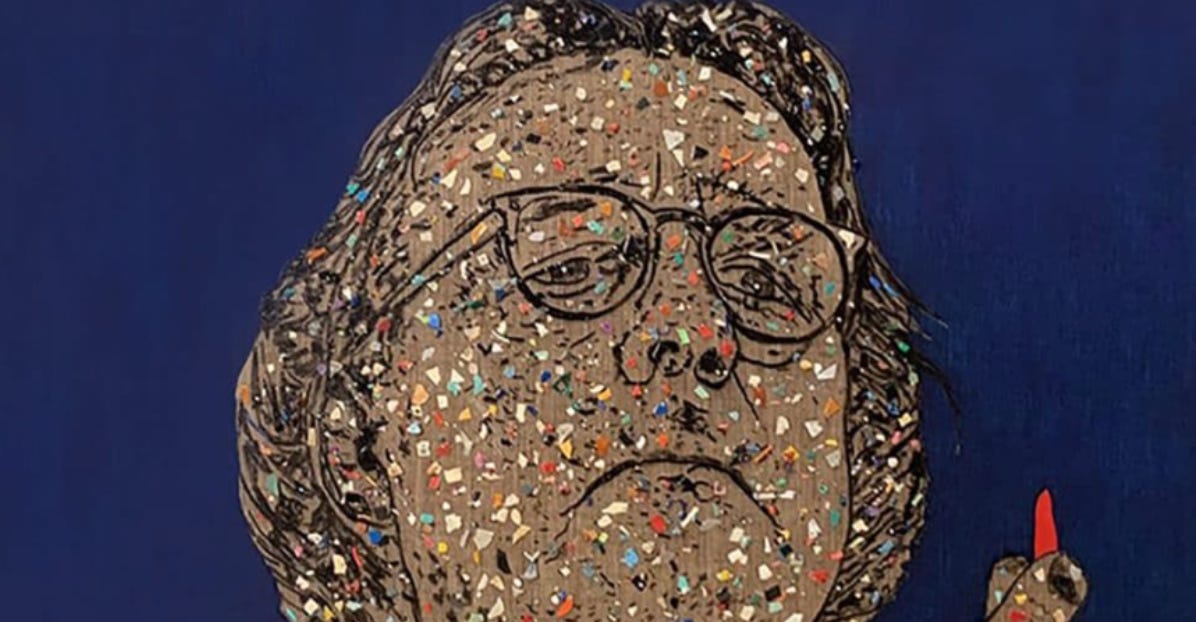
Thousands of years in the future, long after your body is dissolved, billions of microscopic particles in place of you will remain buried six feet down in a vaguely fetal shape. Because surely we can’t get away with this.
The hatefulness of a Holiday Inn faux wood headboard hums just below consciousness, and so you imagine the cursed textile shedding into our water, our blood, our brains. They say it’s in rain, salt, your dog, the carpet under your baby, bottled water, tap water, and spring water. One study suggested there’s just as many microplastics floating around in the air of the Amazon rainforest as there are in the middle of a city. Really now, how could that be?
Researcher Madeline Clough wondered if we really do consume around a credit card’s worth of plastic every week, or if there was just something wrong with the testing methods. She tested everything from the spray bottles to the very air in the lab to see if they were contaminating the results. No. Finally, she tested the nitrile gloves that nearly all the researchers use, and found that a substance to prevent them from sticking to molds had a profile that was nearly indistinguishable from polyethylene. To be clear, it wasn’t the plastic in the glove the tests were detecting, but a harmless salt with a similar signature to plastic.
So the entire microplastic media panic was plausibly built around this and similar false positives. For another example, they found that one particular lipid in the human body shows up falsely as microplastics when broken down by heat in the testing process. The particles of plastic you’ve heard about in your balls and brain could be just another artefact. One highly cited 2024 study suggests having more of it in your arteries causes more heart attacks, but they also used this same lipid method. Adding to the confusion are things like BPA chemicals on certain plastics which can leech off, especially when heated or scratched. These are often conflated with microplastics, but are chemical additives not tiny plastic particles. So maybe don’t put styrofoam in the microwave or eat your mechanical pencil.
It’s hard to figure out how much plastic is in our bodies and how dangerous it really is, actually. Clough’s findings call into question the mainstream panic, but exactly how much is unclear. If you Google it or ask AI, you’re going to be talked down to like you’re a bit dim. It’s maddening. More specifically, it’s bullshit. Frankfurt’s definition of “bullshit” is not exactly a lie, but is just indifferent to material facts.
The plastic panic, like the Satanic Panic in the 80s, refuses to see its devil as primarily a symbol. The symbol is mostly correct, but we should just flatly read it as a symbol and figure out what we actually mean: Plastics, like everything we touch, use, and own, take up meaningful space, not just physical space. Plastic is cheap, ugly, and disposable. Since we make sense of the world by our relationship to the things we put in it, we feel ourselves becoming cheap, uniform, and devitalized. That is to say, every object is stubbornly sacramental. They are visually meaningful, yes, but they also habituate our sense of ourselves. Everyday things like forks are transformed from potentially expensive family heirlooms to white plastic soon-to-be trash. They are one of many emblems that now inform us that it’s OK to eat quickly, without dignity, and alone.
It’s not even necessary that there be some sort of environmental disaster or that they radiate a chemical poison to explain the malaise that they imbue in us, although some of those might also pull the causal strings. Less than they’re saying, surely. More toward what matters, we treat ourselves like our objects: at best, shiny for a few years yet quick to be made ugly with sun damage and finally thrown away and put out of sight. Sent somewhere to some hideous landfill, some modern hades we can’t even imagine.
On some level, we intuit that those billions of pounds of undead dirt will one day pour into our great-grandchildren’s living room. By kicking that proverbial plastic bottle down the road to be dealt with by generations of our progeny, we feel less invigorated to procreate that Wall-E progeny. That is what we suggest to ourselves through our habituating objects: we don’t care about the future or the people in it. So, our biology, which is actually quite well attuned to the meaning of our environment of objects, will react accordingly: reduce our sex drive and shrink our testicles and lower our testosterone and blur our sex differences. Why not? From the perspective of the body, this is not rebellion, it is just acquiescence to a symbolic demand. It is the same reason you sweat during a horror movie.
It’s not only the physical plastic that attacks the reproductive parts, it’s that we’ve assigned our lack of fertility and resulting anxiety to plastic because it is the category defying substance of our age. Anthropologist Mary Douglas says what we define as “dirt” or “trash” isn’t really about chemical poison or hygiene, it’s about category violation. The headlines about microplastics are always about how it’s in the blood brain barrier, the breast milk, the balls, the placenta. It is only salient and scary insofar as it is undead material violating the sacred boundary into the organic and alive. You would never see a headline about how it’s found in, say, your clothes or your hair. You would not worry about “microcotton fibers” in your blood, because cotton does not violate the same categories of living/dead as plastic. We crave a modern Leviticus as a formal code to say which objects are clean/holy and which objects are dirty/degenerate.
When microplastics show up in our headlines as potentially infiltrating every nook and cranny of our biology and making us unwell, we click and share because a lot of plastic use violates our intuition about beauty, place, permanence, sacrament, and so we seek to punish it and ourselves. A plastic headboard made to look like local wood in a hotel room is deemed “unclean” to our collective body and rejected like old implants. Even if the science on that turns out to be iffy, the intuition is true. It is just a mismatch of meaning layers. We have trouble communicating on the meaning layer that I’m describing, so in lieu of that, we want the meaning layer of materialism to continue to conform to our intuitions even if it turns out it doesn’t quite.
It always seems to affect our genitals, doesn’t it? Disposable and hideous objects all happen to destroy our ability to create the future? hm… We’re not willing to pay for the more expensive and permanent things and therefore invest in the future, so that shortsightedness manifests in us as psychic, reproductive, and physical illnesses. The sort of illness tends to be revealingly symbolic. In response, we unconsciously and only half-heartedly attempt to encode that modern Leviticus because we don’t believe in the project of Leviticus as moderns. But we actually crave holy, blessed, and sacramental objects and rituals. We should allow ourselves to hate plastic just because it’s disgusting and not because science gives us a rationalization for what we already know is true about it.
The best thing that we can do is really not worry about plastic on the material level. Worry about beauty, plastic or not. Be grateful for IV tubes and PVC and be disgusted by lead painted plastic toys because you already are. If you make your life ugly and self-centered to avoid consuming microplastics, those cursed midichlorians, you inadvertently do their job for them, which is to make you sexless, lonely, and sick.
This is an EXCELLENT piece: thank you for all the layers you address with the kind of aplomb that instills confidence in the reader to listen to their own intuition—not fear—and live in pursuit of beauty rather than anxiety or reactivity to the ugly.
Fascinating... somehow this wasn't blasted as front-page news everywhere?