

An earlier draft of this (can’t stop editing, sorry) was published in Sword & Spade magazine where they also recently interviewed me in a podcast.
I was playing racquetball when my priest collapsed, saying, “My Achilles just went.” Most of the time, reality is drawn tight: you can’t stray very far from predictable behavior, and not much of what you do will survive in memory. This only gets worse with age. Occasionally, though, the veil pops open like the rupture of a tendon.
To tell you the truth, I feel partly responsible. I’ve been playing the game longer, and my wife watches us, so I really didn’t want him to beat me. This particular night, he won one game out of two. At that point, it was past nine, and all signs pointed to it being time to go home. Instead, I pushed him for two out of three. Two volleys later, he’s on the ground. Of course, this isn’t some hokey “everything happens for a reason” sort of thing. This is just one of those rare opportunities to see on the other side of the veil.
If you ever have the opportunity, I’ll be the one to tell you: drive to the ER, get a Powerade for everyone, then sit in that waiting room and watch Seth Meyers until one AM with the increasing number of injured and paranoid crackheads, no questions asked. It doesn’t matter how much work you have the next day or how tired or hungry you are. Mood and discomfort will quickly fade, and you aren’t often lucky enough to know you’re walking in a memory. Changes of fate only take place in places like these, so tread carefully. When you do finally look back, everything will be trapped in amber and on naked display. All the gripes, competitions, and bodily aches will be gone, and all that’s left is the evidence of who you chose to be and what you’re likely to continue to do. Your future self uses these memories as evidence of who you habitually will become.
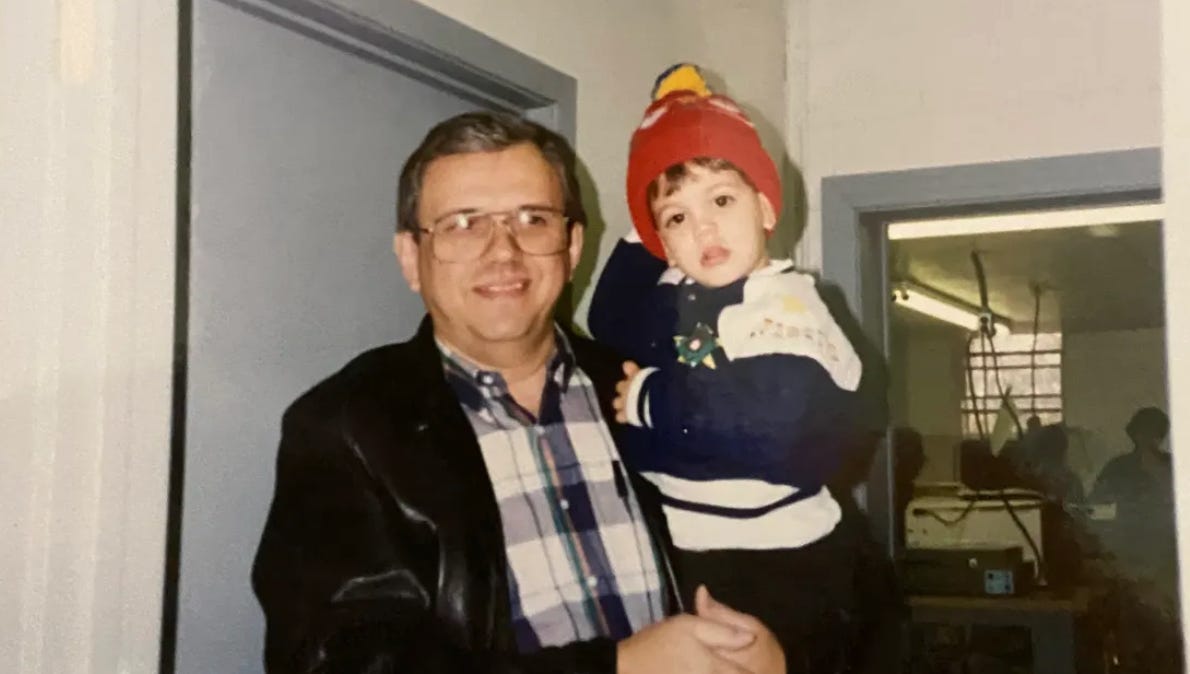
The mechanism of nostalgia is the motivation to know this in advance. I was lucky to know I was in a memory that night and acted accordingly. We had no idea that we were in such a golden memory in the cover photo. That is a picture of my father and me at our family convenience store in the 90’s, named “Buddy’s,” after my dad. It’s almost as if I could speak to them across the sheen between us: they are both still walking in my memory. I wish I could warn them what’s at stake: they will form the people looking back at them, thirty years on. If by some magic I could get back there, I would probably be in awe of all the artifacts that prove it is the 90’s: the hairstyles, the subtle differences in manufacturing materials, the way people talk, and what they talk about. Everything about then and there would be so helplessly 90’s, and yet no one else would have the perspective to even perceive that. Yet it wouldn’t look like the photo’s quintessentially “90s” quality, which tricks my memory into thinking back then was all hard shadows from plastic flashbulbs. It would look stark, new, and mundane, as things do right now. But Clarence would still be alive and flirting with the cashier. Francis’ cartoonishly shrill voice would be chattering over the sound of boiling grease. My mother would be in her office, clapping the calculator for payroll, my father and mother would still be together. If I were drawn through the sheen, I would be compelled beyond all reason to grab collars and shout cliches: Pay attention! It will all be over and gone so much faster than you think!
Nostalgia isn’t a simple yearning to be in the past. Nostalgia is the guilt that the past wasn’t appreciated until it was too late, and the hope that we can learn from that mistake to appreciate this moment now, before it too becomes unreachable. Everything we do and say now is helplessly defined by the fact that it’s the 2020s, like a smell we can’t even perceive on ourselves. We will only know exactly how and why it constrains us once we see it from out there. Nostalgia is best when it reminds us that we are walking in the memories of future minds who, thanks to their temporal distance, can love us better than we can. It is bad when we use it to withdraw even further because we can twist what the past could have been into a bunker to hide from the present. But we should not dwell on false projections. Turn your attention to the fact that you were walking in a memory now, calling to mind how your own child, looking at a photo of you in thirty years, would want you to do, be, and value. Nostalgia is the determination to do, be, and value the right things despite how you feel.
The future is always solidifying and then quickly dying, never to return. This unbearable torrent is happening every second you’re awake. What’s tempting about inappropriately wallowing in the past, in fact, is that the full potential of the future has already been played out and so is no longer liable to unexpectedly pop on you like a ligament. But most of the fears we habitually use to escape the demands of the present will never come to pass. Even the fears you have no control over, like the loss of family, you will eventually make peace with after appropriate grief. What will actually haunt you forever are the small decisions: to be honest or to lie, to be chaste or to cheat, to be present or to check out. Worry much more about those. If you make the wrong ones and then still refuse to notice when things eventually rupture, you will spend the rest of your life wishing you could step through an old photo and do it again.
What’s strange is that what broke open the veil that night was the small choice to twist the knife: not wanting to lose even once in front of my wife. That opened up for me a different choice, and maybe anyone would have bought Powerades and watched Seth with the junkies. What mattered was I knew that I was in a memory, so I’ll never yearn to go back and do it again.
Lovely piece
Thank you for saying "a picture of my father and me" instead of "a picture of my father and I". I hate when people over-correct and use "I" when it's grammatically incorrect.
I had an ER event with my wife last week, and I knew exactly what you knew here: nothing matters except the fact that I am here, being a one-day-remembered version of myself, and I should act accordingly. ER visits are evidence of who you are, as are many (all) difficult situations.