

The movie opens with the rapper Travis Scott as an ancient Greek bard, standing on the dinner table.
Already, we’re either pleased or annoyed. If you’re one sort of person, you’ll think the parallel of rappers to rhapsodes is a smart one, if not a little on the nose. But you’ll nod lightly; at least it’s an interesting choice. If you’re a different sort of person, you’ll be pissed about the “historical inaccuracy” and mad that Hollywood is trying to shove some pandering diversity down your throats instead of focusing on telling a good story.
Nolan knows all that. He’s intentionally evoked those frames of mind because he wants to do something with them. What that is, Travis Scott helpfully bangs his staff and says plainly: “A face, a fleet, a war, a man, a thought, a trick.”
If you want to know what a film is going to try to tell you, you can just pay attention to the first few lines. Often, they will just straight up tell you. The first line of The Godfather is “I believe in America,” which is the entire Corleone tragedy in one sentence.
This movie is going to be a trick.
The trick
The icon of that trick appears in the next frame. The Trojan horse, half sunk in the sand and waves. Nolan said this was the first image he saw when he considered making this movie, and has carried it with him for a long time.
From that image we go straight to Page as a male soldier, which is probably the most contentious bit of apparently “woke” casting. But remember: we’ve already been told this movie is a trick. And we just saw the most iconic symbol for a trick of all time. Trojans approach the horse. Page’s character runs to tell them it’s a gift, but is still killed by their arrows. Because Odysseus lied about his being a trick, the Trojans believe it is a genuine gift, and so take it into their city. With it, the trickster Odysseus, spelling their loss of the Trojan war.
Later, Odysseus sails into Hades — hell, as he explicitly calls it — where he meets Sinon, Page’s character. In a remarkable bit of acting, covered in mud, crawling out of the chaos of hell, Sinon looks at Odysseus and asks, of the Trojan horse being a trick and not a real gift: “Why didn’t you tell me it was a lie?” To which Odysseus says: “Because I needed you to believe it.”
I actually got emotional at this point. A quick aside: Nolan is very private about what he believes. It creates a mystique around his films, so we can’t reduce them to propositions, which he himself may not even fully understand or want anyone to explicitly know. Unlike when I was younger and dumber, there are things I now believe that I also wouldn’t artlessly say in mixed company. So, what I’m going to suggest he “actually” meant is speculation, and to some extent, projection. That’s what movies are meant to make us do. They reveal things about ourselves, and about their creators, beyond what either of us could say we believe. If they were fully reducible to propositional facts, there would be no reason to make them.
I sense Nolan was in the guise of his trickster Odysseus in this Hades scene, saying to Page the actor: I used you as a Trojan horse to pull a trick-on-the-trick on my audience. I’m sorry. The original trick, of course, is the belief that our individual identity is what is most important about us, above our responsibilities to others. Nolan’s trick lures in modern identity politics from both sides.
It might have been more noble, more courageous for Nolan to tell Page this straight out. Hence the heartbreaking post-mortem “Why didn’t you tell me it was a lie?” His answer is simply that if you hadn’t really believed it, they would have caught on to the game. We would have caught on to the game. The trick wouldn’t have worked.
Nolan has made himself into a trickster to win a larger culture war, but he feels he broke something sacred.
Zeus’s law
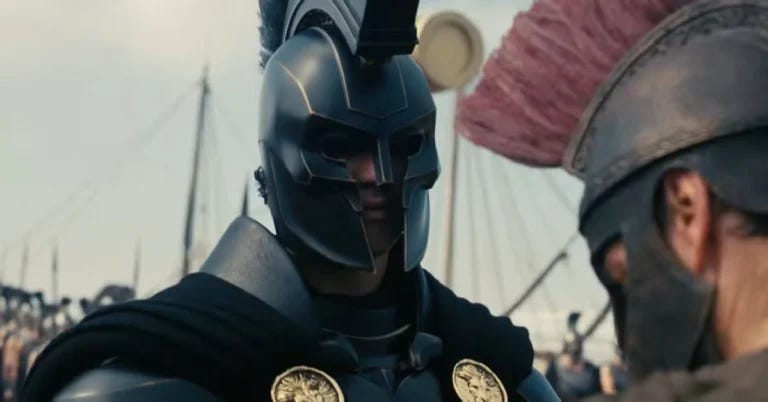
That Nolan’s next film be a blockbuster is demanded by his massive career. So his king Agamemnon is anachronistically armored as this hulking, Batman-like figure. Nolan’s career is itself well-characterized by the similar-looking monster of The Dark Knight, which now looms dominant over even Nolan himself. For both him and Odysseus, this crusade is a command.
Odysseus is forced away from his home in Ithaca, away from Penelope. There is no honorable reason for Odysseus to leave his family to fight this war, but he still must. Since he is the most clever, he will think of a way to win it. So, he comes up with the Trojan Horse. Fittingly, Nolan himself implants the horse into this story (which is not in the original text) from other post-Greek texts. It is a gift taken into the home of the Trojans that betrays their trust by disgorging killers. Symbolically, it is also the epitome of undermining of Zeus’s law.
The law: If you have a guest, a visitor, you must be hospitable, because that person could be a god in disguise. The law binds the guest, too: to betray the welcome you’ve been given is a perhaps worse sacrilege. Hospitality was indeed important to the ancient Greeks, but the movie takes it more seriously as if it is an inkling of the Christian idea that everyone is a child of God. Zeus’s law allowed ancient Greece to be as powerful and prosperous as it was because it fosters trust. Break Zeus’s law, you plant the seed of civilizational collapse.
When we sit down in a dark movie theater, we are passive and open and trust the director to tell us an edifying story. Nolan realizes the only way to make a movie more financially successful than anything in his career so far is to bait the moviegoers. The movie’s casting is itself Odysseus’s Trojan horse, and we are the Trojans.
Look, every single one of Nolan’s films has been layers upon layers of meta-frameworks that often have reached out through the screen itself. That he might take this to a new extreme with The Odyssey is not a surprise. Actually, that he would suddenly make a flat summer blockbuster without those layers is implausible. And that this time his Trojan Horse would be so subtle that he cannot even explicitly comment on it or even tell his actors what he is up to is impressive, but only a half-step more complex than what he has already known to attempt.
He’s at least a good magician, as evidenced by the apparently magical cultural impact of his career.
Apparent magic
The very first words that appear on screen: “A time of apparent magic…” Along with Travis Scott’s opening line, these are words to keep in mind, because the entire first part of the movie is notably more enchanted and pagan than the second half.
It’s dreamlike and brutally unremorseful about murder and rape. Only later do we realize Nolan’s unique twist as to why: For the first half of the movie, Odysseus is actually on Calypso’s island, eating intoxicating lotus flowers. The only way modern minds could possibly get in the head of a pre-Christian is to imagine taking a psychedelic. Thus, the highly mythical elements — the Cyclops, the giants, and the witch — maybe partly are only the memory of his addled mind. Unlike the source material, the film outgrows that consciousness within its own arc, ballooning all the way to something anachronistically modern by the end.
In one of the early episodes, his men enter the Cyclops’s cave and Odysseus assumes they’ll be welcomed and fed. His men say they should be careful. Odysseus says: they have to feed us, it’s Zeus’s law. His right-hand man says: I don’t think these people are going to know about Zeus’s law. Or Zeus. And Odysseus: everybody knows about Zeus’s law. We learn only later that here Odysseus is in denial about the subversion he has wrought in Troy. He still wants to assume trust in the world; he doesn’t yet see the civilizational collapse his own actions planted the seeds of.
Island by island, magical betrayals of hospitality are played out against them. The audience sees them coming from a mile away. But it’s not like they can go back to the world before the trick: once everyone realizes guests can be killers, the possibility for trust in a pre-Christian consciousness altogether dissolves into a nightmare. By the time Odysseus gets to Calypso, his men are dead and he wants to forget it. He stays with Calypso for seven years, unable to face what he’s done.
We watch him slowly begin to want to remember as we experience the first half of the movie through him. Calypso tries to soothe. He realizes he has to go home. He stops taking the lotus. The only way off the island is to totally submit himself to the power of the gods and take his punishment. Calypso says this explicitly. The suggestion here is that the only way out of the now endless cycles of violence is either the development of a sort of Christian consciousness or mutual death.
He builds a small raft from the remains of his ships, lays on it as if crucified, and crosses the ocean, finally without defiance. All the glory of war and rage of Achilles that was at the center of the original Homer is fully washed away. Nolan’s Odysseus is a different character from Homer’s or even Dante’s from here out. He submits himself to Poseidon, the one who hates him for killing his son, the Cyclops. To redeem himself, Odysseus must submit himself totally to that non-being, to death, to the loss of control, and merely have faith that he will be carried home.
From this point of the film onward, we’ve woken up from the spell of the lotus flower, too. Our pre-Christian consciousness has been taken out of the apparent magic of the tribal, enchanted world and into the more rational world of post-Christian consciousness, carried across by the symbol of Odysseus crucified on the ocean.
The return of the king
The second most powerful moment of the film for me: the dog.
When Odysseus returns, his old dog has been tossing in a dung heap, having lived twenty-plus years waiting for his master’s return. We saw earlier that this dog as a puppy was about to be thrown off a cliff for not being fit enough. Odysseus rescued him. This is both a glimpse of the brutality of the ancient world, and a glimmer, through Odysseus himself, of the now normal Christian idea that the meek will inherit the earth.
The moment the returned king lays a hand on him, his tail wags in joy and celebration, in recognition, and then he dies. That is also the moment his son recognizes the disguised beggar as his father.
Together, they kill all the suitors in the house. In the original text, the violence ends only because Athena asked Zeus to stop Odysseus mid-pursuit with a thunderbolt. Mercy arrives as a divine imposition, itself a glimmer of a divine cycle-of-violence ending act later fulfilled by Christ. In Nolan’s version, Odysseus kills all the guests in his house. But he is careful to not allow his son to do the same, keeping him pure of the sin of subversion. In this way, he does yet another trick. But this time he makes himself the sacrifice instead of Sinon. He literally lives long enough to see himself become the villain. So he is banished. Penelope and Odysseus have to leave Ithaca and head to the unknown West. They leave their son to be the sinless king.
We know what’s in that unknown West, even if Odysseus doesn’t. America is the most westerly place you can get. It is the end of the world, the eschaton. We know that if we fail here, we have nowhere westward left to run. This audience-character-knowledge mismatch implies that this is a movie is fundamentally in favor of the return of a rightful order, if possible. It’s a Christian film, even if only accidentally, because when Odysseus wakes from his lotus stupor and realizes what he’s done, the film projects backwards onto the Odyssey a realized Christian morality. There we see revealed a new regret over the slaughter at Troy, which is nowhere to be found in the ancient text. Nolan reads it into the story himself, as if to intentionally say: now that we’ve woken up to this, we cannot go back to a pagan thirst for glory unless you are willing to pay with your life and everyone you love.
For this to work, victory can’t be won for your race, your class, your identity. So it can’t be that white people are particularly evil, or that other groups are particularly victimized or innocent. It is also pointedly against the woke right, who see global-village-style diversity casting as symbolically the fall of the traditionally white West and something to rage against. This all plays out in Nolan’s casting: Pattinson is the beautiful boy, big jaw, the natural heir. He denies his responsibility of his lot and wants the kingdom on the strength of his identity. He is willing to play tricks to take it. He admires Odysseus for the wrong reasons. Sinon is his mirror: marginal, meek, misguided, but willing to sacrifice to do the right thing for others. The film suggests the second is braver than the first, but both are wrong about what their identity means.
We cannot be defined by the particulars of our individual identity. That is too dangerously atomizing. We are better defined by our adherence to laws greater than ourselves: hospitality, truth, self-sacrifice. We know this. We’re just so damn tired of hearing these things in our stories. But it just seems to be the case that there is nothing further west of them. There is no better story to tell. To undo them out of boredom is merely to return to a brutality and division, which we can no longer even imagine in the modern world.
Apparent modernity
There are elements that feel modern enough to perhaps just be a mistake. Nolan’s films will often sacrifice believable emotions and characters for a high concept like I laid out above.
It was, for example, a little clunky that Matt Damon’s Odysseus would want to tie himself to the mast to hear the sirens, based on everything we’d learned of the character up to that point. I did, however, still find the siren scene compelling as a warning about what endless pleasure offers us and how it distracts us from our responsibility to return home. “It told you that what you most want is what you can’t have. And what you most can’t have is what you already had, and lost.”
It is kind of like what he did with The Dark Knight, making Batman less a mystical figure and more technologically explained, e.g. “What if you could functionally explain myths?” However, the first half of the movie is genuinely a mystical experience, done extremely well with beautiful practical effects. It does move toward mechanical by the end, but I think that works thematically, while still granting that Nolan’s rationalistic approach can be a little sterile.
The casting decisions were generally good, both as meta-commentary on woke and anti-woke, and because each of the apparently too-modern cosmopolitan Trojan-horse castings did a particularly good job. Page was fantastic. The Helen of Troy casting was another meant to spark outrage, but within the mythos of the movie it made perfect sense to me: an undeniably beautiful and symmetrical woman. Just not in an Aryan-white-goddess way. Clever bait by Nolan.
I’m sure I’ve missed a lot in my reading. People will unfold this more and more as time goes along. But it captured my imagination and evoked something in me; about my home and my wife. A reminder that we each have a duty to pay the price for our particular sins, submit to death, and go home as a king.
We’re racing into a post-literate age of global media. Local accents are going away, and pretty much everyone in the world is at least 35% American in their disposition. It is in many ways a resubmerging into a more tribal, ancient way of apprehending the world. But this time around, in what Walter Ong described as secondary orality, the entire global multimedia apparatus is the village. We’re a global tribe now, which means it is one big house, and a house divided cannot stand. Worse, our village is extremely susceptible to Trojan horses: betrayals of our trust, marketing, packaging, bullshit, ideology. This film is a double inversion of all that, a trick-on-the-trick. It wants to warn us how fragile our huge shared reality is, but it also may hurry the doomed by being the apotheosis of that trick.
Or it could wake us up to the hard fact that we are all ultimately bound to the same Natural Law which is the now oh-so-obvious Christian morality. It is even more vital in this global village, in fact. No matter how somebody says they identify, no matter what tribal, political bubble or echo chamber they belong to, we should treat them like they belong to us.
Because that person is a Child of God in disguise.
Good essay. The ultimate 'trick on the trick' is Christ dying to kill death, which makes Nolan's reinterpretation more obviously Christian, even if he didn't specifically intend this.
The Trojan War began, as well as ended, with a violation of Zeus's Law: when Paris stole his host's wife.