

I sometimes imagine George Lucas, back in the 70’s, stumbling across Joseph Campbell’s “Hero’s Journey,” glowing gold and cherubim choirs like the Ark of the Covenant.
He connected some cosmic thread and a wicked idea possessed his mind: If these shapes are the fundamental emotional grammar of the human soul, you could use them to make a lot of money in Hollywood, which currently has to rely on old-fashioned, intuitive, and unreliable storytelling geniuses like Kubrick.
Lucas did end up using that famous circle to write a brand new kind of story - not from the depths of his loins, but by an explicit theory that approximates the shape of a universal narrative, discovered over the course of thousands of years of storytelling with blood and bone, only recently distilled by Jung and then Campbell.
That’s how we got the face-melting near-new-religion: Star Wars, the most legible myth in human history.
Contrast that image with Sly Stallone, the illegible man - in his thirties by this point and a struggling actor. He had to be scooped out of his mother’s birth canal, which paralyzed half of his face. This resulted in him seeming wooden and inexpressive and having a drunk-sounding slur.
Obviously, no one wanted to hire him.
A lot of people think that means he wasn’t good-looking enough. That’s not it. We just use the shorthand of “good-looking” or maybe “striking” as a stand-in for what we mean to say when we’re trying to say that most people are non-legibly layered in their constitutions, making them hard to categorize right away - what you might call an “acquired taste.” And that’s fine for real life, but the most useful quality for a successful actor to have is not to be an acquired taste. Actors usually need to be extremely legible in their physiognomy. That often does mean “good-looking” but not necessarily. Paul Giamatti is extremely legible, but not handsome. Tom Cruise is both handsome and legible.
Sylvester Stallone, bless him, is neither very handsome (at least, not at first glance - with his sad, droopy eyes and half-paralyzed face) nor legible.
At the same time, Hollywood entered its apocalypse and the sprawling, experimental films of the 70’s came to an end with the advent of the “Hero’s Journey” blockbuster, created and then mastered by Spielberg and Lucas. Casting similarly shifted toward extremely legible faces, which make them feel like beloved old friends the moment you sit down with your popcorn.
Stallone wasn’t invited to the party. They didn’t want his mug, they wanted Harrison Ford’s. Everything, including his friends, is telling Stallone to quit.
Instead, Stallone enters his life’s great montage. He goes to the theater every single day and he writes out, by hand, the entire script. Late into the night, he writes and re-writes Rocky. He believes, by some intuition, that he can soak the essences of the greatest stories into his bones and make something great. It’s all he does during his waking hours.
It’s important to note that he isn’t doing what Lucas did. He’s not studying the circle graph and retroactively reconstructing something legible and abstract. He couldn’t win at that game if he lived ten lifetimes. No, he is becoming like a storyteller of old - blood and bone. He’s like John Henry, trying to out-dig the digging machines.
Like a great athlete, he is becoming a master of the domain not with declarative knowledge, but in an embodied sense. It is fluidly woven into his form, and that allows him a fluency of inspiration that can’t be reproduced by formula or legibility. And that metaphor, maybe, is why he cast himself as an athlete. A boxer, who is otherwise in the same position in life - a nobody.
The man he writes for Rocky to fight is Apollo, who is the “lean mean fighting machine.” Unlike Stallone or Rocky, he was built for this from birth. He is legible. He is the new Hollywood, unstoppable and unmoved by the complicated dreams of illegible nobodies.
During Carl Weather’s table read as Apollo, he said to Stallone, “Man, get somebody who can at least act!” That’s when Stallone knew he was looking at Apollo. He wanted someone who he genuinely felt he couldn’t win against, in any sense.
Finally, a victory: according to studios, Stallone had written a truly great and original script in Rocky. They had the perfect cast, too, except for one small issue: Stallone. They offered him a large sum of money, provided he wouldn’t act in it. Despite having not enough money to feed both himself and his dog, he said no.
A lot of people think this is a story of believing in yourself, but that’s not it.
The genius of the script is precisely that you can’t stick Harrison Ford in the role and expect it to work because, for example, Rocky has an extremely long first act. You need plenty of time watching Stallone “Save the Cat” before you get used to him. This script makes no sense with an actor like Ford because you don’t need that long to fall in love with his legible face. That’s just an obvious example - a million little intuitive moves like this mean the script is Stallone. If he gave the part up, for any amount of money, it would be a mistake. This script was punched into existence with his own bloody knuckles. Stallone realizes this, even if he doesn’t have the words to express it.
That’s OK, because sacrifice is better than words. In order to make ends meet without money from the script, he sells his beloved dog.
And finally, he gets to be the star of a movie.
Rocky opens on a stucco image of Christ with the word resurrection written below.
We pan down to see Rocky boxing a guy much older and fatter than him. They are in an old church. It’s staged like a cock fight, with people shouting and throwing money. There, in the first few seconds, we have the whole story.
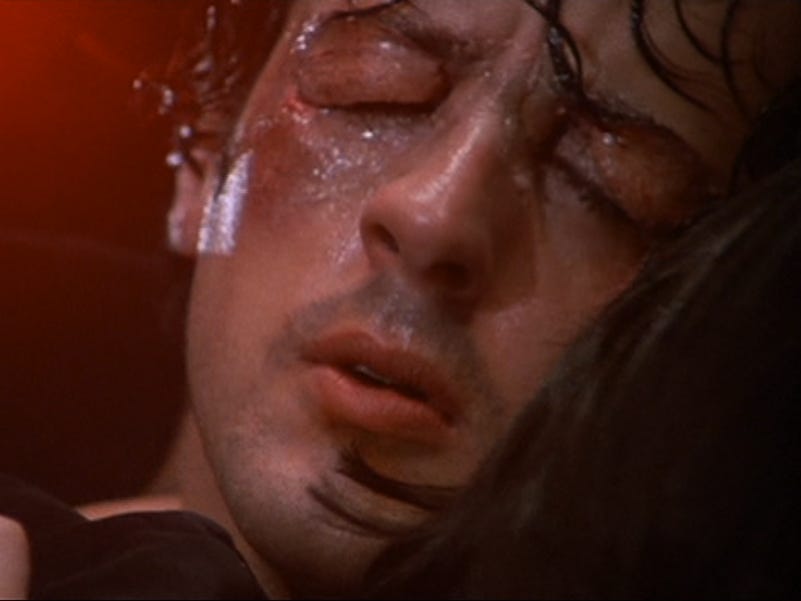
Rocky wins, but barely. It’s not even close to enough for him to get by, and his face is wrecked.
He is, in his own words, nothin’ but a bum. He is only qualified to be a thug for a low-rent loan-shark. He’s too sweet though, and can’t bring himself to break some thumbs even when it “hurts his boss’ reputation.” He wanders around Philly, bouncing his rubber ball. He is deeply a man of place - this city and the people here are in his blood and bones.
The other characters are not immediately lovable or legible, either. In fact, they are ugly, foreign, and untrustworthy. His love interest is called “retarded” and we aren’t made to believe otherwise right away. Her brother and Rocky’s friend, Paulie, is a drunk and actual bum, who’s not even qualified to be a thug. Still, we see Rocky love them the best he can anyway, and so we start to love them too.
Stallone writes for Rocky like no screenwriter ever could - mumbling and jabbering about his turtles to hide the fact that he, and Stallone himself, deeply want to be understood and yet is hopelessly illegible, even to people he loves. His speech patterns are working-class, true-to-life, and extremely lived-in. They have none of that snappy hyper-reality of more abstract writers like Lucas. It feels real, so audiences assume it is real. Most people have no idea of how difficult organic dialogue like that is to achieve. But a master can make it look effortless - even humble.
That is, until Apollo finally appears. He talks fast and he talks wise. His words rhyme and rise as if pre-devised. He sounds like Muhammad Ali. He sounds like Hollywood.
He wants to do a great big event. He knows that for it to be successful, it has to be legible, like himself. What is the most legible story to most Americans? The underdog story. So, Apollo will pick some low-rent boxer and give him his chance to win the national title. Of course, it’s all just for show - no one like Rocky really has a chance of beating Apollo.
How does he pick his man? Blindly, from a list of names and stats: the 31-year-old southpaw from Philly. He liked his nickname, “The Italian Stallion.” It is legible. We as the audience know that no one calls Rocky that, we’ve just seen it on his old robes. This connection with Apollo is not the real Rocky, but maybe some flight of swagger from long ago.
Rocky initially can’t understand or believe the offer. He’s almost aged out by now. No one ever believed in him when it counted. Why now? When his old coach, Mickey, comes hat in hand, hoping to train him for the big fight, Rocky lets all that out. If he has so much “potential,” where was everyone when he was still young enough to make something of himself? You can feel Stallone’s real hurt here. It’s a masterfully acted scene.
The coach has no defense, except to imply that the world has abandoned him, too. His prime was decades ago, and people don’t even remember him now. Rocky is unmoved. Mickey goes to leave, in the cold. At the last moment, Rocky comes out, puts an arm around him, and brings him back inside. It might be true that Rocky slipped through the cracks, but he has the chance now to not do the same to Mickey.
The fight is on.
Stallone and Rocky superimpose on each other here, each training for their life, neither knowing if they can go the distance. For Stallone, if this movie will compete with the mega-blockbusters, and Rocky, if he can even last one round with the lean, mean, fighting machine.
Rocky’s training is not like Apollo’s, just like Stallone’s was not like Lucas’. Rocky drinks raw eggs; Apollo drinks a protein smoothie. Rocky runs through Philly at the crack of dawn; Apollo on a treadmill in a windowless room. Rocky literally beats raw, hanging meat at Paulie’s butcher job. When Rocky is shown on the news, fists bloody, Apollo’s groupie tries to warn him: “This guy seems for real.” Apollo doesn’t even look at the screen.
Apollo’s great weakness is the same as Hollywood’s: they are blinded by their great power and so they cannot see dirty embodied reality. But as the Spoon song goes, “You got no fear of the underdog / that’s why you will not survive.”
But, the hard truth is, you can’t beat Hollywood any more than you could tap out the Statue of Liberty. Rocky can’t beat Apollo. They are not in the same universe. Apollo is literally a god. Rocky, in bed with Adrian, realizes it: he can’t win.
But, still, he doesn’t want to live his whole life as a bum. This means to not, on some level, resentfully half-assing it because he feels slighted by his place in the world. He doesn’t need to win, he just needs to go the distance. To fight, all out, for the blood and guts people who bother to be around.
Rocky sprints now, score swelling. The whole cosmos is at his back like a great wave of spirits. He is able to run even faster still! He climbs up the stairs, taking two at a time and makes it to the top, arms extended for that now-famous pose. He cannot lose.
Apollo and Rocky prepare for the big fight. Apollo is anointed with oil, assured by groupies that he is the greatest. Rocky gets down on his knees to pray in his baggy robes in front of a public bathroom sink.
Rocky gets his head beat in, but importantly, is able to get off hits to Apollo’s undefended body. The themes work all the way down. About halfway through, Apollo finally realizes who the hell this is. This isn’t “The Italian Stallion.” This is Rocky. Despite getting his already illegible face pulverized, he won’t stop. “He thinks this is a real fight…”
When he breaks Apollo’s rib, Apollo grabs him and says, “There ain’t gonna be a rematch.” Meaning, “You think you can come up in here and spill your guts all over my stage?”
“Don’t want one,” says Rocky.
Rocky almost gets knocked out, but manages to get back up again. And again, until the final bell rings. The audience swarms the ring. Through the chaos we can barely catch: Apollo wins.
It doesn’t matter. Rocky lasted in the impossible fight. A human man, made of blood and meat, stood up to the great machine.
He calls for Adrian. She pushes through the shouting reporters. He screams her name, ignoring the microphones. They unite, victorious.
Fade to black.
When the movie premiered, people stood and cheered when Rocky landed punches on Apollo, as if it were a real boxing match. It was so loud, you could hear it across the street from the theater. It’s not legible, but it is palpable.
The truth of Rocky, if you didn’t already believe it, simultaneously happened through Stallone, who finally made himself one of the world’s most successful actors, despite his illegibility. Stallone was resurrected, for real, through the character of Rocky. He was even able to buy his dog back.
We may not be able to beat the great legibility machines of our time - bureaucracy, AI, whatever - but maybe if we can forgive the world for abandoning us, we can at least not be a bum and go the distance for the knuckleheads and freaks we happen to love.
Rocky is the best movie, for no other reason than because I believe in Rocky.
Perfect, but you skipped over my absolute favorite moment of the film. Adrian sneaks into the ring and, before they kiss, he asks, “Where’s your hat?!” Through swollen mostly closed eyes, rendered near useless from having GONE THE DISTANCE with Creed, he still sees her and notices that her hat has fallen off.
Your recapitulation of this film made me cry as it delivered and amplified its original impact on me. Thank you for bringing it back into my attention. I was 15 years old when it was released and it injected the spirit of my youth with rocket fuel. I happened to visit Philly just a few months later as a young actor in my first touring experience. Me and a few cast mates ran up those steps to throw our fists in the air. You capture how Rocky isn't really a story at all. It's the root of us laid real and bare and raw. Truly extraordinary.