

Arcade Fire in a rental car and a sunrise somewhere over Peoria - unnatural American flatness but still glorious.
I parked at a rural hospital, which reacts to my presence as if it only even expected to be visited by the local elderly. How strange, I also feel, that it would know the likes of me.
I’m wearing a polyester polo shirt with my company’s logo stitched to the breast, and a pair of wing tips originally bought for my brother’s funeral. They have salt water stains from walking in briny snow on a different business trip to Kentucky. A messenger bag hanging across my chest has a small computer and some dongles to hook up to conference room projectors, if the need should arise. I am nervous, but well rehearsed. Tired, but extremely caffeinated.
I walk down some God-forsaken linoleum hallway that looks like every other God-forsaken linoleum hallway in every half-forgotten hospital from Springfield to Miami. The lady behind the front desk has already pointed me toward the administrator’s office, perhaps not getting enough salespeople coming this way to have defenses, and maybe assuming I’m his nephew or something because I do look about fifteen.
Really, I’m twenty-two. This is my first job out of college. I need to find the office while not letting the existential void swallow me up. It is almost all I can manage, by the way, to not always be overwhelmed by what always seems to be shrieking bloody murder from these ordinary places.
The office door is already open, dimly lit inside. Behind a desk is one of those massive middle-aged corn-fed midwesterners: loud and big teeth. He asks who I am. I tell him I’m a salesman. He asks what for. I tell him about the software. He’s happy with what they’ve got.
Now is the moment that human social rules demand that you drop the issue and move on. However, the job of a salesman - the real labor that he performs when you get down to it - is to break these rules. Not carelessly - any street huckster can do that. Rather, with artful bullying. A playful attack with just enough plausible deniability to maintain goodwill.
My CEO, himself not a natural at sales, believes in me and so has paid for my executive sales training. I know what to do next, in theory. But the giant already has the upper hand. I try the ol’ one-two: Of course you’re happy, sir. I’ll be leaving now. But… hang on, I have just one question, you know, out of curiosity… I ask about his day-to-day life with his current software. I’m hoping he will reveal what we in sales call a “pain point.” See, you want to find their pain, like a playground bully, and then twist the tender arm with a jocular spirit that somehow feels like a win-win-win.
Horrifically, he answers with practiced avoidance. I’m very nervous now, visibly running through contingency plans in my head, standing there awkwardly, saying nothing in his doorway. “Kid,” he says, “I used to do sales. Come sit down and show me what you got.” By the time we finished talking, we shook hands.
Once I got back to the office and emailed him for the first payment, he dropped off the face of the earth. I never did land that sale, despite months of following up. Nobody, I now soberly realize, spends money (much less a hospital’s budget) for some kid with a touch of chutzpah, especially once I leave and his own stresses foreground again. How would he explain having to pay for and then train his entire staff on a new software? a kid in which he saw a little of himself walked in? I don’t think so. So he ghosts me. I can see now that it was the right move.
Real sales requires you to do no less than to put the fear of God in strangers. Any pity evoked is total failure. When you leave, they must continue to believe that the absence your product will result in something bad happening to them. In order to create what we call “urgency,” this belief must be total and trusting, as if it was incepted into their dreams and they just woke up and there you are, wise sage, to guide them through their stupor.
All this, keep in mind, despite a world increasingly wise to the tricks of salespeople and therefore extremely unlikely to allow them to manhandle their frames of mind. With that growing hostility, traveling salesmen have become a shrinking elite, if not a dying breed, with more and more money going toward the more subliminal warfare of the marketing and advertising departments.
As if that isn’t enough, sales training is useless - probably worse than - because what makes a salesman effective is total ontological violence, and they can’t seem to bring themselves to put that in the sales workshop powerpoints. Without being an etiquette berserker - either by natural temperament, mentorship by an actual master of sales, or being a blind zealot for your product - you are doomed to fail. The lexicon gestures at this implied warfare: “pain points,” “pressure,” “urgency,” “crush it,” and so on. Explicit sales training, though, won’t outright say by what forces it actually succeeds, and therefore fails to do anything but occupy the time of weak salespeople who don’t have the killer instinct. Worse, if you are silly enough to outright ask, you will get the opposite of good advice: “be kind,” “emotional intelligence is key,” “people buy from people they have a real relationship with,” etc.
This accounts for the fact that good sales teams are the last to be fired and great salesmen often rise to the dictatorial seat of CEO. The implicit rules here are the same as war: If you can prove your courage down in the trenches, you gain honor and valor and even earn the right to give orders.
The entire ecosystem of commerce depends on its violence being unspoken, and so is very difficult to understand as a naive inquirer. Fundamentally, everything that you now pay for has been somewhere along the way “sold” to you by a salesman who has simultaneously made you believe, to this day, that it was your idea. This false sense of agency mixed with the semi-conscious fear of what happens if you can’t afford it gives you a strange double-sense of “I need this thing that used to not know about,” which resists questioning with incredible calcicity. Nobody really “needs” their stuff in a strict sense, but because we fear what losing it would mean for our “identity,” we all work together to uphold the network of lies crafted by a culture of ad men.
This is why we think we hate salesmen. Really, we just hate bad salesmen who make us feel pain and we too easily identify them as the source. Perhaps they also subconsciously remind us that more successful salesmen have sold us.
There are, of course, people of genuine goodwill in the mix. Some of them even make a good living. This line is blurred further, too, because the more sophisticated sales becomes, the more closely it imitates genuine goodwill. As if along a logarithmic curve, it never fully contacts goodwill because someone’s gotta cash out eventually. In fact, the first of the 48 Laws of Power is to (pretend) to be humble and never make anyone feel stupid, and the rest of the laws are similar injunctions to imitate trust for as long as humanly possible until it is time to strike. This does not erase the fact of spiritual warfare, but just makes it more sophisticated. I’m also not saying, to be very clear, that winning battles is bad, except perhaps insofar as it the rules are non-explicit and therefore confusing to people like me.
The understandable reason it is all verboten, though, is because the atomic bomb forced a sublimation of violence just last century. If you want to know where the soldier phenotype went once the bomb made overt warfare a mutual death sentence, they have been consumed and channeled into sales and advertising departments. This is what the entire show “Mad Men” is about, specifically the early days of this transition, and why Don Draper was a soldier in the war who changed his name (to hide his true nature as a failed killer). Their inherent and inexorable double nature, built on the foundation of a necessary lie, is what makes them “Mad Men.”
My dread of the linoleum hallways was really the sublimated dread of this warzone, made even more terrifying by the fact its invisible violence kills millions by bleeding out their meaning. We don’t even know we are in a warzone, and it’s not just because there are no bullet holes in the cinderblock and sheetrock. It’s because pointing out the emperor has no clothes may destroy your only chances of paying the bills.
What actually bothers us about the frantic cordiality is that we all sense in our reptile brains that there is some deeply vicious pagan underbelly. We easily roll our eyes at the doublethink of a vague concern for our “mental health,” but don’t dare to fully dismantle the facade. If we stopped satisfying it with abstract violence, it would come out demanding physical violence again.
I sensed this back then, but that very sensitivity made me not a killer. It also now seems germane that all the salesguys on my team who were successful were literally gigantic - three-hundred-pound ex-football players with a voice like a hammer. This was the ancient morphology of a soldier in a polyester polo. I was a David to these corn-fed midwestern Goliaths. My intuition was that sometimes David wins. What David had that I didn’t have was clear vision and the will to kill. I was just outmatched in a strange land. I grew resentful as this continued not working.
The one nice thing about not winning is that it gives you time and distance to step out of the fray and see just what forces are at play. This presents another danger, though, and probably one worse than the first.
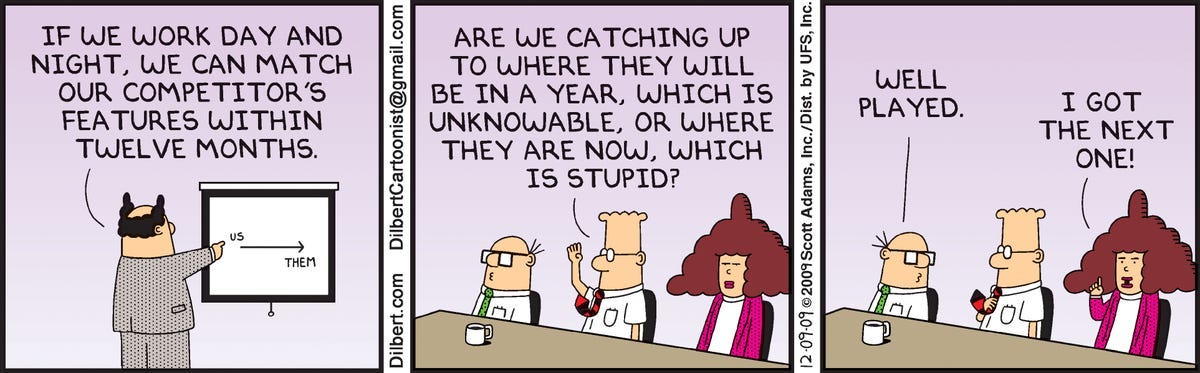
Scott Adams, creator of the comic strip Dilbert, represents this very common re-frame. His character Dilbert is a self-insert: an engineer and highly logical and perceptive in a sort of non-intuitive way. Although my personal source of abstraction is writing, the effect is basically the same: Dilbert, like me, is constantly rebuffed for his rational and earnest straightforwardness. His much “stupider” bosses and colleagues (in the unflattering way Adams characterizes them) get raises and promotions while Dilbert is left in the low-middle.
Adams, like me, was sensitive to doublethink of the corporate world, mostly because he, like me, had no talent for it. Instead of realizing he was bad at the game, he made an entire comic strip about why the game itself is stupid for not recognizing or rewarding his sort of cleverness. In a marvelous act of resentment jiu-jitsu, he finally became successful in business by selling this worldview to other resentful noncombatants. It was a smash-hit.
Unsatisfied with this legacy, though, Adams continued trying to become a genuine success in business by writing self-help and learning all sorts of occult manipulations like hypnotism. Check out Scott Alexander’s excellent retrospective on Scott Adams for more detail on these corporate seances and such. Adams and guys like him are standing in the middle of a football game, sneering at the sweating players for their irrationality, and also moaning about how they don’t get cheerleaders.
For this same reason, self-help books generally don’t work and are also embarrassing. By merely picking up the book you reveal that you envy the “fools” who just seem to win. Those people would never need a book to explain it, and so by the very act of reading it you prove you aren’t like them. Worse, to sell you the book, the writer (like Adams), on some level, knows how to exploit this discontinuity by assuring you of catchy untruths that make you feel clever or spiritually advanced. By this manipulation, you have been “sold” to make the writer wealthy in the way you secretly hope to do to others.
This Russian nesting doll of spiritual violence and dishonesty is why you tend to hide these sorts of books from the gaze of strangers at the airport. Or, you become brazen and write your own self-help (tried it), but this also still just covers the shame of a split identity that projects harmlessness but desires dominance.
Meanwhile, the corn-fed giants chip away for thirty years, go to clients’ weddings, have a family, and quietly become multimillionaires, with no infamy or serious spiritual disorders to speak of. They are like Odysseus, forgiven for their extreme violence by the mere fact of their berserk courage. We do not read their self-help books because they don’t care to write them. They have all the regular human problems, I’m sure, but none so mimetically viral as someone like Scott Adams.
Mastering abstractions like writing is, in general, very likely to corrupt your soul and those of your readers. Bukowski’s warning to potential writers: “If you can do anything else, don’t write.” Writers tend to forget themselves as subjects in the world and instead think they have successfully floated off into objective space. We never ask ourselves, “Why would someone like me want to spend a bunch of time alone in a room away from other people?” The answer is mostly unflattering - closer to “Because I’m a little awkward and a late bloomer,” than to “Because I’m so brilliant.” And so our writing is infected with covert resentment, either in the guise of the more hip literary deconstructions of everything people enjoy, or hyper-optimistic salesmanship that covertly hopes to convince you to buy their widget or worldview and therefore save themselves from the yawning abyss and leave you holding the bag.
It was maybe an accident of fate that these big salesguys were so nice to me or that normal people showed me so much kindness that I never fully allowed myself to believe that my reading and writing gave me some secret gnostic power over “normies.” I just can’t bring myself to do those things proven to get more paid subscribers: clickbait titles and those one-sentence paragraphs. I don’t want to position myself as a pretend expert of some made-up ailment, itself a symptom of modern malaise made worse by the sort of behavior that would make someone legible enough to attain someone’s money on the promise to heal just a symptom of the larger problem they’re actually contributing to. If I succeeded, it would have made you a sucker, and that might make me feel strong for a moment but it would cost me more than it did you, in the end. Live by the sword, etc.
The problem with this approach, as clean as it keeps my conscience, is that the mechanisms that allowed for a new voice to overcome their market illegibility and rise to the mainstream have mostly disappeared. Gatekeepers, as much as we may not like the word, were that odd breed of Mad Men who would take a chance on a noncombatant like Joan Didion or David Foster Wallace. They bore the risk of putting dangerous thoughts (dangerous if your goal is to sell people stuff, that is) in prominent places. Because of that risk, once or twice in a generation, they change the way ordinary people think (and sold a whole hell of a lot, justifying the risk).
For the part of the writers, despite being lonely abstractors, they found a way to bring their abstraction back down to earth, providing something beautiful to the very people who once rejected them. They transcend both the raging bull natural warrior and the resentful covert noncombatant to become David-esque warrior poets. Through an act of forgiveness they spark a transmutation of their resentment into wisdom and violence into temporary peace.
Without gatekeepers or patrons, though, the necessary periodic transmutation of our covertly violent sensibilities are left in the inhuman hands of the algorithms, which are themselves tuned to the lowest common denominator for the greatest overlap of the most amount of sales prospects for the meanest warlords.
Even if there were some perfect symphony of thought for you somewhere out there, it wouldn’t generalize well to others and so you won’t see it. After a decade or two of that, nobody would even bother to make good stuff anymore. That is enshittification, technically. It also explains why new cultural artifacts have nearly stopped emerging and why everything we make now seems like it’s either a sequel or a remake or a Pokemon.
Still, human beings need for transcendence and so will always invent new ways to find it. I have personally seen billionaires and millionaires patronize interesting new artists, thinkers, and writers. The reason this modern patronage system has broadly failed so far, I think, is because all their money still can’t sway the algorithms directly and therefore have limited ability to set new taste.
This is why you sometimes see a name blow up online, then they start posting all the time (they got funded), then the posts become more repetitive and higher signal legibility and finally, more and more rabid, self-referential, and insane. The investor wants a return at some point because they are still Mad Men, in the end. Since they can’t directly gatekeep the outlets to push for depth and taste, their protégés eventually fall to audience capture and themselves become the worst sort of Mad Men.
I wouldn’t pretend like I know how to solve this. Thousands of rich and brilliant people are working on it as we speak, and none have managed it yet.
