

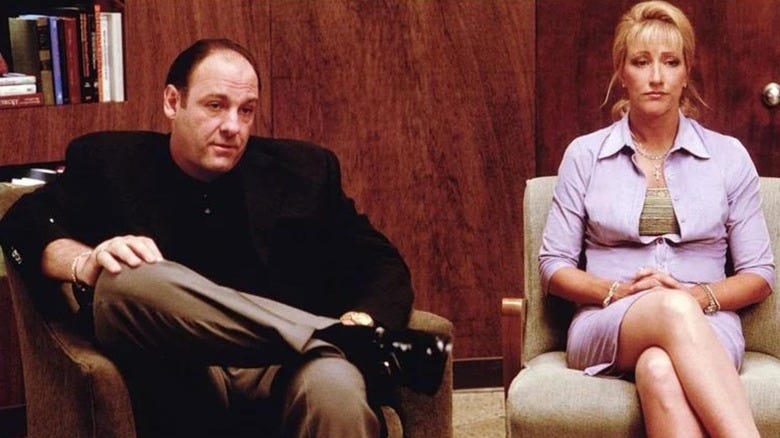
A husband and wife go to one of the nation’s leading psychiatrists. The husband resisted at the beginning, feeling a little overexposed and humiliated, but these feelings are quickly understood through internalized misogyny, and gently given a psychic playpen to harmlessly express themselves. They both have exceptional careers. He works in finance and she is the owner of a marketing firm. The kids too, are in the best schools and have good college prospects. They are well-adjusted and happy. Every square inch of their lives is filled with something to do, something to consume, something to learn. When the parents started going to therapy, they were fighting a lot. The therapist has them go on weekly dates to re-capture the spark. To her amazement, he now says things like, “I hear and appreciate you,” and “I need to set boundaries for self-care.” They have a date planned that night and it will likely end well. Things are good. And yet, if you looked in their eyes, particularly his, something is just not there...
Of course, “therapy” is a good idea in the right context. The Greek just indicates something like caring for the sick. If you tear your achilles, you should go get physical therapy. If you find out during war that not only are you capable of killing someone, but that you quite enjoy it, you will probably need some therapy to deal with what it means to go back to standing in line at the Safeway. In both of these examples, though, therapy is designed to end when normalcy is achieved. You wouldn’t balk at me if I told you it was time to get back to walking when your heel was working again. Why, then, is it such a problem to suggest that continued “Therapy Speak” within a relationship indicates that something is wrong and it would be better, all things being equal, if we didn’t continue to talk to each other like that?
First, let’s crisp up “Therapy Speak.” The pop-vernacular is a downstream sludge of a few things: boundaries and attachment theory, etc. The cleanest single origin is non-violent communication, which arose as a way of de-escalating actual violence. Again, clearly useful in acute situations, but not designed to be a permanent fix. Through no fault of its own, we have adopted a version of it for permanently dealing with conflict in therapy-mediated relationships. Look closely at the original four steps: observe without evaluating, name the feeling, locate the need beneath the feeling, then make a request.
Notice that these steps are, each more than the last, categorizing away your first person perspective (where, in revenge, it can terrorize you somewhere else in your shared psyche). By the final step you have formulated something so reasonable as to be nauseating and so no one on earth could say you did anything wrong and, incidentally, could possibly know or love you. Who could love someone they can’t wrong?
Notice the grammar of it all: The Self is split into an invisible manager and one who is managed. The same Self-Object split that is designed to defuse acute violence (and, again, does do this) also defuses sexual polarity and all its associated dangers and thrills.
Therapy Speak fails the individual because it promises and fails to capture the uncategorizable Self, but it also fails at romance because it succeeds at categorizing the other. You cannot love another as an irreducible Self if you are too terrified to see yourself as that. You also cannot desire what is made into a legible system. Thus, we are turned off by a spouse saying something vaguely therapeutic sounding like “That’s just your anxious attachment style.” With that, we are managed. Our personhood effectively factored out. What follows from that, predictably, is outrage, which is then “de-escalated” with morally superior sounding phrases like, “I want to give space for the fact that you’re feeling angry,” which is both unfalsifiable and unassailable, and so all emotional conflict-from-misplaced-eros is engineered out by slippery language. With it, little by little, romance is replaced by contempt.
Kierkegaard defined the self not as a thing but as “a relation that relates itself to itself.” He noticed the same Self-Object split that therapy now seeks to manage, concluding that the relationship cannot be closed from the inside, no matter how competent the manager. For him, despair had very little to do with bad feelings. It was the natural result of not wanting to be yourself: wanting to be someone else, wanting to be captured by a category, a diagnosis, to hide inside a line, “I just have an avoidant attachment style.” The Self is traded in for a dead specimen. The guy in the opening isn’t sad; he’s pretending to be something dead and general when he’s actually alive and singular. Despair is perfectly compatible with things going well. By 1966, Philip Rieff was watching as these ideas became institutionalized into something he thought would replace religion. He predicted “psychological man,” whose deepest ambition is to perfectly manage his own inner life, would overtake “religious man” in the West. He was right. Therapy speak is just his liturgical language.
Walker Percy made the futility of all this especially obvious to me in “Lost in the Cosmos: The Last Self-Help Book”: No matter how much you generalize your ailments and neuroses as typical of their genus or trauma type, you are still stuck sitting behind your own eyes looking out at the world. The only thing that you can’t categorize is the categorizer. No amount of diagnoses or labels or divergencies will resolve the fact that it feels like something to be you. You alone must live your life and die. Anxiety about that is what therapy seeks to cure us of, but may be the only way to discover the possibility of the freedom to become a Self. Percy asks some questions like: why is it that we often feel so bad when things are good, but feel so good when a devastating hurricane is set to make landfall in a few hours?
