

Out of the fog appeared an Australian Shepherd.
“No, that’s a Border Collie,” said my wife. The black-and-white stood out against grass on the side of the road, then seemed to evaporate into the mist in my rear-view. “It is a beautiful dog,” she added. “Because he has a job… Well, actually, now he’s probably unemployed.”
I knew what she meant: the dog’s beauty was made - cultivated? evolved? It’s an odd case for dogs - designed? - in relationship with an embodied need in the world. In this dog’s case, shepherding livestock - you can almost sense some rolling shire and the pure love of an English schoolboy in the dog’s DNA.
I also knew what she was contrasting him with: lap dogs, or the perennially unemployed breeds. The dogs in bags at the airport and the vibrating companions of shut-ins who yip pointlessly at all moving objects.
Of course, those dogs do have a job. We just don’t respect their work, which may speak to our character more than anything. Really, those dogs are in the business of cuteness, which is to say, technically, they imitate human babies. Besides your rare drug sniffer or hunting retriever, cuteness is practically the only profitable line of work that’s left for the dog these days. How did we arrive here?
You could imagine the primordial woods: Howling, you sense, is the wolves’ way of triangulating and communicating your location and of your tender children to every hungry wolf in a five-mile radius. If they happen to wander into the moonlight, they are loudly devoured.
You could imagine a precautious boy who stumbled across an abandoned pup, out exploring when he wasn’t supposed to. Maybe, fearing his father’s retribution, he kept the pup a secret and fed it table scraps. Maybe his mother found out, but out of her compassion for her child overlapping with the furry mammal’s human-baby-like eyes, she helps keep his secret.
Then, when the wolf is no longer a puppy, an accident happens - someone gets bit. Maybe they were asking for it, but the reason doesn’t matter. The father banishes the wolf. The loyal boy goes with him.
That is, until someone vulnerable is attacked by wild wolves and the cries for help are answered only by the boy and his wolf. Now, the tribe accepts the power of the dog, and even his reluctant father makes amends.
A key bit is that the original wolf has to be a baby when the boy adopts it. Its “cuteness,” that is, its likeness to human babies, helps override our predator-detection system enough to kickstart an evolutionary relationship.
Just as importantly, though, in order for the father and the rest of the tribe to accept the full-grown wolf, he has to be more than just cute - he must also have a job. His most primitive job title is alert system for other wolves. That’s why all dogs bark. They can sense and alert us to wolves better than any human could, obviously, because they were the enemy. Thus, they are ever-eager to prove their worth to the “father” with their most fundamental display of good-faith: barking all the damn time.
The third key element: the boy, symbolically, has integrated the shadow of the wolf. He is able to comprehend and therefore thwart it, saving his tribe from the ancient terror. He is the proverbial border-walker and that’s the basic pattern of the hero, millions of iterations of which formed the DNA of modern dogs, and is still woven into the mutual genetics of our relationship. Sometimes, the wolf is a dragon (How to Train your Dragon) and sometimes the boy is a man living with apes (Tarzan), but the essence of the story is always the same. It’s why “dog” is one of the first words children learn and poking at a bored husky is one of their favorite activities. It’s also remarkable to watch how dogs “know” to play gently with human children.
Our stories go way back, indeed.
It strikes me that the people who have lost the most faith in other transcendent structures like God, country, and family - presumably even more profoundly interwoven into our being - are the people most likely to most strongly “believe in” the love of dogs. The sort of person to have a “Flying Spaghetti Monster” bumper sticker is more likely to also have one that says, “Say hello to your dog for me,” if you know what I mean. Rational materialism has a limit, it seems, and it stops firmly at their “pupper.”
Of course, if I wanted to make a reductionist argument for the “love” of dogs, it would be easy: it has been demonstrated that domestic dogs’ genes have literally made them perpetual puppies by blocking adult growth hormones. So, you could say, dogs evolved to be a harmless parasite, using our deeply ingrained infant-protection-systems to make us swoon at their baby-mammal-like faces. In exchange, we feed them scraps and keep them warm.
In a study, some Russian scientists bred foxes. Actually, what they did was go up to wild foxes and shoot the mean ones with a revolver. They kept the most social ones and bred them with each other until, after only a few generations, the now-domestic foxes would pee on themselves because they were so excited to see the humans. Interestingly, the foxes also developed other qualities of domestic dogs: floppy ears and “socks” in the fur of their feet. They even developed bigger eyes, making them “cuter.”
There you go: the love of dogs re-created with nothing but wild foxes, a revolver, and classic Russian non-sentimentality.
But of course, I don’t “believe” that story. I believe the first story - the “myth.” I don’t think you can sum up something as powerful as “A boy and his dog” with one artificial metric and claim that you understand it. Everything is contextual and interrelated and it’s brutal and inappropriate to collapse meaningful relationships down to one perspective. It would be like saying best friends only cost a handful of Cheeze-Its. Maybe it did that once, but that’s not really what friendship amounts to, is it? I believe in myth because, among other reasons, it’s more accurate (although sometimes less precise). Reductionism, because of its obsession with precision, leads to far worse accuracy.
That is all to say, I agree with the dog lovers, in so far as they sense that our relationship with dogs is a sort of mythical-genetic-cosmic partnership and therefore beyond some cheap cynicism. But I disagree, of course, that a dog’s love is the most important thing for a meaningful life.
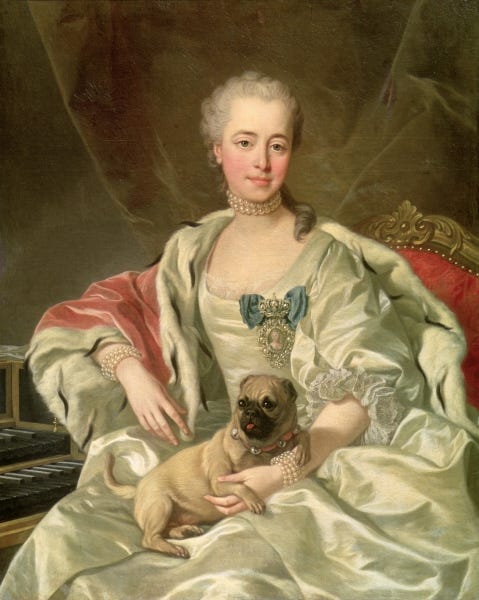
In fact, ever since the love of dogs has become a high good-in-itself, we have dropped any presumptions of usefulness, and our relationship has gone a bit weird. We’ve become like their Oedipal mothers, consuming and retarding them to make them ever-more helpless and puppy-like until they can barely move or breathe. In exchange, they are never able to leave our “loving embrace.” Some of them have become like a grotesque mockery of the precious infant.
We’ve fully embraced the first part of the story: where mother and son conspire to hide the puppy from dad, but we’ve rejected the second part. Dad is supposed to rightly banish the outsider until it can prove itself by doing a job for the tribe that feeds it. We’ve decided that that is oppressive and wrong in all cases. We want to believe that the third person of the story, the hero (us), would bloom in the absence of the oppressive father; but, no. The absence of the archetypal Father makes jobless pugs of us all.
To be a beautiful dog, like my wife said about the Border Collie, is to be built for a job. To be a beautiful person, for that matter, is to have sort of a job - a purpose, a telos. The same goes for everything from a serving spoon to a graveyard. Telos glimmers through form in the guise of beauty, which can be clocked by your intuition in less than a second - even on the side of a foggy road.
Richard Dawkins wrote a paper about how if you gave a bird to an alien, the alien would be able to deduce almost everything about the bird’s environment: the size of the planet and its gravity, the atmospheric composition, and the climate, and so on. The bird, in some sense, is like an inside-out mirror of the environment.
Dawkins is right, but he doesn’t go far enough. It’s not only physical qualities that create the representation of its inhabitants, but psychic, moral, and archetypal as well. This is especially true for dogs, whose “environments” are more the mental landscapes of their masters than the incidental physical surround. Ideas floating in the heads of human beings have shaped the DNA of dogs more than hills or ducks. When we look at them, we are really looking into our own souls. It is not coincidental, then, that when our motivations for owning dogs turn ugly, our dogs get ugly, too.
Jobless dogs allow us now to “have” a child without the responsibility of children. Collectively, we are sublimating our innate desire to reproduce onto our dogs, who are purposed as permanent puppies. We know it’s wrong because when we see a dog in a stroller, we are revolted. That is a far better indicator for what is true than whatever we explicitly claim we think.
The nihilist’s nihilism tends to stop suddenly at their love for dogs, not because that’s rational, but because it allows them a harmless source of higher meaning but demands no responsibility and therefore no sacrifice, unlike real people.
How often do you hear someone brag that they “like dogs more than people?” Sure, your dog might pee on themselves because they’re so happy to see you, and that’s nice and all, but the Russian foxes loved their owners, too.
Deep in our being, we desire real moral growth toward a higher purpose - to prove ourselves useful and good to a judgmental Father. Dogs just don’t provide that, and so, with them, we devolve into an excess of mercy and therefore mutual ugliness.
Our animals can outwardly manifest our own moral cowardice. But they also can become as beautiful as a Border Collie, but only if we busy ourselves doing beautiful and useful things.
That was a crisp and beautiful essay.
What do you make of the other two deep, mythical relationships we have with animals - cats and horses? The "cat lady" is a common trope, but we don't seem to infantilize cats with a smothering mercy the same way as dogs (is there any pug equivalent among cat owners?). And horses still seem to be a way that we seek spiritual liberation, not comfort without responsibility.
I just watched the original 101 Dalmations last night. The opening sequence is a fun example of the mutual exchange of characteristics between dog and owner.
It's funny how all the narrative motion is generated by the dogs because the owners have no agency, to the point of the dogs calling their owners "pets".