

I remember reading Noam Chomsky’s Manufacturing Consent when I was in college. I felt like I had learned a clandestine secret about the way the world “really” works.
Chomsky demonstrates the “will” of the American empire by showing how regimes aligned with our interest get more American dollars, yes, but are also more likely to be positively reported on in the New York Times. Regimes that conflict with the American interest are more likely to be the victim of American military intervention, of which there will be little to no reporting in the New York Times. All of this is plain-as-day in publicly available data. They aren’t even trying to hide it, man!
What Chomsky would like you to explicitly believe is that your consent to this machine has been manufactured by market and institutional demands, no conspiratorial cabal of bad actors required. He doesn’t need to point to the real shape of his enemy, the reader’s imagination supplies it: Some nasty, greedy capitalists are repressing the possibility of utopian socialists because they want to enrich themselves.
This was a near-perfect maneuver for Chomsky. What’s almost darkly ironic is that none of the most ingenious maneuvers he’s making are stated explicitly. They’re built into shared assumptions about how the world works, particularly in academia, particularly at the time. It taps into our hunger for cosmic drama, without ever lowering itself to what academics would think of as the naivete or superstition of cosmic melodrama.
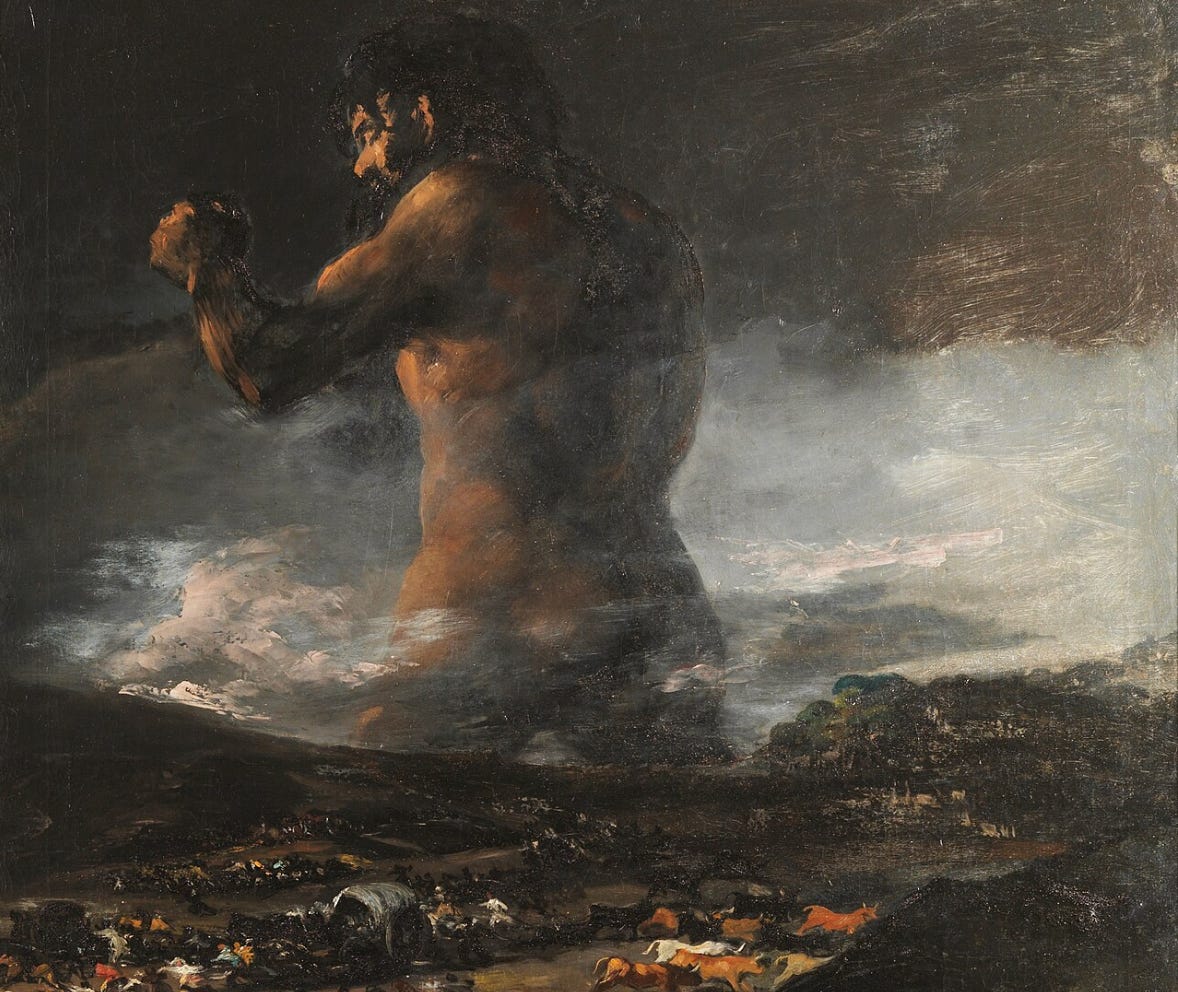
The worldview underlying it is that everything is like a machine. There are, of course, no such things as gods or titans. Further, this inert world-machine would work perfectly toward our collective flourishing if it weren’t for the bad incentives (who makes the incentives bad is, again, left to your imagination). Now we may approach the text feeling very smart, clear headed, and rational. Academics and intelligent lay people can share the book to confer the status of intelligence on one another, driving sales and positive critical reception. But what really drives the enormous interest in this otherwise inert phone book of information is that unspoken daemon.
You, the reader, are allowed to imagine this spirit however you like. You can incarnate it in a man like Dick Cheney, who helpfully plays the role quite well. Or you can just allow it to remain the shadowy cabal of some mystery thriller, like The Da Vinci Code in your unexamined imagination.
I wouldn’t want to make it seem like the left, however you’d characterize that, is the only side capable of playing this game. In fact, the right has recently begun to acquire a real aptitude for it, most prominently starting around 2016 after the rise of Jordan Peterson.
For most of post-war American history, the right were the adherents to the American style of capitalism that was making us so darn wealthy. They didn’t need to be savvy at naming the dark animating spirits of those on the left. In turn, the left saw themselves as noble rebels against this rising world-order with basically all of the intellectual clout and less of the economic power.
Then, there was the somehow cosmos-shattering Cathy Newman interview with Jordan Peterson. She was a hapless recipient of the worldview that took for granted a gormless right wing, so she had no memetic defense against the incursion of someone like Peterson, who was not right wing in the sense that he merely defended the economic and social powers that be, but had spent the majority of his career thinking about the negative aspects of the spirit of the institutional left.
Before 2016, and it’s hard to remember this, the right had very few compelling memetic weapons. Only rants about political correctness on AM radio. Now, ten years after the rise of Peterson, it has new more native weapons in its arsenal: Luxury beliefs. Virtue signaling. The replication crisis. P-hacking. Even seemingly unrelated things like the food pyramid and seed oils are now right-coded.
The political landscape has become more dynamic. Probably because the slow decline of post-war exponential economic growth has made it necessary for traditionalists to be more sophisticated than just red-blooded capitalists. You now have highly online terminology like woke versus chud, which in some ways has pushed these dynamic poles to more extreme opposites. People are observing this radicalization and echo-chambering in faux wonderment. The old left just names it all misinformation and hopes it will go away.
That is to say, the entrenched old guard of Chomsky-style academics have largely not caught on to the new dynamic. In fact, a new wave of right wing academics are making their careers by humiliating these people, unawares, in the public sphere. It started with Cathy Newman and the fall of the New Atheists, and is perhaps culminating grotesquely with the Jason Arday affair at Cambridge.
What’s being missed in this current landscape, still, is that it’s the same trick that Chomsky played on me all those years ago: pointing out gods and titans in a conveniently limited way. Giving them a catchy name. “Woke.” Allowing the reader to fill in the gap with smoky cabals of evil enemies, and their vision of the neglected and abused good.
They rightly notice that seemingly machine-like interactions of a bureaucracy or a state, if investigated with a want in mind, will reveal themselves to somehow bend their very machinery to achieve that want. If you decide that what the state wants is to disenfranchise you, you’ll find plenty of evidence because that is, in fact, part of what the state or capitalism or the machine wants to do. Insofar as it is a true part of the personality of the spirit of the age, data will reinforce your idea of almost any conspiracy.
The problem with this approach goes perennially unexamined. You could say it like this: The personality of a spirit can be factually described, concretely, through revelatory data, to affirm the relationship between that spirit and the thinker who is observing it. But that description, however true and factual, does not exhaust the personality of the spirit nor the observer.
What these thinkers tend to abuse is an unspoken occultist theater: the feeling that the revelation is exciting because it gleams; because it suggests cosmic drama with enough plausible deniability to not abandon the empirical feel. It’s perfectly deceptive because it’s all true, but incomplete.
Cultures and states and ideologies have persistent tendencies and demonstrate top-down agency, so calling them “systems” is a weak metaphor. They are much better apprehended as personalities. Like our own personalities, they have emergent patterns and competing processes. It’s not a question if America has a little “mind” somewhere in central South Dakota doing its wanting, but, for our purposes, only if treating it like a personality predicts more than treating it like a machine. Because of its nature and ours, what we expect to see in it in part determines what it is and who we are. If you’re a good faith reader of history, at some point you’ll have to concede what was obvious to every human being before the modern age: gods and titans clearly exist, and they contain within themselves personalities composed of dynamic opposites, just like any human being you happen to know. I don’t care what you make of the phenomenology of these personalities, acting like they “exist” works better than not.
There does not need to be any cabal of conscious conspirators for there to be a desire of these larger personalities to achieve their ends. It’s completely plausible that no single person on Earth wanted us to spend thirty years arming Suharto, tilt a US presidential election, or whatever else. The incorrect bit of the culture warrior explanation is what you ought to do about this, as an individual who seems to find himself in a landscape of gods and titans.
Your personality and temperament are more predictive of how you identify politically than any argument, anyway. If you begin to notice grand conspiracies against the group most like yourself, you’ll be drawn further and further into a caricature of your own temperament to appease one pole of the spirit of the age, which is by definition one radical pole of two necessary opposites. If you’re talented enough, you can make yourself a public avatar of a resistance against that interplay. This, put plainly, would be political commentary.
What being an avatar of the fight against a great enemy affords you is legibility in the marketplace. Power, status, and wealth. Because, unbeknownst to you, what’s happening is that you’ve aligned yourself with a personality that is much more powerful than you. It wants things and is happy to use you to achieve those ends.
If you allow yourself to be used like that, you will eventually succumb to what we commonly call audience capture or partisan derangement. These are named as if they are benign sociological phenomena, but it’s really more like aligning yourself with half the dynamic of your age at the cost of your own local internal balance of opposites. Your sanity. Arguably, this is what happened to Peterson. He initially made a courageous and principled stand, and helped millions of young men make non-political choices: to be grateful for their place in life, to make their room better, to do slightly better at their job, to be humble, and to not sell out to activism or whatever the universities were offering. He eventually succumbed to a shadow of what he fought against by making himself an avatar of a fight against the cultural left.
It would be too easy to convince myself, particularly at this point in my life, to follow the example of Peterson like I did earlier in my life with Chomsky. Or I could just notice that on a civilizational scale these are more like the hemispheres of the mind of a god that will gladly rip my soul apart in its own struggle to find its dynamical balance. It needs to walk its own razor’s edge, as Peterson says, between chaos and order.
When I see that terrifying and unbeatable landscape of titans before me, I can only reasonably choose to walk that edge between chaos and order in my own life, no matter what they threaten to do to me. That would be much more humble and grounded, and I wouldn’t get to have the quick payday of polemic or ideologue takes, and would probably have more to do with listening carefully to the worries of my wife or not saying the thing at work that I’m “supposed” to say but don’t believe. That would protect my soul, meaning my body, self, and progeny would flourish over a longer timeline.
The temptation there too, I think, for someone like Peterson or Chomsky, or any of their cultural warriors, is the sensation that if they just keep attacking, at some point they can win and then give up the sword. That their version of the good would be fully manifest in the world, if everybody they hate would just get out of their way.
The thing is, you can’t win a culture war. Because the culture war doesn’t want to be won. However cleverly you attack your opposition, and however many battles you win, it will only cause them to adapt to your tactics, evolve, and come back and hit you harder. The spirit of the age wants to balance its opponent processes, not total victory. If one opponent ever wins, it regenerates its own opposite. This dynamic knows more than we do, as becomes clear when we finally look back at history and see how political squabbles of the day were less interesting than the people having them.
It’s still okay to be affiliated with a political party, depending on how you see the world, again mostly as a result of your disposition and circumstances. But a wiser recognition demands that you hold it lightly and without loyalty. Realize that the supposed enemy is also seeing the way that things seem to manifest to them, and that it’s completely rational and comprehensible from their perspective. There has to be sort of a post-rational bipartisan respect, despite the fact that we must also have a local political perspective we believe to be true.
None of this is quite as exciting as it was for me to read Chomsky as a philosophy major and feel that I had some secret knowledge about the way the world is, and therefore a clear enemy to fight. I don’t think that’s totally intractable, though, because the new battle I’m talking about is a battle against categories, against easy explanations and world-closing solutions. That is a deeply personal battle against the fear in your own heart. Constant leaps of faith forward in a world without end. That’s exciting, too, if I can just get my head around it.
Every great thinker I continue to truly admire through the decades, despite all of my evolutions and changes through life, were in their own way struggling to give voice to the preference of the personal battle over the cultural one. Socrates, Kierkegaard, Lewis, Percy. That humbles me, because if they haven’t already convinced the whole world, I’m not very likely to do it now. I probably can’t push anybody away from rabid political takes if they’re already getting a lot of validation and meaning out of that.
Part of me still, maybe irrationally, believes that if I can figure out the right combination of words, suddenly somebody might see that impossible horizon of lumbering titans and tricky gods, ancient and immortal, ready to eat us, use us, or destroy us. That we are, tiny, with no chance in hell. Only there I can know that if I believe something seems so obvious that everyone who disagrees must be stupid or evil, I am probably the stupidest and most evil person I know.
Maybe with that realization I might, after an appropriate time of despair, start to wonder what tools could possibly be available to tiny mortals like us. Old gods and titans are famously afraid of certain mortals, and we need to try and remember why that is.
Just passing through to say that you consistently publish some of the most insightful and thought-provoking work on Substack. Whatever you're doing to "feed that fire", keep doing it!
Related to the subject at hand here, I've noticed that many (most) creators on any platform start out with the intention of originality, but eventually get swallowed by the audience's incentives and "the discourse" and become the <subject> guy: the "distributist guy", the "militant trad guy", the "vanquisher of woke guy", etc..
In light of all that, what you're doing here is great, and I (and many others, I'm sure) are very grateful for your willingness to "think out loud" WITH US rather than proclaim false solutions from the heights of "Mt. Wisdom". Anyhow, have a good one!
So insightful and clearly articulated James, thank you for putting words to something I’ve been grappling with for the last few years.
I find myself easily seduced by these Gods, and galvanized to their needs, as you say so well. Even as I begin to congratulate myself for steering the middle channel, suddenly I’ll be reactively, emotionally defending the Titans of the Right, with receipts amply furnished, in response to lefty wrongspeak. Ironic and frustrating.
I’m printing this one out and will distribute it to the very few I know who might be able to appreciate the value of your understanding of our predicament. Yeah that probably sounds arrogant, but sadly it’s true in my world.