

About a month ago, I was sitting on my couch, scrolling through recommended YouTube thumbnails.
I was on the hunt for what my wife jokingly refers to as Boy YouTube. If you don’t know what I mean by that, you can get a good sense by clicking on a Veritasium video and then scrolling through all the subsequent recommendations. She doesn’t like them because of, as she describes it, the monotone narration style and overly abstract subject matter. I usually don’t mind that because I’m just there to nerd out with the dudes.
I have noticed lately, however, that the vibes on Boy YouTube are nearing intolerable. There are more explainer-style video essays than ever before, but vanishingly few of them are weird and messy and wrong in an interesting way. Long gone are the bizarre days of early Vsauce. They don’t necessarily have those very-obvious AI-isms, but an overall crispness that makes me feel, more and more, like I don’t know who’s talking to me and why. There are a few cases where I’m outright sure the script is AI-generated. Even where I can’t be sure, though, there’s just a hard-to-explain, disgusting glaze on everything over there lately. I’ve been indulging less and less.
This particular night, I ran across a Hank Green video. It was about AI, I think. I hadn’t watched Hank Green in a long time, so I clicked. About halfway through I was almost certain I was listening to him read an AI-generated script. Now, you can’t always prove these sorts of things. And it’s not necessarily even the AI as such that I dislike; it’s just that the prose style is not especially fun to listen to. So I turned it off. I didn’t think much of it beyond that.
When the controversy happened in the last week or so, I was not surprised. If you haven’t heard, Hank Green seems to have accidentally left an artifact of his conversation with AI in his script. Specifically: “I appreciate the pushback,” at a moment when no one was giving him pushback. Then, Hank came out and said that particular piece of dialogue was an ad-lib, but admitted that he’s been overly relying on GPT for his research. He thinks that it’s addictive because it activates his “dopamine,” so now he needs to pause his channels, take a step back, and reevaluate how he’s going to handle his work going forward.
A few more wrinkles have emerged since then. One is that the claim that the line was an ad-lib seems unlikely, given the context of the clip. It seems much more likely that it was a forgotten artifact of an earlier conversation he was having with GPT. Can’t prove it either way, but that’s how it seems. People also went in and transcribed his narration and tested it for AI, and they indicate that a lot of it is AI-generated, for whatever that’s worth.
But I don’t want to participate in some weird witch hunt here. Hank seems contrite, and the fact is, most of us are using AI more than we would readily admit in public. Most of us think we can spot bad-faith uses in other people, but that we uniquely (but privately) know how to use AI correctly.
The reason AI is so tempting to use is exactly because it is not, as some people claim, stupid and useless. It will probably be remembered as a great transformation in human cognition, just as the alphabet and the printing press were before it. Maybe more than those tools, though, it tends to encroach violently on our ability to distinguish where we begin and it ends. If you’re the sort of person who thinks you know how to wield AI without it corrupting or humiliating you, you are probably not that person.
Take my own admission of guilt as an example: I’ve been writing for a long time. I handwrite every day. I am obsessed with language. I like crafting sentences, and how crafting them transforms how I think about those sentences, and therefore transform me. I’ve experienced that probably millions of times by now. Writing is just how I think, and so I’m not really tempted to use AI prose. However, I am aware that thousands of people sometimes read these dumb little essays, and will sometimes come after me for what I say. So, I am beyond tempted to pop these into Claude to verify my facts. Really, to make me feel safe. Because, at least from my limited perspective, the stakes feel high. I have to admit to you that if that behavior is not wrong, it is at least a dangerous line to walk.
I wrote a piece called “We Know You’re Using AI,” in which I said, based on a text I received from a family member, that using AI causes a phenomenon someone later named LLMbarrassment: when you detect that someone is using AI, but you don’t want to tell them because it would embarrass them. So you’re stuck in a catch-22 where you socially can’t reveal that you know you’re actually talking to ChatGPT. A lot of people thought I was saying it should be embarrassing, or that I was mocking any and all AI use. That’s not what I meant. I was just observing that in obvious copy-and-paste instances it just is embarrassing. That reflexive embarrassment and desire to hide it reveals the bad motivations of the user, despite whatever they say explicitly.
What we still have to work out is: at what level can we even use these tools without them corrupting us? It’s probably not none. It’s also probably not any and all usage. What is most surprising to me is that the use that I feel is aligned and good is actually far more limited than I would’ve thought.
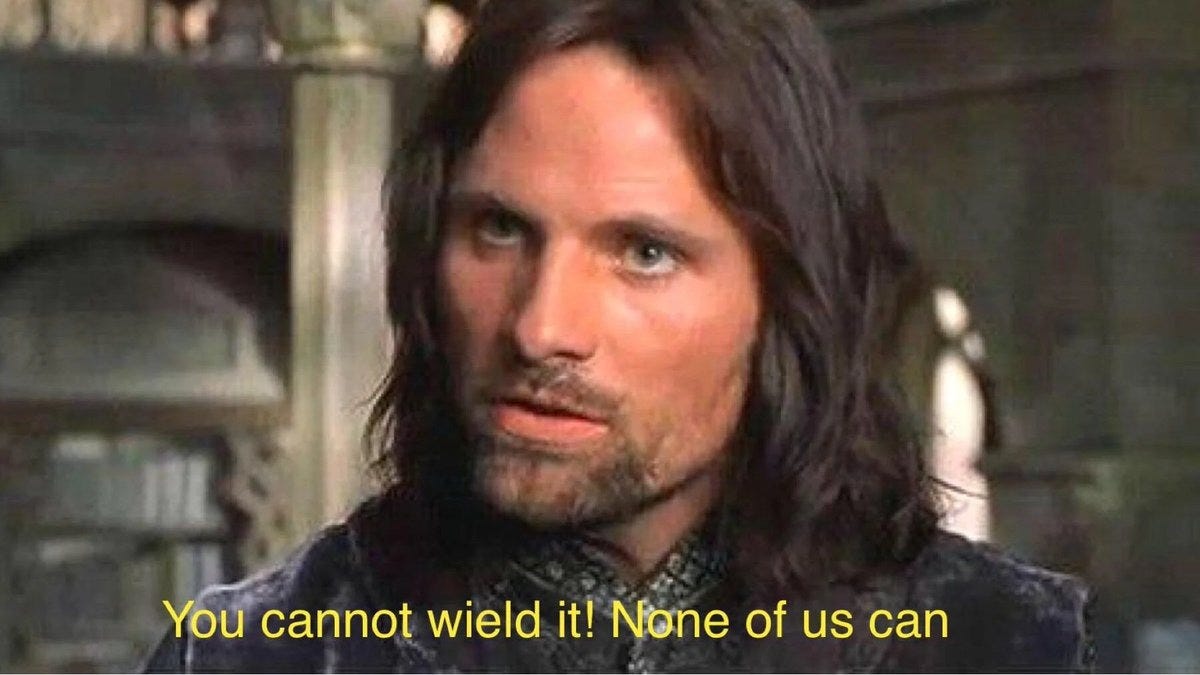
Nothing is “just” a tool. The tool also wields you. The One Ring is a good symbol for all technology because it corrupts us by its very purpose: concealing our deepest vulnerabilities. It gives us the power to transmute the fear of vulnerability into control of ourselves and others. Given that, if I look at myself honestly… Well, I’m using the power of this tool to try to control how people who might disagree with my work will react. I’m hiding my own squishy humanity, my ignorance. By doing that, I’m really only hurting myself. Like Hank and probably many other people, I am also very likely to convince myself that I have a total handle on it. I alone know how to use it without it corrupting me. I disclose my own hypocrisy by the mere fact that I would be embarrassed if you saw an open chat window with an essay in it.
Everyone thinks they can use the power of the ring for good. They always start by protecting the “right” kinds of vulnerability. Their family, their home, their reputation. It always, given a long enough time frame, corrupts. So the wisest people know they probably shouldn’t even touch the ring, especially if they’re already powerful.
Hank Green is a powerful person. He has a lot of cultural pull and maybe he feels that could go away with a factual slip. He himself said he’s under a lot of pressure, that he’s addicted to the dopamine these tools give him. By that admission, he shows that he knows his usage is wrong. He’s just using very modern language (dopamine) to indicate why he thinks that.
Dopamine, for a lot of brainy online people, is the closest they will come to the concept of sin. We don’t like those antiquated words anymore. But the problem with the dopamine metaphor is that it’s only applicable on the chemical level. It’s not applicable on the level of social responsibility, and it’s no good at solving at the level of pattern. The concept of sin, on the other hand, solves for a much larger pattern, which also encompasses whatever chemicals you have going on in your brain.
Hank is saying: I’ve made a mistake, and I need to stop making videos for now, because I’ve breached the trust of the viewer. But at the same time, he’s also saying: I’m not really responsible for the chemicals these tools induce in me. That’s where the dopamine metaphor fails. Hank Green alone is responsible for how he uses his tools, no matter how they make him feel. The reason nobody wants to say that is because once you try to take responsibility for everything you do, you realize that it’s impossible to be good.
Going back to the One Ring: the only person capable of wielding the ring in order to destroy it, Frodo, is the person humble enough to admit that he can’t. He’s a hobbit. He has no power to begin with. So, paradoxically, he’s able to carry it. But even he still fails. The reason the story is so salient is that it really understands the near-impossibility of the task.
I have a lot of sympathy for Hank and for the pressure he’s under. He’s like Boromir: he wants to protect Gondor; his career. That career feeds his family. It also does a lot of good, and maybe even guards parts of the world from various sorts of evils. He could feel very justified in using the power of the machine, and therefore breaching trust with his audience, because of all the good it does otherwise. Until one day when he realizes it has gone too far when he gets caught purring over his precious.
Which is all to say: none of us are likely to use this tool very wisely. Any tool that vastly increases our power to manipulate the world and each other is going to corrupt most people. Practically everyone. Even those of us who never personally touch the tool —maybe especially those people because they will be more easily manipulated by AI-powered manipulators. Either way, the less we realize that we have no chance, the less humility we have, the less likely we are to be the sort of person who can do what is right.
I wrote “We Know You’re Using AI” right before the Pangram integration with Substack, and before the AI witch hunt really hit. Since then, many of us are sneering and pretending that these machines aren’t powerful, useful, and therefore very tempting to use. None of that is what I was saying.
It’s very powerful and I can’t deny that. I can take long walks and have AI listen to me and transcribe my voice into word-for-word text. I no longer have to spend ten hours clearing out the ums and errs in my notes. But somewhere along the way that is incredibly hard for me to distinguish, I start to cross the threshold where the tool is no longer helping me further express my humanity, but to hide it.
To establish new social norms, there will be many more scapegoats. So the Hank thing is predictable, but maybe not entirely proportional. His response was at least partly honesty and contrition. If we continue to witch-hunt and punish people for honesty, all of us will be more and more incentivized to hide the fact that we alone think we know how to use these tools right, which only pushes us further into the shadows.
It’s just a tool. One of those sayings that’s unhelpfully true. Atomic bombs are just a tool. As it turns out, they can’t be used at all, because their character as tools alone assures mutual destruction. To the extent AI is like that, I actually do not know. It, after all, sources every piece of evidence to defend any flawed and fallen position we already want to hold.
So maybe the more productive thing is to just accept how stupid and evil we really are. Only wear the tool around our neck when it wouldn’t be shameful for others to see it there. To accept, also, that we will all still make mistakes and overstep constantly.
As people living in history and almost certainly not at the end of history, we should aspire to be one of those few, and not resign ourselves to hurrying our own destruction and the loss of the ability to trust each other.
Ok, well, I'm not trying to wield AI at all because I'm just a little hobbit who can recognize a tool of Sauron when she sees it. Maybe that will put me behind on work and maybe that will make me a worse writer and certainly it will make me out of touch with society, but I don't care. I'm not going to pick up the ring, because I'm weak and it's evil.
I actually deleted youtube from my phone a while ago, because every other video was like the one you described of flat boring screenreader guys reading off an obvious ai(edited) script.
But still, I do use ai almost every workday, mostly for very narrow and very specific one-off things I want. Two recent examples are the crafting of a comprehensive overview of all kinds of literature forms, genres, styles, and such + author examples I could read for each of the types and another things was producing the HTML+CSS for a quiz (quiz contents I made myself). But I won't ever use it for writing my essays or fiction or for thinking for me.
Still, I have been lured in previously in sharing more than I actually want with LLM's and since then (the start of the year) I have taken to creating a new account every month because I got tired of LLM's trying/asking to do the thinking for me and bringing in the context of other conversations I had with it.
Anyway, long story short. Yes, I think it is immensely dangerous to wield, and every time I do I am cognisant of it being a trade-off between efficiency and soul. It's why I think it shouldn't be used for soul-filled/tasteful/art works.
And also why I think it's good to have some distance between a human and the LLM's, also why I hate human-level voice in ai. Please just give me the robotic voice so my subconscious doesn't get tricked into, for a fraction of a second, thinking I'm listening to a human.