

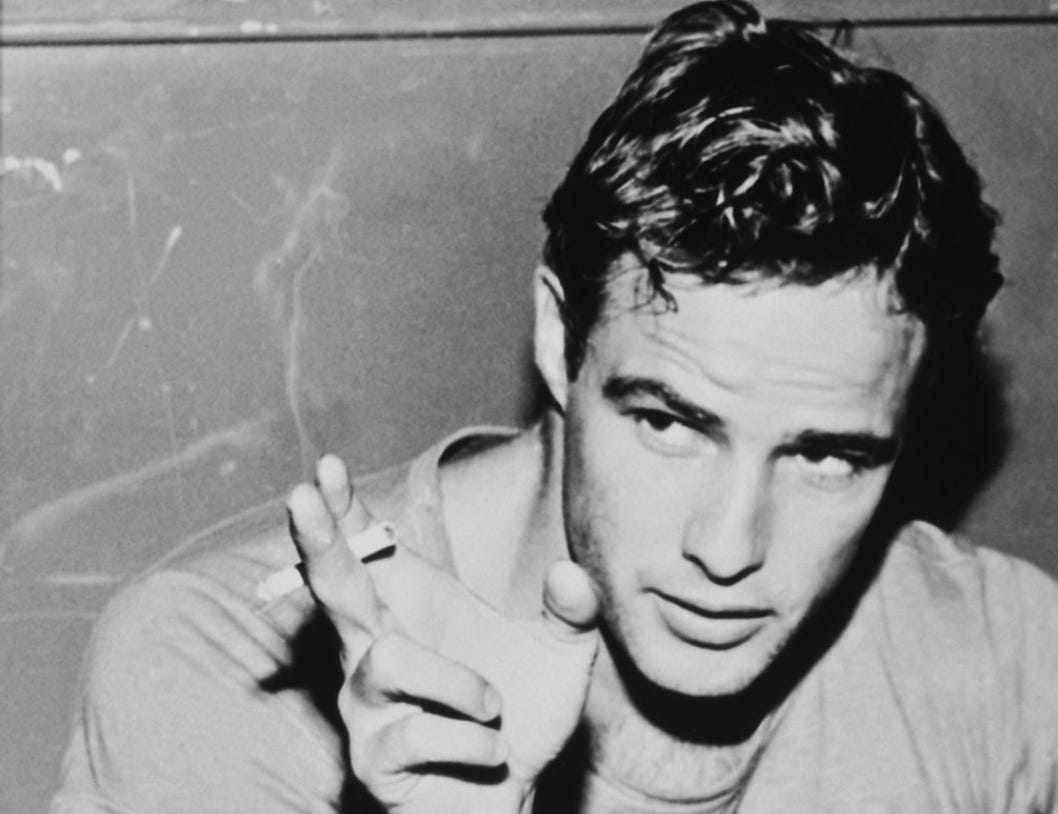
There is a performative contradiction at the very heart of the American psyche. It functions best when not examined. If it’s ever brought to consciousness, it’s usually because it’s either not working or suddenly stops working for you. Once seen, the contradiction can drive you insane.
Here’s a common example. A star athlete of a high school has unconsciously absorbed, through his classmates and American media, the need for him to be casual and cool about his status. He wears the letterman jacket, because it was given to him, but otherwise he’s James Dean. He doesn’t care.
When he goes to college, though, he continues to wear the letterman jacket, assuming, unconsciously, that it’ll confer the same status on him as it did in high school. Here, though, he’s bullied for wearing the jacket. With that, he’s given an impossible choice: Keep wearing the jacket, demonstrating that he still doesn’t care what people think of him and yet still hoping this will make them think well of him. People will continue to think badly of him. Or take the jacket off because he cares what people think of him, thus losing his ability to not care what people think of him, making him effectively uncool. People will continue to think badly of him. Either way now, he can’t escape. Whatever he does, he is consciously doing it because of what people think of him.
That, in essence, is what it means to be an American, summed up in this one paradoxical sentence: be cool, and don’t worry what people think of you, and people will think highly of you. Built into the sentiment is both the notion that it matters what people think of you, and also that it does not matter what people think of you.
Once you’re aware of this contradiction, you will start to see it everywhere.
Historically, it began with unnatural abruptness. It’s easy to see this abruptness visually, if you go looking for it. Type in “common menswear in the 1940s” and you’ll see someone that looks like Jimmy Stewart. Same goes for the 30s, 20s, and 10s. Then type in “common menswear in the 1950s” onward, and you’ll suddenly see guys looking like James Dean, undershirts and cigarettes in the sleeve. The ragtag and rebellious Americans won the war. Now our idea of coolness, for the most part, has become the ideal of the entire world.
Before that, the ideal was more something you could probably describe as elegance. It was a given that we owed something to the public sphere. Instead of denying that we cared what people thought of us, caring what people thought of us was the central thing about life. You weren’t allowed to dress or act certain ways in church, home, with mixed company. To not know these delicate mores was to be considered a brute, low class, inelegant.
In fact, you can feel the stitching of this seam, nearly the exact moment of the transition, in Tennessee Williams’ play A Streetcar Named Desire, where the depiction of Stanley Kowalski’s brutishness and inelegance is frightening and violent, but sexually charged, extremely attractive, especially because it was played by Marlon Brando, and the emerging ideal of cool. Blanche, on the other hand, was an avatar of the collapsing aristocracy of elegance.
As an aside, the reason Southern literature had such an international moment around the times of Tennessee Williams and William Faulkner and Flannery O’Connor and Walker Percy is because Southerners had been feeling this collapse of their aristocratic class a hundred years before it was codified into the world consciousness after World War II.
Blanche is a member of this crumbling Southern aristocracy. Her phoniness, costume elegance, and concern for her untoward behavior is to keep the whole charade afloat. She secretly becomes a prostitute to pay upkeep for her family’s dynasty plantation for a little longer. It literally drives her insane.
These days, there’s a subset of people who are extremely nostalgic for the age of elegance. There is some good reason for this, most notably because elegance at its core doesn’t contain the same performative contradiction. It’s honest with itself that it certainly does care what people think of it. However, it’s very easy to be nostalgic for something that you no longer have to live with day to day. The great difficulty with elegance culture was the pressure to keep up appearances, even when things were going very wrong. It was so great that people were prone to phoniness, lying, fits of hysteria. In fact, this is what was so well depicted in Tolstoy and Dostoevsky’s novels: what happens to people who fall from grace and try to keep up appearances until they are deemed insane and forcibly removed from the elegant classes.
If I’m being completely honest with myself, being an American to my core, I would instantly fold under the pressure of keeping up appearances. In practice, I much prefer the performative contradiction of coolness, even though I have, like almost every American, struggled with it many times in my life.
As a person whose habit is to bring unconscious things to consciousness, coolness was always very difficult for me to figure out. When a new trend would hit, and all the seemingly and supposedly blase cool guys and gals would immediately participate in that trend, I was always confused by that, wondering, sometimes aloud, hey, aren’t you guys supposed to be the ones who don’t care? So why do you care about trends? Of course, as I said in the beginning, making this contradiction conscious makes it painful, and so people, especially cool people, hate to be made aware of it. If you’re, say, in high school, you’ll get bullied for trying.
Only now do I realize that there’s no solving it. I don’t have a better answer. You can’t think your way into coolness. You have to somehow trick yourself into sinking below the level of awareness of it.
Now, some people, I can feel, will say, no, the trick is that you just don’t need to care about what people think of you. This is the most common piece of American advice, and a total delusion. You can’t not care about what people think of you. In fact, saying “you shouldn’t care what people think of you” is an unconscious bid for the person listening to you to think that you are the sort of person that doesn’t care what people think of them, and is therefore cool. Which is why it’s bad advice: it’s not really about the person you’re giving advice to. It’s about the coolness of the advice giver.
What frustrates me about that is that that lie has made our public places so ugly. It’s the old line that people used to wear suits to the airport, and now they wear sweats. You can see videos from the 1930s where practically everyone in New York City is wearing a three piece suit and a top hat. They’re not doing it for themselves. They’re doing it for each other. They believed that they have a duty to elegance, to make the public square a more beautiful place, and to shirk that responsibility is to give a middle finger to everybody else that can see you.
Fundamentally, we build with this idea in mind, as if buildings were mere shipping containers for the individual’s freedom. We refuse to take a chance on the specifics of beauty, because they might contradict the coolness of the individual to decide for themselves what beauty is. And so practically all of our public places are flat and lack any theory of beauty by the builders. Hospitals and malls and movie theaters are like architectural sweatpants, a shrug that says, I don’t know, who cares?
My wife is a Zoomer, and so when I first met her, she texted in all lowercase, as they do. Now that she’s married to a millennial, she’s made the somewhat uncomfortable decision to turn off that setting and to text her Zoomer friends with the auto cap on. That itself speaks to this performative contradiction: in order to text in a way that suggests I don’t know, who cares, it’s just off the cuff, you actively have to go into your phone settings and turn off the feature that automatically capitalizes your letters.
This Zoomer communication style has started to infect the way people write. On places like Substack, people will write entire essays in all lowercase. Which is an interesting little performative avant-garde, I guess. I don’t think it’s particularly unreadable or anything. I’m being careful here not to be an old man shouting at a cloud. What it suggests to me is the same thing that hoodies suggest in Silicon Valley, and what James Dean’s T-shirt suggested to his suit wearing parents, which is resentment: Not only do I not care what you think, but I’m not even going to act like you’re here in the room with me.
What capital letters suggest instead is, I know you’re reading this. Because I know that you’re in the room with me, I’m going to class up the joint a little bit, out of care for your existence. Which I think is a little bit more honest than the all lowercase, which suggests both that you can screw off if you don’t like this, but also, I really hope that you think I’m cool and nonchalant and that you like this.
The problem with that performance by now is that we’ve already seen what the dominance of coolness does to the public square. It makes it ugly. It’s no longer a social experiment. It’s just, finally, rebellion totally without a cause. The thing about James Dean and the Beatniks and the hippies was that they actually had something to lose: jobs and standing in their society. For all their faults and foibles, they were at least willing to sacrifice for what they believed to be an increase in personal freedom. Now it’s just kind of pathetic. It’s total self-regard, self-protection, a way to try to say what you really mean but have plausible deniability.
This isn’t a sort of young Republican plea to wear ugly cheap suits to business seminars and be a little out of the loop and feckless. If we’re honest with ourselves, we know that being cool, or being perceived as cool, is still a huge and important part of our lives. Instead, this is to say that, given our circumstances, what we’ve seen play out over the last seventy years, it actually seems a little bit more courageous to class up the joint for each other. Not out of a sense of yearning for the past or stuffy rules, but because it looks nicer. I know that you’re reading this. It’s not just my personal self-expression. It’s a risk to say that I believe this belongs to all of us. I hope you like it. I try to make it good.
Working against me, of course, is the whole AI thing. You can stick your essay in and it’ll tell you exactly where to put all the right punctuation and capital letters. It’ll even tell you what to say that the most people will like. So I can understand why the lowercase thing has invaded writing recently. I still don’t think that the right reaction to that is to further atomize and to further make everything ugly. That, perhaps, is the real meaning of slop. The antidote to slop, or the right rebellion against it, is maybe to make handmade things nicer for each other.
Americans invented AI as the culmination of the power of the free individual. When something culminates, it usually means that we’re finally ready to reintegrate what we left behind. As far as I can tell, what we left behind after the war was the idea that we do actually care what we think of each other.
Every time we leave our bedroom, we have a moral duty to remember that we’re not just showing up for ourselves. We’re showing up for each other.
I've been thinking about this essay for a week. I settled on two points:
1 - American Coolness is the culmination of the American desire to have a classless society. A cool person is blessedly free from condemnation from either above or below. But at the limit, coolness converges to shamelessness. Elegance requires a class to be a part of and to judge the number of stitches between the shirt and jacket collars allowed. If you exceed the limit, you are shamed, and that is not cool.
If you look at Google's N-gram, American Class falls off a cliff in the 1930s, and as you said, Coolness filled the void.
2- American Coolness is *not thinking too much*. Nerd, geek, and dork are all defined by too much thinking. Cool people think enough to see the pattern, but not so much about the why and how behind the pattern. Athletes and artists are equally cool because their expression is intuitive and often illogical. If the HS athlete is still playing in college, wearing the HS jacket is still cool. It's only uncool if he is no longer playing; the old symbol is discordant within the new context. That he doesn't get the pattern mismatch is what makes him uncool; he lacks *unthinking mastery*.
In a way, American Cool is highly Italian-inflected: La Sprezzatura. The contrast is the highly studied subversive subtlety of the French: L'Élégance Désinvolte. Alain Delon, nearly silent, cool, unaffected by the rules. Versus Marlon Brando, mumbling emotions and volcanic outrage at the rules. In America, we see the Delon-style as villainous. In France, Brando is unreliable. It's all true.
https://books.google.com/ngrams/graph?content=American+class&year_start=1900&year_end=2022&corpus=en&smoothing=3
“In fact, saying ‘you shouldn’t care what people think of you’ is an unconscious bid for the person listening to you to think that you are the sort of person that doesn’t care what people think of them, and is therefore cool.”
I used to believe this too, but I think it is the same mistake postmoderns make: that everything is power or a bid for power (in this case the social power of looking cooler than the next person). It really is possible to give good advice and that be all that it is, good advice (not a bid for the receiver to think well of you because of how cool you are). It can happen, it is just so, so rare.