

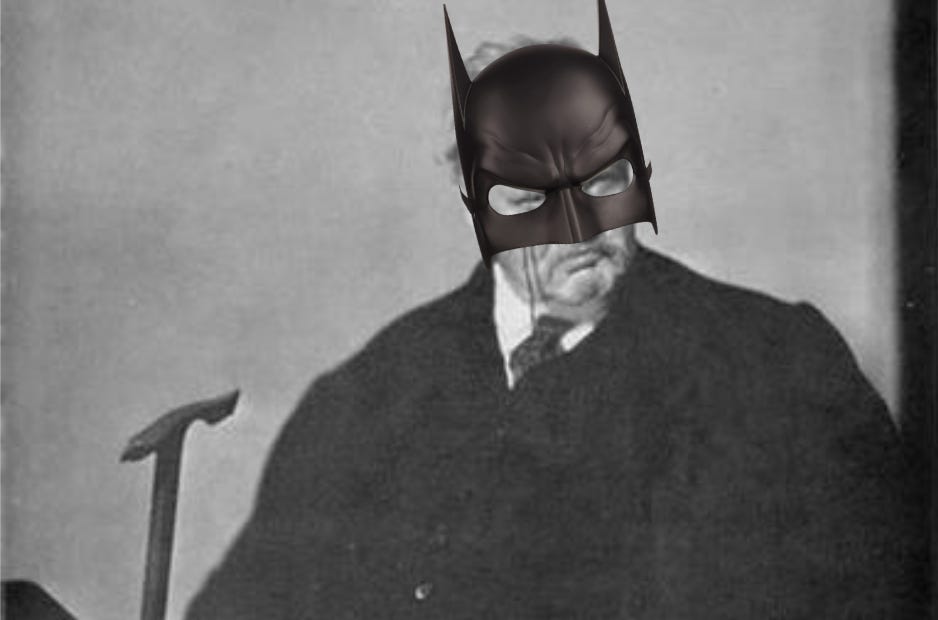
Imagine a vigilante who stalked philosophers who had concluded, in some form or another, that non-being was preferable to being. That life was absurd, or everything was about power, or it’s impossible to justify the suffering of existence, or whatever flavor of that.
This vigilante would follow that philosopher for days or weeks, finding out where he slept, where he ate, where he smoked his cigarettes. One night, dressed as some hulking, monstrous figure, maybe a bat, he would sneak into the philosopher’s bedroom, yank him out of his sleep, haul him somewhere no one would hear, and believably threaten to end his life.
The philosopher would, every time, beg and plead to be spared. The vigilante, well versed in his philosophy, says he will quiz him first and kill him afterward: If everything is about power, there’s nothing intrinsically wrong with a vigilante using his power to do whatever he wants with the philosopher. If being is worse than non-being, the philosopher should be thrilled at his impending exit. If you can’t justify the suffering of being, the vigilante is about to do him a huge favor by making it quick.
Inevitably, each time, the philosopher would disavow his ideas, begging for the chance to continue living. At which point the vigilante would fire his weapon, seeming to make good on his promise. For just an instant, the philosopher would truly believe his time was up. But the vigilante will have missed. The philosopher does not know the miss was intentional. Then, without a word of explanation, he vanishes into the night.
Right afterward, without fail, the philosopher sees everything anew. The stars shine with some kind of meaningful glory. Each breath is a tremendous relief from its previous exhale. Distant air conditioning units hum with the reassurance of a miraculously cooperative society. Tears swell in his eyes. He shouts for joy. He calls his mother. If everything goes according to the vigilante’s plan, he’ll begin to backtrack his public nihilism. If not, at least live more knowingly of his lie.
I borrowed some of the details here from an episode in G.K. Chesterton’s Manalive, mixed, I think helpfully, with some Batman flair. Because when I was in college, I studied philosophy, and that department is like Gotham. It has largely failed as a social project. It is now the home of fear, hypocrisy, and social parasites. You could imagine that if a Batman-like figure were philosophically inclined, he might see some potential in dressing up as a personification of all of these fears, and showing these people, face to face, exactly what it is they’re succumbing to. That might wake them the hell up and give them a chance not to abuse their influence on the minds of young people.
I find that philosophy departments tend to blame everything but themselves for their bad reputation. Some of that is understandable. We are a culture uniquely impressed by the expertise of the scientific inquiry as it investigates the natural world. More accurately, as our scientists unconsciously devote themselves to the beauty of uncovering the true form of the natural world. The reasons for that aim, going unquestioned for a while now, have still produced glorious and admirable thinkers: Richard Feynman, John Wheeler, Stephen Hawking, Carl Sagan. They were men who not only uncovered and communicated wonderful things about our natural world, but presented themselves as good and courageous and worthy of imitation. Not so much for what they say they believe, but by how they act and the things they achieved.
To the great embarrassment of modern philosophy, philosophy departments, by contrast, are full of chain-smoking neurotics who conclude that none of that is really worthwhile. They have become neither the sort of person you would want to imitate, unless you were feeling particularly resentful about your place in the world, nor uncovering anything much of interest lately.
The historical reason for this failure, perhaps, is that as science gained its great power and popularity starting around the 1500s, philosophy departments became less interested in the well-lived life. That is to say, in ways for individuals to better pursue what is self-evidently good, true, and beautiful. They instead started to imitate the scientific method, out of some jealousy of its growing prestige. What both the modern scientists and the philosophers failed to understand is that what you find in an investigation is partly set by who you are. This has been a much worse disaster for philosophers because that is particularly true if you are investigating the investigator himself.
You could imagine some fantasy world where the project of philosophy did not seek to imitate the scientific project, and instead continued to write, and actually live out, the example of a well-examined life. To talk more about what scientific discoveries had to do with each of us, personally, say. This would have required great humility early on in the universities, which, knowing human nature, was never likely. But if they had stuck to their humble aim of describing how to live well in and through each subsequent age, they would have produced a cohort of people who were extremely effective and admirable.
You see flashes of this, of course. It’s the reason philosophy is still a thing and not a total joke. Despite the bad incentives, a few philosophers have continued to be great. Chesterton, Lewis. Both notably mocked for the simplicity and beauty of their prose. Even when philosophers failed catastrophically, some were at least great enough to be interesting, anyway. Nietzsche. Some of the great philosophers of the last few hundred years have also been extremely prescient, able to predict the future of further material investigations by the scientists. Kierkegaard. In its best form, philosophy is the tip of science, pointing its imagination where it might want to investigate next.
The most abject failure of philosophy, though, is the one that most ardently imitated the scientific method: analytic philosophy. They obsess over the precision of each word, mistaking that precision for meaning, and thereby reducing all of their writing to the trivial and also somehow incomprehensible. They fully mistake philosophy for science and therefore sever it from anything to do with the philosopher. Everything they produce is seemingly devoid of the central questions. Namely: what does this all have to do with me? How does this take me where I want to go? Does this help me see the stars better at night, or properly hear the hum of an air conditioner, or call my mother?
They have at least spared themselves this humbling truth: philosophy is best when it is clumsy poetry. It is the imposition of linguistic violence to help us remember why we care about the things we’re saying and doing at all. In fact, by its very nature it is violent and clumsy, which explains how it can so easily go bad when it badly uses its questioning violence on itself. It attempts to fully undo how you apprehend the world, which if not guided toward a higher way, is the source of nihilism and despair itself.
What’s worse, philosophers of the modern age have been so terrified of being understood, and therefore scrutinized and rejected by the trite well-actuallys of analytic philosophers, that even the ones who had something interesting to say had to veil it in walls of incomprehensible prose, with abusively little attempt to ground it and make it apprehensible by the reader.
All of this combined makes it very difficult for any novice with a burgeoning interest in the good life to even set foot into this mire. Even what is good and true and beautiful in the great modern philosophers is so hidden behind a quagmire of nonsense that novices have almost no chance of getting to it. If they do train themselves over many years to be able to get to the good stuff, they will often ruin themselves and their simple ability to understand that the point of philosophy is to enumerate the good. It is most basically the love of wisdom: love being the primal sensation that being is good, and wisdom being the means by which we use knowledge to make the good manifest in the particulars of our lives. It’s a crime, really, what’s been done; how difficult it is for anyone to write or read good philosophy.
As many people have noticed, philosophy of the ancients is certainly a step up from the current situation, in general. Aristotle and Aquinas and Augustine are really much simpler because there was less of this parasitic mind game going on. They’re only obscure, not by intention, but by the fact that they are ancient. Their language is no longer our language. Their examples are no longer our examples. They are of a different age, and so there’s an accidental veil between them and us. A veil that philosophers of our age are supposed to be tearing open, making their search for the good new and inspiring again.
Given the halls of veils we find ourselves in, you now have people who were acolytes of Sagan and Feynman, like Neil deGrasse Tyson, saying that studying philosophy is a waste of time. Which, on the surface, is a philosophical statement about philosophy itself, and therefore a sort of performative contradiction, and also not very insightful. But I can completely understand why he would be driven to say it, because the philosophy departments, as they stand, are basically a waste of time for young people. They attach themselves to the desire for young people to know something and give them complicated teenaged cynicism as the only answer.
However, the idea that young people should only go into scientific pursuits is also completely absurd. Scientific pursuits can be used to make nuclear bombs, AI to wipe out entire species, or for eugenics. It doesn’t matter who you are or what part of history you’re in: everyone has intuitions for the good and will personally find the limits of that somewhere along the way. Philosophy is supposed to be the tool for handling that. Carl Sagan and Stephen Hawking should have had access to better modern philosophers to help them assign correct value to their desire to know more about the physical universe. They got by OK without it, but they were lucky to be so entranced by self-evident beauty. We should have philosophers to question people like them when they’ve gone off the rails in their suppositions, when they’re headed toward dangerous territory, or a dead end, or the destruction of their own vision of the good.
We need philosophers, as evidenced by Neil deGrasse Tyson’s bad philosophy, and many like it. Also as evidenced by the fact that our most beloved technological achievements in the modern world seem to be making us, by and large, miserable and stupid. They are making us wealthy and doing a lot of positive things, but they also seem to be making us depressed and suicidal. Civilizationally suicidal, at times. Correcting all of that would be, in theory, the purview of good philosophy.
Good philosophy doesn’t just have to do with cutting-edge scientists and thought experiments about whether Oppenheimer should create the nuclear bomb or if Sam Altman needs to beat China to AGI, though. It, by and large, is about the human condition in its normalest sense, which even great scientists have to deal with. They have relationships with family, brothers, wives. They have kids, or don’t. Even they need a good philosophy that protects them from the lies of despair and nihilism. They might even need a vigilante to come into their room at night and point a gun at them to make them see the most basic fact of all: being is good.
Philosophy, I think, is the discipline of clearing bad ideas out of the heads of the rest of us, so that we can, in our own way, more clearly focus on what’s good. In some ways, Socrates was an ancient version of that vigilante. He was famously annoying for questioning people about their unexamined beliefs, disrupting what they already thought was good for the possibility of something even better. That process is always painful. Often more so than physical violence. As evidence, what they did to Socrates for trying to do that is kill him.
So the project of the philosopher is a project not only of clarity and simplicity, but of courage. People will always hate you for saying they’re going the wrong direction. Like Socrates, and like the vigilante, the project of the philosopher is to do it anyway. We often misuse that same courage to settle in the in-between and say everything is meaningless. I don’t think that’s really so brave anymore.
Hopefully more of us can wake up to these simple truths. Then maybe more philosophers can do the hard work of helping the rest of us put them into practice in all the details of our lives, in a great defense against the hordes of parasites who try to blind us to that. Maybe we can even do that without needing a gun pointed at our heads.
I love this! What a great metaphor. A sturdy appreciation of this wonderful, horrifying and messy, profoundly dear puzzle of life does give a certain immunity to torture by vigilantes...
Liking this before reading bc GK is the goat.