

Most of what I’ve read, I’ve completely forgotten. Whatever it all was about, it turned out to not be relevant enough to remember.
Occasionally, though, while reading, I will be shocked with sudden insight. My heart rate will rise. I’ll almost not be able to read fast enough. The thinker in question will become a new fixation for me (most recently this was Walker Percy). I’ll go on to read many books’ worth of his material and his influences’ materials. When the frenzy ends, I’ll hopefully have added one or two essays’ worth of worthwhile insight to my worldview.
I’ve noticed a power law: it takes the average prolific and committed writer approximately one lifetime to produce the equivalent of one good essay. It’s impossible for them to know from the outset what tiny fraction of what they write will be worthwhile. If they had set out to directly write their lifetime essays’ worth of material, they will have only produced what is entirely beside the point. A writer has to spend most of his time writing wrong things in order to learn to feel what it’s like to write the right things. That isn’t even to say he will necessarily write the essay that perfectly circumscribes his essay’s worth of material. More than likely it will be dispersed across their corpus like the members of Osiris.
He has to rely on the readers doing a similar power-law navigation to interpret and identify his relevant material. As a reader, the vast majority of what you read is practically useless and irrelevant (as far as you’re concerned), except insofar as the practice of reading itself is your journey of blindly circumscribing your interest. And as you read all of this mostly irrelevant material, you gain, by those seemingly random frenzies of insight, the direction and sense for further insight.
After all the hundreds of books and essays I’ve read, and given how they’ve developed my ability to see what is important about what I read next, I have only distilled from all of that about ten essays’ worth of insights that formulate my entire worldview. That number could be anywhere from five to a hundred, depending on how you define it, or on how often there’s churn: when reaching that new level destroys the previous insights’ value.
Only once they’re in hindsight, those foundational insights are fully digestible in one very human-sized portion: thirty minutes to four hours. A sitting. These things have a natural rhythm to them, based, I’m sure, on our circadian rhythms and gastrointestinal limits and the resulting scale of waxing and waning attention spans. The relative length of sustained attention reveals the relevance and interest of the subject matter: You have a very long and steady attention span for something that’s relevant to you, and a short and sharp attention span for something that’s probably irrelevant to you, but has a small chance of being extremely relevant. Looking at it this way, social media feeds are hypothetically like micro-essays that may, in theory, lead you to a longer essay, which might lead you to a book, which might lead to a change in your foundational beliefs. More on why that doesn’t happen later.
The essay is a better format than the book or short form when you first start looking for these insights, specifically because it fits into a more natural rhythm of human attention. When not stricken by a total immersive interest in a particular writer that lasts for days or weeks, a good thing to do is to read essays and short stories until something really grabs you.
Wouldn’t it be nice if we could just know what material we needed to read, and be directed straight toward them? This, unfortunately, is impossible, because your ability to even recognize the right information only comes in random explosions of insight after long slogs. This is the Mr. Miyagi wax-on-wax-off idea: you’re not capable of doing the cool karate move until you’ve bored yourself stiff with the basics. Short-form does not cultivate this, but both books and essays do, I find. People are much more likely to finish essays.
At first, I thought I wanted to say that books are too long. That is partly what I’m saying. Even the world’s best books only contain about one essay’s worth of material (although, paradoxically, you will have to experience a lot more than that one book to get at it). They contain much that doesn’t have to do with you, like addressing contemporaries and their research, which is only useful for a frenzied reader on some other bender. Your aim is to somehow become a reader like that, not to seek his summary. Books are usually too long (when in doubt) because nobody knows exactly what is relevant until much later, and so books are themselves partly exploratory. A nonfiction book is written for many audiences simultaneously, so most audiences who read most books would be better served by reading essays of that same author, and then deciding whether they want to invest the time to get to know his entire thought processes that would fortify and complete the ideas.
Books are traditionally valued more than essays because they are beautiful physical objects and status markers. It would be impractical and unsatisfying and wouldn’t even make anyone jealous to fill a library with essay pamphlets. In this way, a little counterintuitively, there is something admirable about the people obsessed with distillation and skimming and summary, but not for the reason they think. They think that the information in a book is entirely propositional, and that once they attain the relevant proposition, they’re done. This is almost never the case. You almost always have to have an experiential understanding of a set of ideas, which is only attained by spending a lot of time with those ideas, and by meshing those ideas into the narrative of your life.
At the same time, the people who say that reading is all about pleasure or the aesthetic, or that it’s an end in itself, are reaching for the intuition outlined above: reading is not directly propositional. But they’re also wrong in the sense that all books, even fiction, should ultimately lead to a better belief that helps you live a better life and be generally better at apprehending the world. That’s why we’re interested in them.
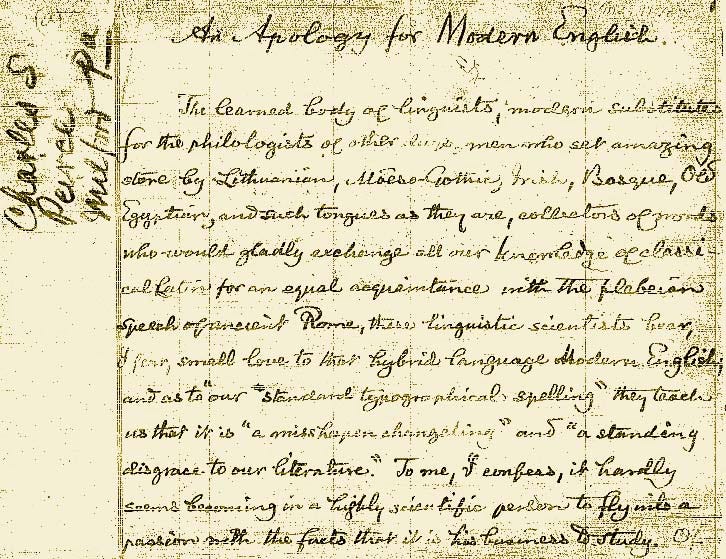
Really, the problem with short-form content is not exactly to do with the medium, although it is true that the medium is also the message. What’s wrong is the belief that puts short form as the central mode of consuming information for modern people (or perhaps the mode of information itself creates the belief; there’s a chicken-and-egg thing going on there). Regardless, the belief behind a short-form addiction is that it suggests by its behavior that you can’t find the right beliefs to assuage the pain of doubt. Peirce called doubt the irritation caused by uncertainty of what to do next. We have a looming cultural moodiness that doubts you can find real truths, so you should just titillate yourself constantly with the false possibility of an inkling of truth (a good definition of “entertainment”), but never pursue anything beyond that, because it won’t be worthy of your prolonged attention.
Now, this in itself is not a true belief. You can, in fact, arrive at true beliefs that work better than false beliefs. The fact that you have yet to arrive at an unassailable set of all-encompassing beliefs is a shortcoming of the human capacity for knowledge acquisition, not a fixed quality of the cosmos itself. The cosmos can be understood, with more and more sets of more and more true beliefs. The problem is we don’t even know enough to identify who knows what we need to know. The obsession with clips and short form is a parasite on the desire to sample thinkers in our search for truth. It’s fine if we want to maximize surface area, which is especially helpful when you’re at the beginning or when in doubt. It’s bad when we think we can’t go beyond the initial search to culminate in an idea that will lead to better flourishing.
The problem is not that modern people have short attention spans. I’m not interested in cynicism in that regard. That most people struggle to find fleshed-out good beliefs is both understandable and itself something that could be assuaged with better beliefs. Some people have experienced those breakthroughs of belief from reading since they were young, so to them it seems self-evident. There’s a much larger group of people who either don’t believe they can arrive at true beliefs, or know it’s vaguely possible, but find books too long to plow through without seeing a light at the end of the tunnel. For them, the transition from short-form to books is too harsh. They aren’t going to do it. Or they’re going to pretend they’re doing it, and really they’re just scanning words without letting them have the possibility of transforming them, just for the sake of having “read” a book. They don’t have the sufficient set of true beliefs that suggests that all this work toward those beliefs would really be worthwhile. You know you have this balance right when reading becomes not just difficult, but difficult and worthwhile. You have to have many, many sufficient beliefs to enter that flow zone with something like James Joyce.
My suggestion to people who want to read more: when in doubt, much more often than we already do, read essays and short stories. Essays by living thinkers you admire, but maybe even better, the great essays of the great thinkers of the past. Start something that you can finish in one sitting. Even though it most likely won’t spark the frenzied search that would make reading huge books feel difficult but worthwhile, with every essay you read, you increase the possibility of that surge happening to you. That is the biological reaction to your doubt being assuaged by the possibility of better beliefs. Most fundamentally, it is the feeling of entropy, represented by doubt, being turned into order, represented by belief.
The circumstantial constraints of the market and object preference have too-long neglected essays. As far as I can tell, the actual niche that Substack occupies is that people want more essays to test the beginnings of true beliefs. Substack solved the problem of making essays marketable, through the subscription model, which has only recently become possible through easy internet payment. I sometimes wonder if the founders really know that they’ve resurrected the natural unit of serious thought and that’s where they should continue to grow.
Still, books are great. Just as with the reader, though, the writer should only write a book when he can’t help but write the book. There are already too many books, because most writers want to publish a book not because they are obsessed with an idea, but because they want the prestige of having published a book. For this reason, most books, especially contemporary ones, are worthless, which still further clouds the ability of daunted readers to navigate this terrain.
Essays are better. They’re less precious. You can make many soft attempts. You can skim the ones that partially grab you, and read deeply into the bibliography of the people who seriously grab you. By reading and writing more essays, a lot more writers and readers will be able to find the essay of their lifetime.
Reading the best old essays is a great suggestion. If I can offer my suggestions:
1: Power of the Powerless - Vaclav Havel
2: Why men love war - William Broyles
3: Dialogue Between Franklin and the Gout - Ben Franklin
4: Of This and Other Worlds - CS Lewis (this one is recommended to JTF specifically.)
5: Homers Contest - Nietzsche (I am working on my own rebuttal to this one, but it still excellent.)