

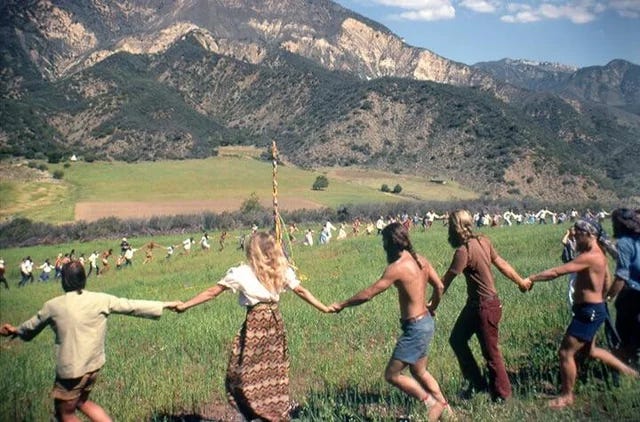
If you were a journalist living in the 1960s, I could give you a great headline: The Countercultural Movement That Wasn’t.
You write: I know you see all the hippies on TV and in the movies, talking about the free love in the Age of Aquarius. The fact remains: statistically, it is still the 1950s. Almost everyone goes to church. A fleeting fraction of people identify as having no religion. Although there are some indications that girls are running off into the woods and you can go with them, it’s really more style than substance.
People would eat that up. Some were vaguely excited by hippies, some feared them, but almost nobody was them. It would have been reassuring to most, or at least grabby as an headline, that their whole deal didn’t bear out in the numbers.
We now know that the fervor of that tiny minority changed the air quality forever. It imbued itself in the clothes and the hair. Even the quality of film is somehow steeped in the sensation. If you look at a picture of someone in the 1960s, you know, in a way that the person in the picture could never understand, that this person is in the 1960s. Everything about what you’re seeing somehow belies its quality. It is the water he is swimming in, and he has no contrast or perspective to see it about himself. What you can see, as his light refracts into the different water of your time, reveals all the psychological implications, and even where things were headed.
In our time, there’s a similar thing going on, in the opposite direction. Young people are interested in traditional religion. They are returning to the Mass and having adult baptisms at record rates.
We’re writing the requisite articles: Hey, actually, the revival’s not in the data. It doesn’t bear out in the numbers. Keep calm and carry on, everyone. Yes, there are lines down the street to go to Mass in New York City, and France, and all over the Western world. Gen Z’s are veiling at the Mass and looking for a husband on social media, but that’s more LARP than touch grass. Head counts are not meaningfully rising. In fact, the only truly growing denominations are the ones that dovetail most elegantly into the remains of the counterculture.
You can nitpick with this if you like. Ross Douthat explained it best: there can be both a revival and a departure happening at the same time. If you flatten all of that into one number, it fails to capture exactly what’s going on. His is, sensibly, more representative — a more appropriate use of two numbers when one number is not capturing the vibe.
Either way, I’m not impressed. In the context of sociology, there are endless ways to stop searching for numbers once you’ve reached the answer that you’re looking for. What’s always most relevant is what you’re looking for and why. What is the vibe of our time? Who gets to decide that? Historically, it’s the disaffected young men who seed where everyone heads next. It doesn’t take many, either. That hardly matters. With this sort of thing, it does often boil down to: if you know, you know. And if you don’t, you don’t.
All I know is that something strange happened to me: I was reading Peter Singer ten years ago and donating a large chunk of my meager income to Effective Altruism. I was a rationalist, a materialist, trying to be Less Wrong, as it were. So you can imagine my surprise, as much as anybody else, that ten years later I find myself a Catholic, married, child on the way, living in a small parish with many close friends. There is the sensation among us that something is happening.
We know a young couple, for example, lawyers, who have similarly moved into an old house built in the 1800s with 15-foot ceilings. They’re renovating it while also having a child. We met them and a few like them in our OCIA class, which are experiencing record numbers across the country. We notice that younger people are generally more reverent than the older people. They want to sing in Latin and Greek. Our parish has a young priest who is putting several million dollars into making the church more traditional, like it was before the avant-garde, asymmetrical architectural movements, implemented in the Catholic Church by some bad interpretations of the Second Vatican Council in the 70s and 80s. We’re even putting in an organ, a real organ, without electronics.
The fact that overall head counts are still decreasing does not pertain to this, exactly. But it also doesn’t necessarily drive me to want to squabble about the data — to make Douthat’s finer point. It would be too much in the mode that I left behind: Wanting to maximize, with the greatest numbers, what I have decided is the correct ontological orientation. Everybody who isn’t convinced that bugs are more important than people already knows the limits of data. Sure, it missed the obvious nuance: engagement, average age, and momentum over sheer numbers. I still say, let them think whatever they want.
What started in the ‘60s is still very much the dominant cultural tide in the world. That can be true, while also recognizig that a 60-year-old phenomenon maybe doesn’t have as much life left in it as a new one. You could even speculate that new one, perhaps, is pushing out the hangers-on at an even faster rate; the spiritual-but-not-religious cradle Catholics are leaving at the arrival of the weirdly intense trads, and now their kids aren’t getting baptized, either. There’s the data in a more flattering light, if you like. That’s still not going to be a very convincing story to the overwhelming majority of people who believe progress is inevitably the liberation of the individual from all social and familial ties.
Unlike some of the more radically “trad,” I don’t pretend to have given up on the idea that history is a progression, either. I just don’t claim to know what constitutes “progress.” I just personally no longer want to live in a world where I am totally free to go and do whatever I want. The vibe shift I’m experiencing is that the heaviness of being is not only bearable, but preferred.
As people are suffering from their atomization and loneliness in the peak of abstraction, most of them are still hoping that the next technological breakthrough will cure them of its disease. Slowly, however, a certain small, more desperate cohort seems to be giving up on that idea altogether and choosing to bind themselves to spouses, and to children, and to communities and churches.
I see them doing that in my real life. When we meet each other, and shake hands, and talk about the YouTube videos we watched and the books we read that led us to these places. There’s some kind of understanding between us. You feel it too. Yes. Something seems to be going on.
When I see the headlines that tell me that my life is not bearing out in the numbers, part of me wants to fight them. There are two numbers, not just one, you see. But maybe then they tell me there are actually five numbers. Really, there are as many numbers as you need to be right. One of us must be like the suit-wearing, conservative father of four in 1967 who had no idea what was about to happen to his children. Both think it’s the other. Mostly, though, I just feel that that’s fine. Think what you like. It’s not a revival. It’s a reversion. Why not?
Maybe we climbed too high along a single axis, and now we have to climb back down a little, into each other and with each other. Get a little bit more provincial and agrarian. When we look back in 60 years, we will see how the light looks from there and how our new Age of Aquinas actually played out.
Not to stupefy ourselves back to the Dark Ages, but to gather who and what is necessary to go higher.
Why I am Christian again

In college, while my friends were getting slammed at house parties, I was working as a bouncer at a hipster bar called Red Star. Lots of IPAs and a jukebox playing Bob Dylan.
You Cannot Win a Culture War

I remember reading Noam Chomsky’s Manufacturing Consent when I was in college. I felt like I had learned a clandestine secret about the way the world “really” works.
“The vibe shift I’m experiencing is that the heaviness of being is not only bearable, but preferred.”
Cool article man. And relatable. I’ve been hesitant about calling it a revival too, despite that word being thrown around a lot, but what’s undoubtable is something is happening. I too would have never seen myself in my situation five years ago—similar to yours—but I am, and I’m elated about it, and people I know are doing it too, and strangers are popping up in my life all over who “get it.” Or, feel it. I live part of the year in a very liberal metro area in the United States and just this week saw two separate people younger than me reading CS Lewis on public transit, and that was on my way home from Mass. This just didn’t happen ten years ago and yet it’s happening in this strange immeasurable way.
“the only thing that makes the Church endurable is that it is somehow the body of Christ and that on this we are fed. It seems to be a fact that you have to suffer as much from the Church as for it”