Taste Won't Save You
Taste is a second thing.

On one hand, I'm happy that, in their limited way, tech bros are suddenly interested in aesthetics. It's expressed through their new obsession with the word taste, as in: the thing that remains when AI does all your white collar work for you.
On the other hand, it's doomed to fail. It's a stupid word, needlessly substituting for what we are obviously grasping for but too shy to admit: beauty. It's easy to understand why someone would prefer a tepid, weaselly word like taste, though.
Taste is something you have in your own private little mouth hole. In there, people can't yuck your yum. It's an expression of your individuality, in that it subtly denies that there is a moral or aspirational aspect to aesthetics. Instead, it smuggles in its own self-defeating implicit assumptions: no one's taste is better than anybody else's, and yet somehow “good” taste is something you should aspire to (hurry!).
Beauty, on the other hand, plainly suggests an angelic choir and you’re somewhere near the bottom. Beauty itself sits at some great pinnacle, never fully manifest in the material world, and yet all beautiful things necessarily gesture in its singular direction. When dirty apes aspire to beauty, we subject ourselves to its harsh demands and so humble ourselves to more deeply discover its already established order. We realize we could only manage to start with ordinary things like neighborliness and cleanliness, and only aspire to grandeur if so called.
Taste, meanwhile, is something that separates you from the plebeian masses of doomscrollers and daytime TV watchers. Taste, for a certain class of tech bros, is the gesture of I'm not like you. It's a way of getting out of the ordinary, the neighborly, skipping to unearned and usually upside-down gestures of grandeur. “Good taste” to these people is usually something as clumsy and stupid as: bro, what if the bad guy was a good guy? or what if beautiful things were ugly? or some other played-out postmodern inversion we've seen a million times. It denies transcendent beauty so they never have to answer to its demands. Tellingly, it always allows the most convenient thing: what if something ugly and monstrous (me) was actually secretly beautiful? This is considered peak authenticity.
Taste is a real thing, don't get me wrong. You could have a child-like palate that only tolerates chicken nuggets and you can develop it to enjoy more complex things like wine and olives. But good taste happens as a side-effect when you want what's beautiful and are therefore willing to reject good for the attempt at great. If you only aspire to second things like taste, you get a distortion of it and then finally nothing.
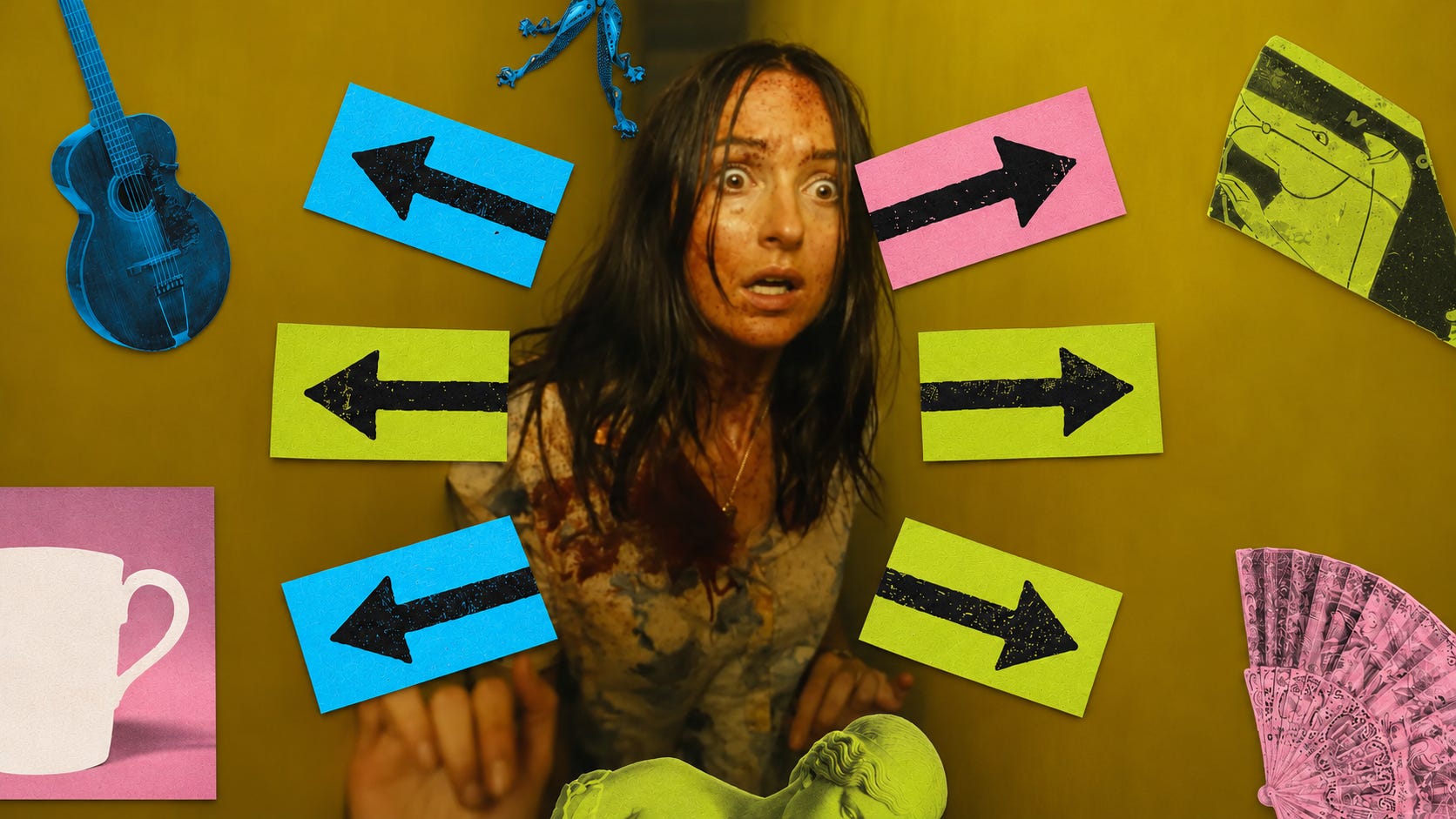
A great visualization of this lossy process of second things is the movie Backrooms. In the back rooms, everything and everyone is a copy of a copy, second things. They become weird, distorted, and monstrous without a sufficient grounding in first things. Everybody who tries to escape by differentiating themselves from the copies only cements their place in the back rooms. As we learn at the end of the movie (spoiler alert), their’s is the even worse fate of not realizing, on some level, that they are in back rooms.
This is the inevitable trajectory of anyone who hopes taste will save them from AI doom. For them, there's nothing but symbol and simulacrum, mimetic competition and its barely veneered violence. Glimpsing this hall of mirrors and being horrified by it, we try to separate ourselves from it with well, I just like things a little more sophisticated than the average person. But this, of course, just plays more deeply into the rules of the back rooms and makes us into the worst slop monsters you could imagine because we have no idea what we really are.
Backrooms is a horror and a tragedy, and so that's how that story ends. It's a great movie because it correctly represents the cost of doing things wrong. I don't know if the movie knows there's a way out of the back rooms. For the sake of the movie it doesn't really matter. For our sake, we should know that there is a way out. The demands of second things, like taste, won't offer it to us. The much harsher demands of beauty, will. It grounds us in being, in reality, and offers the respite of actual demanding feedback.
AI is trained on many texts, which were all informed by direct experience of reality and its demands. To the extent that those texts conform to that, we deem them authentic, beautiful. Worth keeping. AI training weights more heavily the sort of text we deem high value (beautiful), and weights down the incoherent, the ugly, and the forgettable. The experience of beauty over time is implicitly built into how the machines were trained: how the texts were produced, informed by firsthand experience; how they were received by audiences, informed by firsthand experience; and how it was canonized historically, based on changing experiences through history and therefore finding what remains through change. The machines borrowed a trillion instances of these ontologies. That’s why they’re pretty good at imitating them.
Something fundamental: they can’t experience the onslaught of rapture required to produce a single iota more. They must continue to borrow that image of infinite light from you, even now. They need you to tell them how to be. Every time you use the thing, you’re telling it, from the depths of your guts and balls, “not like that, like this.” In this way, AI is itself a hopelessly second thing. A copy of a copy. It lives permanently in the back rooms. It may be useful, tasteful even, but never beautiful.
I read that New York Times piece "The Internet Broke Our Taste. Will AI Destroy It for Good?" The author was describing the treadmill of trying to keep up with the right tastes and liking the right things, worrying about being performative in what they read, or buying the right lamp: chic and cool, but not too chic, and also not too pedestrian. It clarified something for me: optimizing for taste has the same qualities of AI slop. Status competition is mimetic. Meaning, we imitate each other for what we desire, making copies of copies of things desired. A mind fixated on status, taste, has an inherently simulacrum quality to it. It copies but cannot create. It is always all about how it seems to other people.
I relate to this, in my worst moments. Importantly, though, I know for sure that there exist primary experiences of beauty, which are entirely for their own sake and speak to the real shape of being itself. I know this because I’m human and I yearn for and love these things. You cannot talk me out of it. I would die for it. Still, sometimes I catch myself doing something so other people will think I have good taste. I get it. It’s a vice. A bad habit. It's sad, almost, that these yuppies don't have a sufficient primary experience of beauty to know for sure it is real. I suppose the central joy they get out of life is being higher status than other people. They use and abuse a copy of beauty as a way of gaining that status, thereby making it almost impossible to ever have a true relationship with it. They are like semiotic peacocks, the lovely final flourish of a genetic strange loop, a dead end.
When the realms of taste reach toward the transcendent and the divine, they overcome a fixation on the self and its social standing. Beauty shines from between the gaps of ordinary relationships: the suffering and their miraculous comforts. The ability to show compassion to a struggling stranger, for example, or to build something beautiful that you'll never get to enjoy but that will be enjoyed by generations you'll never know. This is the place where taste stretches itself thin into beauty. You lose yourself in the stretching and the loss of self is exactly where taste may die into beauty. The taste people haven't yet understood that this realm is completely ontologically superior to the their realm, wherein everything is about signifying your personal sexual competency (that is, status) and therefore separating yourself from others. If devoted to, that realm twists and warps you weird, into a monster.
The social, cultural, economic, and even technological realms are all still natural ecologies, and so there are universal laws that we can derive from them. Because we ourselves are specimens in the tank, we have to do this in good faith or we will distort the results with convenient lies. You can always pretend not to know what you know to be good or bad in order to get something you want now, which is basically the gist of modern philosophy and politics.
You know beautiful things when you see them. Don’t let anyone try to fool you. We have much more responsibility toward those things than animals, because we can self-consciously aim at them (or their opposite), not over evolutionary spans but over the course of days and weeks. We live in a super-ecology of angelic forms that we have partial access to, and yet we remain painfully embodied. We can access the realm of forms, witness them in awe, and then come back down to our earthliness and slowly change things in our actual environment, thereby changing our fate. This is unique in the cosmos. It is the realm of beauty. Taste, put simply, is optimizing for your sexual fitness within your meager life. Beauty is optimizing for humanity’s place in the cosmos.
AI produces outputs. We say whether we like them or not, whether they're good or not, whether they conform to our expectations of how we see things, how we think of reality, and hopefully what we think is beautiful. It continues to depend on our intuitions to even exist. The only thing to do in response to that is to more deeply develop our intuitions toward beauty.
One instance of being humiliated by a beauty beyond your comprehension will do much, much more for you than even the most sophisticated palate.


*Reads piece and marvels
me to my wife “he can’t keep getting away with writing this well”
Excellent piece again
“Importantly, though, I know for sure that there exist primary experiences of beauty, which are entirely for their own sake and speak to the real shape of being itself.”
Yes, and once you see it you can’t unsee it. When you’ve had a taste of primary beauty, that ontological contact with reality, external status-seeking can be seen as a the wafer-thin substitute that it is