

When I was a kid, I would get off the bus at my friend’s house so that we could sit right next to each other on the couch and watch each other play Pokemon on our Game Boy Colors, until we were forcibly separated because I had to go home for dinner.
We still cut the grass and did our homework. In the summer, we went on long hikes and camping trips away from the Game Boys. But the entire time, we were talking or thinking about Pokemon, or whatever other video game or piece of cutting-edge technology we were interested in at the time.
I remember a vague disgust this behavior elicited from our parents, and also how they had basically no way of stopping us. They and their parents had grown up in a time before all this. They had personally watched the entire world transformed before their eyes by post-war technological advancements. It made a lot of the Boomers rich beyond belief, and it had granted them, and by proxy their parents who had lived through the Depression, the ability to give their children everything they never could have afforded, and so much more. Even though they were annoyed that we were looking at the stupid Game Boy and talking about the stupid Game Boy practically all the time, they still felt, somehow, like they owed this to us.
I remember that I had a Gateway desktop computer. I pulled it apart and discovered an extra couple of slots for more RAM. With the help of the local computer repair guy, I brought my bedroom’s computer up to a whopping 768 megabytes of RAM. That was still relatively modest even for the time, but since I couldn’t afford the multi-thousand-dollar gaming computers, it at least was enough, I knew, to play Call of Duty. So the next time my mom took me to the mall, I got the boxed CD-ROM, and on the way home I read the back of the box and the entire manual, and recited passages of it to my mother like it was Whitman.
Then, one day my stepdad came into my room and told me we had just gotten high-speed internet. He got it to connect all the high-tech security cameras at the convenience store we owned, which was, helpfully, just a short walk across our front yard. Suddenly, I could play the even newer Call of Duty 2 online with strangers from all around the world. I did that so much I would dream about it every night and one time had an anxiety attack about my kill/death ratio (really).
I remember also that I had a GameCube, and I tore open all the little flaps at the bottom and saw ethernet ports, plug-ins they had included for potential online games in the future. This was a magical promise to me. I dreamed of being able to play Animal Crossing with my cousins who now lived far away. These sorts of dreams of non-local hyperconnectivity were getting better and more possible all the time. It felt like it was all headed somewhere better than merely here: to the stars or virtual reality or downloading ourselves into a computer. That stuff was more inarticulate than it is now, but it was certainly there. That was what was so exciting about technology, and particularly video games: it was always getting closer and closer to simulating a better reality. As the dreams of these video game developers shaped our minds and our aspirations, we wanted nothing more than better graphics, better connectivity, more realism, faster physics engines.
What I’m describing is what it was like to grow up in America in my age group. To buy a PlayStation 5 these days (and notably it’s mostly people my age still playing these types of video games) would be a sad imitation of the excitement of possibility we felt back then. That’s not to say people don’t continue to play lots and lots of video games. But something has been lost about that exciting frontier that was unfurling in front of us back then. Kids now don’t play Game Boys and dream of Pokemon being made real. They don’t look forward to the next newest thing in the same way we did. They’re just handed an iPad and go slack-jawed, for the most part, watching other kids play video games for them.
There is some saturation happening, we must notice. We’re bored by promises of better technology and now looking elsewhere. We’ve gotten pretty much all we can consume. We’re informationally obese and looking to go on a diet. Millennial parents are more likely to restrict their kids’ access to technology. The more they understand the technology, the more likely they are to restrict it. They’re understandably horrified by the now clearly negative effects of it, how it’s making kids depressed and anxious and unable to be in the world. Kids today aren’t like we were, forced to spend time away from already limited technology, out in the woods, seeing the real thing while fantasizing about the fake thing. Now it’s all fake things, all the time. Parents can hardly help it, because they are also caught up in being entertained by all the fake things they are now too afraid of the real world to send their kids off into it. But the important change is that now at least we want to want it to stop.
My wife and I were discussing this on the couch the other night, talking about our future kids. For us, it seems obvious in a way that just wasn’t to Boomer and Gen X parents that we wouldn’t just hand our kids the latest technology. This seemed to have shifted around 2020 (with a sad, lost generation of young Gen Zs who had the full blast of the best technology and none of the restrictions). It’s also interesting how disinterested in better technology we’ve become ourselves. She joked about seeing an Apple Watch on sale for $200 and briefly feeling a pang of excitement, like she was a child again and might get herself something good for Christmas. Then she realized: what would she even want with an Apple Watch? She already hates her phone. Why would she put it on her wrist so people can text her even more often? We even have “bricking” software installed on our phones to make them inaccessible and dumber in certain ways.
This is not to say I hate technology. In fact, I am in my backyard as we speak. It’s a beautiful day, the sun is shining. It’s largely thanks to technology that I can be out here comfortably while I write down these thoughts. There’s a distinction I want to make between Technology Is Over and being Against the Machine. I find myself very much feeling that Technology Is Over, but definitely not in the camp of Against the Machine.
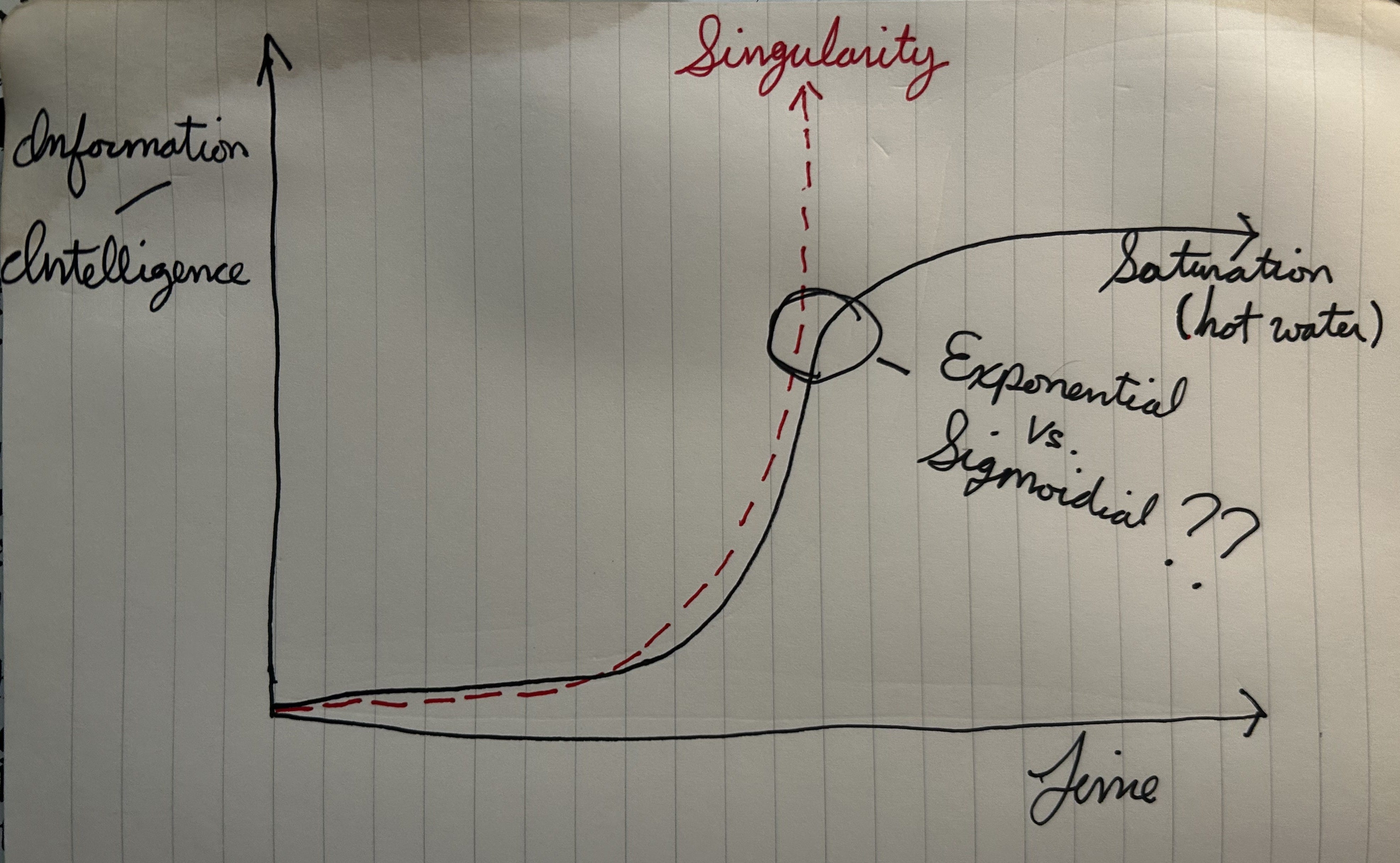
The way to make sense of this, I think, is by making an analogy to other resources. Technology distills information. In the case of video games, it synthesizes social storytelling into a format you can do by yourself. You are participating in civilizational myths, almost like being around an ancient campfire, but it’s optimized for the convenience of one person to do that alone, in the most salient way possible. The primary unit is information: information about good storytelling, about electronics, about whatever else you need to make that happen to get the most salient thing for least effort. At a certain point, presumably, you get enough of that. When that happens to enough people, the exponential graph eventually becomes a sigmoid one. The demand flattens, as it did for many other commodities like, say, hot water.
Our hot water heater broke the other day. It was about twenty years old; the input spigot had rusted through and was pouring water all over the utility room floor. So my dad and I went to Home Depot and picked out another one. It’s pretty much identical to the twenty-year-old one we already had. We replaced it, connected all the same tubes and pipes, and once again our hot water was 100% functional, in exactly the way it was twenty years ago.
Long before hot water heaters, people had to boil water over fire if they wanted hot, clean water. This required enormous amounts of energy and motivation, so hot water was used sparingly. People took very few baths. They washed clothes by hand in cold water. Then, we invented small versions of the hot water heater, making it much more convenient to run a few gallons of hot water through pipes in the house. New things were invented (the dishwasher, the laundry machine) to use even more hot water, which expanded our need for more of it. We made the heaters bigger. Then, we invented hot showers, and non-leaky faucets, and all this other technology that made the convenient use of more hot water possible, and so expanded our desire for more.
This was once an exponential graph, very similar to the exponential graph of computing power we’re undergoing right now. If you were making the same assumptions about hot water that people make about compute, you would assume that the quantities of hot water we desire, and the new uses we invent for it, would grow exponentially forever, creating infinite new jobs and new uses for hot water.
The reality is that at some point, we got enough hot water. However many gallons the tank was twenty years ago is the same number of gallons the tank is today. We’ve thought up all the reasons we would need hot water. It plateaued, and now hot water is “over.” We still use hot water. We still appreciate hot water, when we even think about it. But the exponential gain of more and more hot water is no longer. There’s no gold rush. It’s just a steady part of our lives.
Scott Alexander wrote “The Sigmoids Won’t Save You.” He reasons that historically it’s basically impossible to say when the exponential will flatten like it did with hot water. We have a record of being wrong about birth rates and solar energy. So when I compare hot water to AI and its quickly growing data centers, I can’t say at what point we will have enough information and intelligence to satiate all our desires for it, or for how long it might help us invent new desires. That would be to make a prediction about the future, and people are notoriously horrible at making predictions about the future. I don’t know when or how the curve will flatten; in a hundred years or less than one. What I do see, however, are indications that we are reaching some important limits of information satiation in the social realm. Scott’s own example cuts this way: the airspeed record didn’t flatten because ramjets hit the walls of physics. It flattened because people didn’t want to pay for the next generation of technology. He says the best way to understand when an exponential will sigmoid is to understand the mechanism of the trend. Great. The demand for this trend is capped by our appetite for information.
The best technologists have always known that technology is not about the best possible tech. In a famous Q&A, a very technical audience member grilled Steve Jobs about his refusal to use the “best” technology in his products. After a very long pause, Jobs calmly explained technology is not about making the most advanced tech ever and then working backwards to find a place for it in the market. It is about finding the demand in the market and using whatever technology you can find to make that market dream manifest. So the “susceptible population” for AI isn’t compute, it’s an unsatiated human desire. When parents start taking away the iPads and bricking their phone and it’s embarrassing to be caught using AI, that’s a real indicator that some seam of a limit is being felt. The social world is where you are going to see the first signs of this saturation, not the technological one, which is the exact space the technologists tend to overlook.
In video games, there seem to be massive diminishing returns on increasing compute and graphical fidelity. Not only that, but it takes exponentially more compute to increase the resolution marginally. At this point, most people are pretty much satisfied with phone games, or just playing Jackbox games with their friends. It’s not that high-fidelity video games go away as a source of entertainment, as a way of bringing that ancient “campfire” desire into more private access and higher fidelity. We will still probably be somewhat excited by technologies that foster or enhance that. But we’re now at the point where we’re actually limiting the input rather than seeking the infinite horizon. That seems to be a fundamental shift in our relationship to technology. My kids will perceive tech much differently than I did when we were kids.
Because unfettered personal access to technology, we’ve now realized, makes it more difficult to learn certain embodied skills. Skills that, importantly, transfer from one context to another. Being able to play Spider-Man at the very highest levels on your PS5 (which I could) doesn’t translate to being fun at a party or telling a good story at a bar. Kids today, Gen Alpha and Gen Z, are much more depressed by their inability to be fun at a party or get a date than by their inability to buy the latest video game.
I wouldn’t want to forget that there is a very committed crowd of people who quite passionately do not think Technology Is Over. They are mostly in Silicon Valley. If they’re wrong, they’re going to take the longest to accept it. They’ve dedicated their lives to the infinite horizon of exponential growth of intelligence as a source of their power and wealth. AI, like the written word and the printing press before it, attempts to make organized information easier and more accurately acted upon in the world, which is the definition of intelligence. Like Jobs, they should intuit there is a point of satiation for even that. All of this technology has to be for something, after all. It has to entertain us, or feed us, cure us, protect us, or whatever it aims to do. Those desires could be invisibly fulfilled by AI-powered research and development for many years to come. B2B and government applications, as abstract as they sometimes seem, still have to cash out in reality somewhere. For them to be right about infinite exponential growth, the technology itself would need to become an infinite consumer of its own outputs. They do think it will do this, but there is, so far, no real evidence for that.
The techno-optimists, as they’ve so conveniently named themselves, have bet their lives on an infinite exponential. An exponential curve going on infinitely is necessarily a singularity. To them, the “singularity” actually means that all the sacrificing they did of their ability to be normal in the real world will never have to be paid for. A lot of them semi-religiously believe they’ll get to live forever in some abstract super-world where they never pay the cost of being weird at parties. Maybe. But that’s a suspiciously convenient thing for them to think. Go and read AI 2027 with this in mind, or whatever papers where they’re predicting these various sociopolitical apocalypses and runaway self-improving technology. It becomes a little more just-so. Wouldn’t that be nice for you?
Now, again, I can’t accurately predict the future. Any attempt at doing so will certainly be wrong, probably in an interesting way. Still, it seems to me that AI in particular, as the self-proclaimed culmination of Moore’s law, is a threshold we can’t come back from. As it becomes more and more clear that these machines are nothing like conscious people, that they don’t do runaway self-improvement, and that they won’t foment the apocalypse, there will be a great disappointment among the builders and a permanent disillusionment in the rest of us. In a twist of fate, the apocalypse the techno-optimists are predicting is probably their own apocalypse. Their lifelong abstraction and rebellion from embodied living created the machines that satiated our desire for those very machines, causing us to become more and more uninterested to further improvements of them. Intelligence will at some point become a utility, like hot water, that we use when necessary and shut off when we’re playing in the yard. When that happens, you’ll be better off if you know how to play in the yard than if you know how to code.
I know a lot of normal people worry about the tech people, that they’ll usher in a technological surveillance state where we have basically no usefulness as humans. That we might “get” to live in virtual reality masturbation machines for all eternity seems intuitively evil to anybody not already deeply immersed in that perverse hope. Really, though, if I go outside and see the sun, and my backyard, and the house my dad fixed up and that my wife and I are living in now, I am strongly reminded of the fact that it hasn’t changed much in 200 years. The only difference between me and the people who built this house 200 years ago is a few small pieces of nearly invisible technology that are, as Marshall McLuhan pointed out, merely extensions of my human senses and desires. Our ability to communicate with each other, our ability to see, our ability to hear, and so on. If I get real, so to speak, I become a lot less worried about all that. The thing about reality is that you can’t beat it for long.
Maybe it seems like they can beat it forever because we’ve all seen exponential technological growth for our entire lifetimes. But it’s much more likely that this is a historical anomaly, and that the actual day-to-day future will be much more mundane than we think. Predicting that the future will be relatively mundane is the one prediction that often turns out to be true (but is not very clickable).
Just like all the people who were worried about the nuclear bomb earlier in this age: the thing to do is to get on with living. Building a house, having a family, and being useful to people, and making things beautiful: making a garden, making a little hut where you can write your essays, cutting the grass and weed-eating. When all is said and done, twenty or fifty years from now, I have a strong feeling that most people will wish they had been doing that all along. That is what it practically means to believe that Technology Is Over.
Even if that’s not true, and everything is suddenly taken away from me in an AI apocalypse, at least I’ll die with people I love, doing normal things.
The law of diminishing returns has not yet been repealed.
Thought there will be this C.S Lewis quote at the end, fits perfectly:
"If we are all going to be destroyed by an atomic bomb, let that bomb when it comes find us doing sensible and human things praying, working, teaching, reading, listening to music, bathing the children, playing tennis, chatting to our friends over a pint and a game of darts—not huddled together like frightened sheep and thinking about bombs. They may break our bodies (a microbe can do that) but they need not dominate our minds."