

In Aristotle’s Nicomachean Ethics magnificence (megaloprepeia) is defined as a fitting and tasteful expenditure of large-scale wealth on a grand or noble public work.
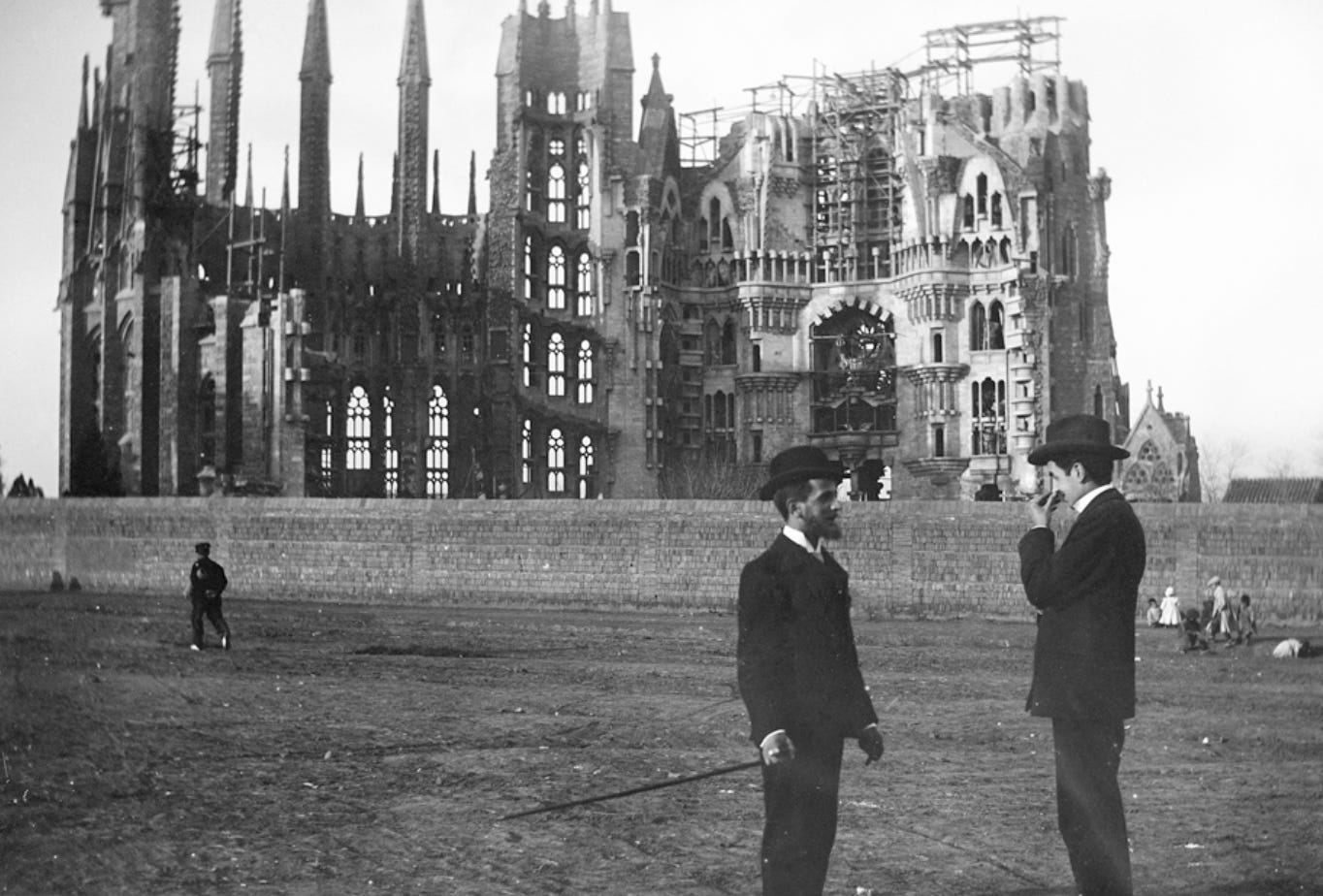
Warren Buffett is perhaps the least magnificent rich guy in history.
This is to say nothing of his other virtues: thriftiness, industriousness, intelligence, and so on. I’m sure he’s a nice guy. But he is decidedly not magnificent. In fact, he is purposefully not magnificent. He’s enriched himself into an ahistorical demigod while strictly seeming a doddering boomer, eating McDonald’s and reading the newspaper for eight hours a day or whatever he says he does. He’s built or invented no great public work with his name on it. He desires to imbue nothing with his own image except funneling his pile of accumulated wealth into “philanthropy,” which just amounts to emptying his bank account in the name of a conveniently intangible and distant “good cause.” This is generous, but not magnificent. He carefully makes no claims about what he thinks is good, true, or beautiful. He has no artistic protégés.
This is a perfect defense mechanism for the 20th century, and he’s a man of his time. The industrious American from last century needs to believe that as long as you work hard and save your money, you too can become fabulously wealthy. By risking no vulgarity in spending, he protects himself from the danger of the public consensus that his wealth is a grotesquely self-sustaining phenomenon, a vulgarity in itself, gotten by luck and circumstance and talents of birth. He must act like a peasant, to prove to the peasants that if they could just be as thrifty and hard-working, they too could be kings in rags. That is the very clever defense mechanism for Buffett’s public image. Also, it’s hideously ugly.
It’s understandable, though. Since the turn of the last century, people have had to deal with extreme new levels of public, global wealth. Now, of course, Pareto distributions always existed. Clan chiefs are buried with all of the clan’s gold. This pattern is deep and everywhere. The sun in our solar system has almost all the matter. The city has almost all the people in any given area. And so on. But the new mass media starting in the 1950s made wealth inequality very uncomfortably public. A very tiny minority of people accumulate all the wealth, thanks to these very predictable mathematical feedback loops, which behave suspeiciously as if orchestrated by an cabal of the rich, and which the rest of us all must endlessly spectate, green with envy.
For a bright, short stint near the beginning of the modern economic explosion, you have what we now call “The Gilded Age,” which is that time when the Titans of Industry built all those Art Deco buildings, libraries, and colleges. Magnificence “peaked” here, but that was more like a convergence of forces with different trajectories. Wealth was exploding, funding a historic crest of otherwise declining magnificence. Mark Twain coined the term “Gilded Age” as satire, as in a layer of gold, covering rot. Magnificence risks vulgarity and modern scorn by its mere glamour, drawing too much attention to disparities in wealth, and so rich modern men slowly unlearned it as we marched into the 20th century.
In general, we’ve had a terrible time dealing with the idea of visible global industrial wealth, psychologically and culturally. Some try to explain it away with merit: those at the top must deserve it. Others try to explain it away with class warfare, but then struggle to make sense of all the terrible poverty and violence they cause by “fixing” it. Buffett’s answer is at least a relatively stable one. By acting like a person who doesn’t have money, he’s allowed to keep his money and we’re allowed to think we are just him in the past. But this is an older, boomer-y defense mechanism. People aren’t buying it so much anymore. We’re feeling around for a new story. What else could we do to protect ourselves from the unbreakable math of runaway wealth accumulation, the resulting envious masses, all of which is as numerically inevitable as the orbit of Saturn?
Here’s a new idea based on an old idea: the virtue of magnificence.
Aristotle gave us the word. It’s been bastardized to merely mean “very neat indeed,” but originally it meant “greatness that fits.” Appropriate acts of enormous spending in the public sphere. It’s different from generosity. Anybody can be generous. Magnificence is specifically when rich people spend big money on public things that are tasteful and good.
Aristotle knew that every virtue is a mean between two vices. The vice on one side of magnificence is your Warren Buffetts: stinginess, smallness, pettiness, lack of vision. On the other end, the vice is vulgarity: selfish displays of wealth meant to show off the power of the spender. The appeal of Donald Trump’s vulgarity, come to think of it, is an overcorrection for the implicit lie of old-school liberals like Warren Buffett: you can nickel and dime your way into billionairehood, or at least to upper-middlehood. Trump’s whole vibe screams, no, that’s a scam. You’re never going to become rich like me. But I’m the sort of guy who’s at least rich in the way that poor people want to be rich. That’s to say, honest.
The reason we swing so wildly between these two extremes is because balanced magnificence is not a liberal virtue. Magnificence suggests that your wealth isn’t yours. In a liberal state, you are sovereign only over yourself, so the acceptable mode of magnificence can only be an extreme of either of its vices. The deeper truth is that if you are lucky or talented or hard-working enough to become one of the people who attains runaway wealth, you gain a new responsibility and its associated virtue that only exists in your tax bracket.
If you’re rich, you are obligated to develop taste for spending fabulously. You are meant to identify projects and protégés of beauty and public good: not monuments to yourself, but also not rent-seeking, uninspired office buildings meant to glorify nothing but your bank account. They should be projects and people of lasting beauty. The more the beauty elevates everyone, and the longer it lasts, the more magnificent you become, and the more honor you receive, which can last generations. If you fail to develop your virtue of magnificence, if you nickel and dime the construction of whatever you’re investing in, you fail to generate many times the value of the bare resources deployed, which negatively compounds over time. You actively hurt the people who have to live with your manifest ugliness day to day.
A lot has suddenly changed in the last 100 years, which contributes to our collective confusion about this simple, ancient idea. We stupidly don’t understand the value, even the brute economic value, of beauty. At the same time, we’re dealing with amounts of money we’ve never seen before as a species. That still doesn’t change the nature of the virtues that we’re working with, but it does make the sliding scales more sensitive. It also gives more opportunities to ideologues who manipulate our vices (typically envy) to get us to participate in “resistance” that hurts everyone.
We, for example, developed copyright and intellectual property and patent laws shortly before the rise of global economics. As it turns out, being able to patent and protect a mere idea, rather than invest in a physical creation in the world, encourages industrialists and artists to become obsessed with abstract and replicable forms, which leads to products that are extremely temporary and have no lasting value as permanent objects.
We’ve gotten very used to the patent world, each of us thinking we will one day become a famous screenwriter or inventor, so we will resist their destruction. One potential upside I see of AI: by making nearly any software or IP reverse-engineerable, it may bring the practical, if not legal, death of IP culture. You may feel it: A vacuum is forming for where to put our ambition and our visions and our creativity. What’s still missing is a practical patronage model to funnel our desire for magnificence.
Now, there are still institutional grants for geniuses and artists here and there, but your average suburban millionaire has no local, personal place to put his generosity besides faraway “good causes” run by people he doesn’t know or trust. A lot of his money is sitting useless in tax shelters at this very moment. He has no way to show off his taste and therefore no reason to develop it. This has been a brutal loss for culture, especially locally: patronage of artists and local public buildings was an excellent way for rich people to show off their magnificence. They got to partly choose and foster generational talents, geniuses, to make these objects. The geniuses get to focus on creating without having to bend to mob rule.
IP culture forces most of us to be not only an artist but also our own marketer and business person. No matter how talented we ever get at this, we’re still always having to make sure that we appeal to mass sensibilities. It lowers the beauty of our outputs because what is popular is not always what is beautiful. You sometimes need to create things that people are uncomfortable with for a short period of time, but that change the way people see things over a long period of time. Some modern films have managed to do this with the quasi-patronage system of the studios, but those are now slowly failing in the streaming wars.
I have also known a few people, and I’ve heard of many more, who have been funded by that shadowy cabals of billionaires. This is a sort of patronage system, but also a suboptimal one. The most representative of this type of billionaire is Peter Thiel, and it seems to me that what he is trying to get out of patronage is a return on his investment. Specifically, he’s trying to maximize forming global “mimetic” worldviews for the greatest amount of personal leverage. He (reportedly) forbids his protégés from talking about certain topics. They themselves tend to keep their funding secret. Worse, to stay funded, they still have to hit certain audience numbers to remain relevant and go viral. This is a very short-sighted and cynical way of doing patronage. It has all of the downsides of mass appeal media and none of the upsides of patronage. The only thing you really get out of it is more power for Thiel and short-term financial security for the thinker. We, the public, get almost nothing, except manipulated.
Patronage is not about a return on investment. That’s just venture capital. Patronage is about leaving public artifacts of beauty to elevate the consciousness of everyone. Making genius more numerous, but also making ordinary life in the commons more enjoyable.
To the creative and ambitious: Stop trying to be like Warren Buffett. Rich is something that happens to the lucky, the elite, the talented, and the exceptionally hard-working. Those people never needed to watch inspirational YouTube videos to achieve that. Seek instead to create beauty and let the cards fall where they may.
To those with some money: patronize the people and projects you believe are beautiful. Develop taste, or fall into vice. Build lasting monuments. Become magnificent.
You can’t take it with you.
America Is Coolness

There is a performative contradiction at the very heart of the American psyche. It functions best when not examined. If it’s ever brought to consciousness, it’s usually because it’s either not working or suddenly stops working for you. Once seen, the contradiction can drive you insane.
Microplastics Are Bullshit

Thousands of years in the future, long after your body is dissolved, billions of microscopic particles in place of you will remain buried six feet down in a vaguely fetal shape. Because surely we can’t get away with this.
WB was born in 1930, an early Silent. Lots of assumptions about his motives. Or maybe he has said the same, idk I guess.
You should expand your concept of magnificence. And as the first commenter identified, stop hallucinating. A modest amount of numeracy would have told you WB wasn’t a boomer.