Anakin Is a Loser, Though
Gen Z men have accepted the Star Wars cosmology so deeply that they would die by its rules before seeing outside of them.

A long time ago, in a galaxy far, far away… there were no beings through which the universe experienced itself. There were only two things: one and the other, cause and effect, yes and no. Yes had hovered over the face of no, and, for whatever reason, overcame it. Thus, there is something rather than nothing.
Then, at the beginning of duration (that is, time as experienced by a self-consciously mortal being), is “I”: looking, seeing, hearing, listening, reading what I’m writing. The observer, who is experiencing this right now, is the third to complete any two things. Even when looking back through faraway galaxies long ago, I Am is always there to make any two things three.
From this development emerges a most fundamental pattern, one you depend on so deeply to perceive anything that it manifests in your very biology, down to your semi-bifurcated brain structure. I’ll retell it to you now, but only to remind you: The world is fundamentally composed of what has been named and what is unnamed and, you, in the middle, are the namer. The third. You are the Walker between order and chaos. By the miracle of your birth, you simultaneously birth into each half the cosmic pattern mother and father. This fact is more fundamental than atoms.
At a primordial level, we associate what we have named and ordered with what is masculine, with our father. We associate the opposite with the mother: creativity, the womb, potential, and all diverse particulars in harmony and peace. In the middle of those cosmic parents we have the good namer, the hero, the savior. Here, we have the original cosmic cast of three.
But, because of our ability to know and even create things via names, we have a spirit like a god. And gods can fall. That’s to say, we have the free will to name things out of a desire to hurt and control as well as to enjoy and celebrate. After this split, another three fundamental characters emerge: the bad father: the tyrant and the fascist. His queen is the bad mother: chaos, destruction, predators and all that must rot and break apart into disorder. They are the parents of the adversary, the Walker of the wrong path, the anti-hero, the snake.
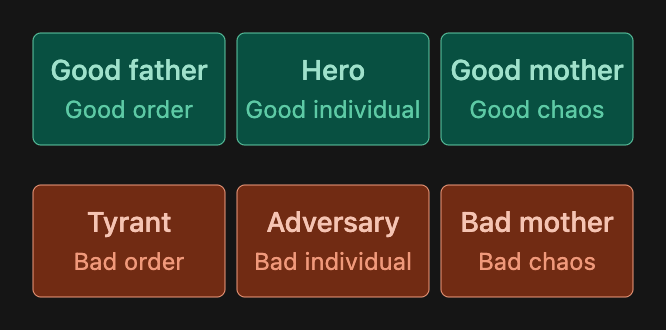
These six characters map onto every story you’ve ever heard or even could understand as a story. They are grammar that cannot be overcome, only subverted and thereby reinforced. They work like the limiting rules of music, which through that very limitation may produce infinite melodies. They play out through human lives and stories and heroes’ journeys and kingdoms and democracies and empires and tech companies. The six characters eternally vie, meld, change hands, exchange emphasis, in ways that are both painfully obvious and eternally surprising.
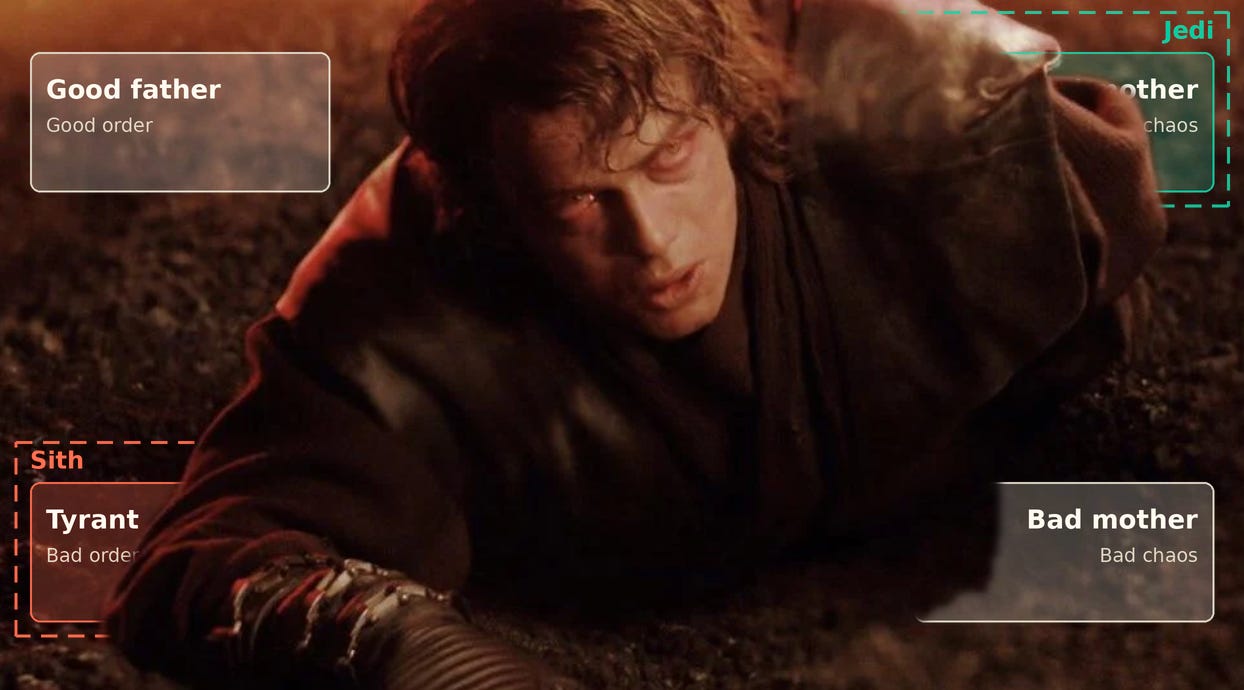
With that in mind, consider that Gen Z guys are newly interested in the Star Wars prequels. They apparently identify with Anakin Skywalker. They feel that the Jedi are like their boomer fathers, setting them up to fail by hoarding wealth and position; pretending to be a fair and diverse democracy, but secretly coveting power and squashing rebellions just like the Sith they claim to be against. They won’t give Anakin the rank he feels is due to him, and so logically the only thing for him to do is to become a Sith.
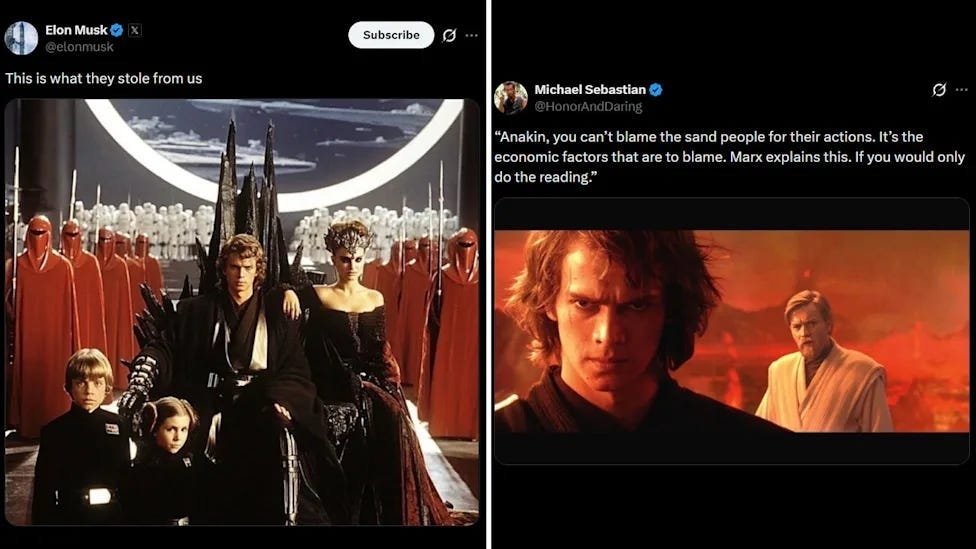
When Lucas wrote this movie, I’m sure he couldn’t have foreseen a generation later kids would be identifying with his proto-Hitler. In good storytelling fashion, he wrote Anakin as an attractive foil, but was also careful to show that he was not ultimately attractive because we know he eventually loses to and is redeemed by his Jedi son. The Star Wars universe does allow a redeemed father, but only if he dies and never rules.
We’re at an interesting point in history, though, because young men are so disillusioned (and as I’ve said before, older people underestimate how bad this is) that they don’t even care about losing catastrophically in the long term as long as they get the power of Darth Vader in the short term.
They would rather be an evil loser who at least has some backbone than a stooge in a system they can’t begin to compete in. It’s the same phenomenon that had young men identifying with Patrick Bateman and the Wolf of Wall Street. But the Anakin phenomenon feels more fundamental as we approach what feels like the end of the functionality of the Star Wars mythology. It must end because it is an ultimately imbalanced story – it leaves out two of the six fundamental characters.
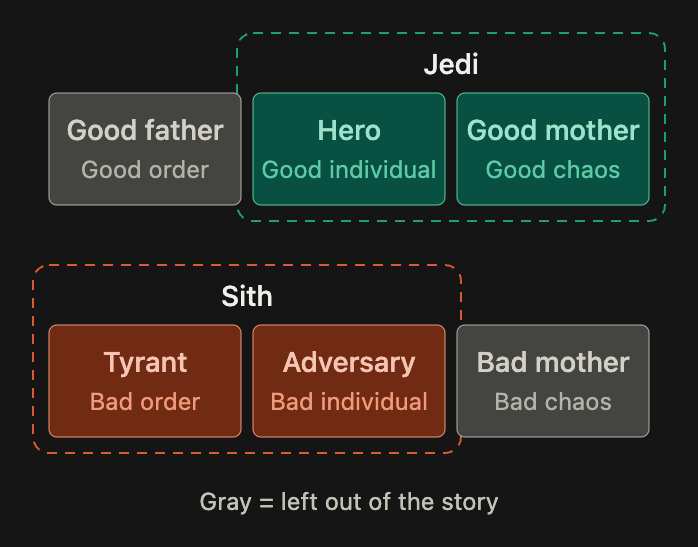
The Jedi, when pure, are heroes associated with the good mother. They’re in favor of rebellion and creativity and diversity. They profess no king, no particular form of government, only diversity and personal freedom. The Sith are the adversary aligned with the tyrannical father. In their worldview, order affords you power over others and should be attained at any cost.
This very American-style propaganda worked like crack cocaine on the collective consciousness in the 1970s. Just a few decades earlier, after all, a ragtag group of diverse Allies had defeated the power-obsessed Axis. Star Wars was its pop-culture memorialization and became the war-cry of the (ironically) now world-dominant American empire. The story is simple and easy to digest. It cuts away the complexity of a complete story, and therefore offers a stark binary between dark and light, and even treats them as equal forces. But it ultimately fails, because the repressed characters always slowly encroach into our world, via our unconscious. The more we try to keep them at bay, the stronger they become.
The two characters Lucas left out are, first, the good father: positive order, good hierarchy, the good king. Fittingly, Anakin is born of no father, only a mother. He is given two false fathers, the Council and Palpatine. Notice also that there are now few places (besides the military) for men to rank themselves by competence and generosity, and to rightly serve the best men.
He also ignored the bad mother, the chaos of “no” that God defeated at the beginning of time. Instead, we pretend that all of nature is positive creativity. We ignore the destructive aspect, and so we also ignore the foibles and propensity for evil that the feminine is uniquely capable of.
What is notable about these Gen Z men seeing themselves in Anakin is not that they are (rightly) tired of the blindness of the Jedi (boomer) worldview. What is remarkable is that they’ve bought the mythology of Star Wars so deeply and so unreflectively that they don’t see a way to correct this blindness except from within the rules of the universe itself, i.e., becoming a Sith. They would rather die as a Sith then tell a better story.
There are better stories, however, if you have an eye and/or stomach for them. Take for example a character like Aragorn, who at the start of the story is partly associated with the chaos of nature: a Dúnadan, a ranger, an old forgotten king patrolling the dark borders. He slowly realizes himself as the good king of Gondor, restoring the broken sword, which is a symbol of order gone bad. Tolkien even wrote a complete Anakin in his story via Saruman, who is the head of the wizards’ order, decides it’s too weak to win, still loses, and is finally murdered by his weasel servant. For most of the mainstream culture, especially those who are heavily online, this more complete and dynamic story is just not as readily available to their imagination.
This is understandable, too, because modern storytellers, even storytellers deeply influenced by Tolkien, have been relentlessly telling a two-thirds-story for decades: masculine, hero characters who serve the good king are said to be boring, or played out, or not relatable. Think of George R.R. Martin, who dissects characters like Aragorn through Jon Snow, and shows him in a “realistic” light: morally gray, corrupted, or compromised. Similarly, the negative feminine is said to be the good feminine, just abused, victimized, and misunderstood.
When the good king is repressed in the culture, his otherwise heroic heirs go bad. Their desire toward nobility sours into revenge, and tyranny grows in their hearts, à la Anakin Skywalker. Naturally, rising up to meet wannabe fascists, you also have that ignored aspect of the feminine, looking for its way of expression. You could name the repressed female the witch, the succubus, the Whore of Babylon riding the Scarlet Beast. They remain unnamed or, worse, treated as the same as the good mother.
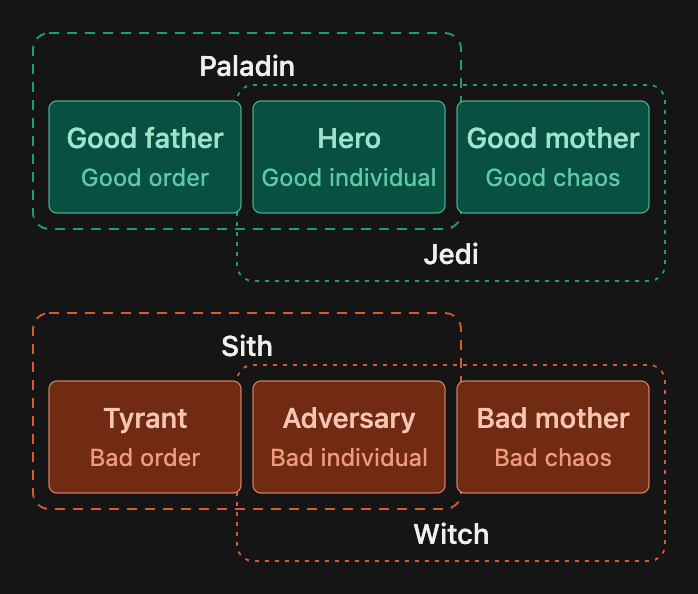
Here is the central psyop to overcome: Paladin characters are not old-fashioned, one-dimensional, and boring. It’s just not true. A Paladin serves an order and has to answer for whether it is good. They’re just as dynamic and interesting as any of the other fundamental characters. There are just as many, if not more, ways to be good in surprising ways as there are to be evil. However, unlike the dissillusioned Gen Z Sith-lovers, I’m also not trying to reject the Jedi. The Jedi is a great archetype. It is the archetype of Gandalf the Grey. In a story that is more balanced, the Jedi and the Good King overcome their respective temptations toward corruption and finally work together to cover each other’s blindnesses. Another good image of that pair is Mufasa and Rafiki.
Because of its overly simplistic binary, the creation myth of Star Wars is ultimately political. From the first film: “A long time ago, in a galaxy far, far away… it is a period of civil war.” As unconscious inheritors of that mythology, we are overly political in our attitudes. But the work of rescuing disillusioned young men is not political. In a more complete cosmology, politics is always downstream of cultural levers, which are themselves downstream of mythological assumptions about the structure of reality. It’s definitely not economic, either. Even if they’re poorer than their female counterparts or boomers at their age, it doesn’t particularly matter. They’re richer than any people in any part of human history, anyway. What’s driving them isn’t objective measures of wealth, it’s rage and envy. The central problem is their own inability to orient themselves towards becoming the sort of man who would be able to withstand the suffering and injustice that comes with the adventure toward a rightful throne. You’ve forgotten who you are.
I’ve talked to a lot of these disillusioned young men in my comments section. They tend to respond to the suggestion that they could do something to change their situation with cynicism, bile, and self-pity. They are too prideful to be a servant to a good king, not realizing that even Anakin inevitably becomes a stooge of Palpatine. You always bend the knee, in the end. To avoid noticing this, they point to whatever social ill you can think of, from feminism to globalization to the feminizing hormones in the food supply. This blindness of resentment and anger is the essence of the Sith. They refuse to channel their rejection into becoming Paladins like Aragorn, who despite being denied his rightful place as king, does not become resentful, but thanklessly guards the perimeter until his time to be king returns. He’s 87 when the story starts.
Over and beyond all of that, to help each other out of this situation is to tell each other better stories. It is to overcome the storytelling limitations and expectations set by our overly subversive boomer and Gen X parents.
If you think that sounds boring, then I dare you to try to tell a story about good men and women. You would realize, only through that process, how difficult it is to become good, and what incredible fractals of texture and light may arise out of trying.
You Probably Cannot Wield AI

About a month ago, I was sitting on my couch, scrolling through recommended YouTube thumbnails.
Rocky Is an Illegible Masterpiece

I sometimes imagine George Lucas, back in the 70’s, stumbling across Joseph Campbell’s “Hero’s Journey,” glowing gold and cherubim choirs like the Ark of the Covenant.
I’ve also been paying attention to the Anakin-meme fascination, lately. It’s been maybe understandable, but still concerning in ways that I couldn’t quite put my finger on. Thank you for doing that so well here.
Better stories are the answer, and Aragorn is the best answer to Anakin. I hope that embittered young men find hope in that. It’s freeing and heroic, fulfilling in ways resentment just can’t. It doesn’t pretend bleakness doesn’t exist but chooses to cast light into it.
Been thinking about the Paladin archetype a lot too. Good stuff as always here